


Introduction
In addition to government policy support for the disposal of livestock manure, which has been rising with the increasing number of livestock in the Republic of Korea, research on the production and utilization of livestock manure/liquid fertilizer for agricultural resource management has been promoted concurrently. Livestock manure is influenced by various factors, including animal breed, age, feed type, breeding conditions, and manure treatment methods. The inconsistent quality of livestock manure/liquid fertilizer is a common reason why smaller-scale livestock farmers hesitate to use it (Ahn et al., 2021).
Pig manure liquid fertilizer, a liquid fertilizer derived from livestock manure, has been evaluated for its potential to reduce chemical fertilizer use through soil application in crops such as lettuce and Chinese cabbage (Lee et al., 2024a), whole-crop barley (Lee, 2023), and red pepper (Lim et al., 2010). However, its use in soil cultivation for greenhouse crops faces challenges, including rainfall interception and concerns about soil salt accumulation from fertilization (Lee et al., 2024a). Studies on its applicability in hydroponic systems have also been conducted. Ryoo (2010) reported that while hydroponic cultivation using pig manure liquid fertilizer resulted in low yield due to the fertilizer’s limited N and P content, the yield improved when bone meal, seaweed powder, or similar supplements were added. It has been reported that organic liquid fertilizers alone may not provide sufficient nutrients for crop growth, and doubling the liquid fertilizer concentration can help ensure adequate yields (Zandvakili et al., 2019).
Coir substrate has recently gained widespread use as a solid medium in hydroponics. Its particle size distribution varies significantly depending on the production location (Evans and Konduru, 1996), which directly influences the physical properties of the substrate, necessitating the development of efficient liquid management technologies (Abad et al., 2005). In circulating hydroponics systems using coir substrate with different chip-to-dust ratios, a higher dust ratio reduces drainage volume and increases water content, potentially leading to higher drainage electrical conductivity (EC) due to nutrient accumulation over prolonged growing periods (Choi et al., 2019). Chemically, coir substrate has a lower cation exchange capacity than peat moss and contains higher levels of Na and Cl, which can adversely affect crop growth (Evans and Konduru, 1996). High concentrations of Na and Cl in the substrate may reduce yield in hydroponic lettuce; however, within a range of 40-80 mM, Na content in lettuce increases, potentially improving storage potential while reducing nitrate N (NO3-N) content and increasing dry-mass rates (Zandvakili et al., 2019). K and Na are present in soluble forms, while Ca and Mg are adsorbed into the medium (Choi et al., 2019). Prolonged use of coir substrate leads to continuous dissolution and reduction of K and Na, while Ca and Mg levels accumulate. Additionally, reusing coir substrate enhances physical properties such as porosity and water retention, resulting in higher crop yields (Lee et al., 2018).
Lee et al. (2024b) compared pig manure liquid fertilizer with culture medium for hydroponic lettuce and evaluated the feasibility of using fermented pig manure liquid fertilizer in hydroponic systems. Their findings indicated that the fertilizer was deficient in NO3-N, P, Ca, Mg, and S, but high in ammonium N (NH4-N), K, Na, and Cl, resulting in poor plant growth. Consequently, further research is needed to investigate supplemental nutrient supply and address concerns regarding excessive Na and Cl accumulation in solid media cultivation.
This study was therefore conducted to establish hydroponic lettuce cultivation technology using fermented pig manure liquid fertilizer. Specifically, it aimed to investigate the characteristics of reusing coir substrate with supplementation of nutrients lacking in fermented pig manure liquid fertilizer.
Materials and Methods
This study was conducted in an interlocking plastic greenhouse at the Fruit and Vegetable Experiment Station of the Gangwon Provincial Agricultural Research Institute in Cheorwon-gun, Gangwon-do. The objective was to evaluate the utilization of fermented pig manure liquid fertilizer in hydroponic lettuce cultivation.
Lettuce seeds were sown on September 1, 2023, in 128-hole plug trays (Dyne, Gyeonggi-do, Korea) filled with horticultural topsoil (Topsoil No. 2, Seonghwa, Chungcheongbuk-do, Korea). Three lettuce varieties were tested: Seonpungpochap (Kwonnong Co.), Ezabel (Enza Co.), and Ezatrix (Enza Co.). A Styrofoam bed (20 × 15 × 120 cm) was filled with coir substrate at a chips-to-dust ratio of 5:5, and a drip hose was installed. To saturate the coir substrate, treatment-specific culture medium was supplied for 3 days prior to planting for each treatment plot. The planting spacing was 20 cm, and the media volume supplied was 4 L per week. The lettuce plants were transplanted on September 27, 2023.
The culture medium used as the test material was supplied by a co-recycling facility in Gimhwa-eup, Cheorwon-gun, Korea (Lee et al., 2024b). The liquid solution concentration was adjusted to an EC of 1.5 dS m-1. The liquid application volume ranged between 80-100 mL per week and was applied on a timer 3-6 times daily, depending on weather conditions and the growth stage. The treatment consisted of supplying fermented pig manure liquid fertilizer (PMLF) for single use and adding Ca nitrate (Ca(NO3)2・4H2O) at 874 mg/L, Mg carbonate (MgSO4・7H2O) at 31.5 mg/L, and phosphoric acid (H3PO4) at 117.6 mg/L to compare the two treatments (Table 2).
The test plots were set up in a completely randomized design with three replicates. Growth measurements included leaf number, leaf length, leaf width, SPAD (chlorophyll content), aboveground fresh weight, total dry weight, and dry-mass ratio for 10 plants per treatment plot.
The culture medium was analyzed by collecting liquid and drainage samples at 7-day intervals after planting. The samples were stored in a refrigerator at 4°C. The analytes included EC, pH, cations, and anions. For analyzing the ionic content of the plant material, 10 g of the edible parts of lettuce were finely chopped, mixed with 50 mL of distilled water, and homogenized using a grinder (Ultra-Turrax T25, IKA, Germany). The homogenate was centrifuged at 5,000 rpm for 10 min. One milliliter of the supernatant was taken, diluted with a specified amount of distilled water, and analyzed (Yoe et al., 2017). Culture medium and plant extracts were analyzed using an Ion Chromatograph (940 Professional IC, Metrohm, Switzerland).
Other procedures followed the Research and Analysis Standard for Agricultural Science and Technology of the Rural Development Administration (RDA, 2012). Statistical analyses were performed using the SAS (ver. 9.4, SAS Co.) program to conduct multiple tests (SAS, 2023).
Results and Discussion
At the time of planting, the Ezabel variety showed a leaf number of 5.7 leaves per week, with leaf length and leaf width measuring 6.35 and 3.58 cm, respectively. The SPAD value, indicating relative chlorophyll content, was higher for the Ezatrix variety at 25.0. Fresh weight and total dry weight did not differ significantly between varieties, but the dry-mass ratio was higher in the Seonpungpochap variety at 8.58, reflecting a variety-specific trait (Table 1).
Table 1.
Characteristics of seedling quality at planting time according to lettuce varieties
| Cultivar | No. of leaves |
Leaf length (cm) |
Leaf width (cm) | SPAD1) |
Fresh weight (g/plant) |
Dry weight (g/plant) |
Dry weight ratio |
| Ezabel | 5.70 | 6.35 | 3.58 | 15.5 | 0.91 | 0.066 | 7.24 |
| Ezatrix | 7.10 | 7.43 | 3.52 | 25.0 | 1.03 | 0.066 | 6.40 |
| Seonpungpochap | 4.60 | 7.39 | 4.32 | 14.0 | 0.91 | 0.078 | 8.58 |
| LSD0.012) | 0.48 | 0.40 | 0.36 | 2.88 | ns3) | ns | 0.43 |
The characteristics of the PMLF and the modified pig manure fermented liquid fertilizer (MPMLF), adjusted with chemical fertilizers for the lettuce hydroponic application test, are shown in Table 2. With a liquid solution concentration of EC 1.5 dS m-1, the pH of the MPMLF was reduced from 7.7 to 7.3 compared to the PMLF. This difference in pH was primarily attributed to the additional supply of P. The excess Na, K, and Cl ions in the PMLF were reduced in the MPMLF, while the deficient NH4-N, NO3-N, Ca, and P contents were increased, thereby somewhat addressing the ion imbalance.
Table 2.
Chemical composition of nutrient solutions used for hydroponic cultivation of lettuce
| Nutrient solution |
EC (dS m-1) | pH | Cation (mg/L) | Anion (mg/L) | ||||||||
| NH4+-N | K+ | Ca2+ | Mg2+ | Na+ | NO3--N | PO42--P | SO42--S | Cl- | ||||
| MPMLF1) | 1.5 | 7.3 | 3.4 | 271 | 47.0 | 12.3 | 79.4 | 58.2 | 6.6 | 25.7 | 189 | |
| PMLF2) | 1.5 | 7.7 | 1.2 | 310 | 31.4 | 13.7 | 86.8 | 46.0 | 1.4 | 26.8 | 210 | |
Comparing the ion-specific concentrations of PMLF used in this study with a previous study on lettuce culture using PMLF (Lee et al., 2024b), the concentrations of most ions were not significantly different, except for NH4-N. In the previous study, NH4-N concentrations in lettuce hydroponic culture and PMLF were 7.9 and 26 mg/L, respectively. However, in this study, the NH4-N concentration in the PMLF was only 1.2 mg/L, which is extremely low compared to the optimal level. This finding underscores the need for regular analysis of time-varying ion concentrations and periodic calibration of the PMLF.
Fourteen days after planting, growth parameters such as leaf number, leaf length, leaf width, and fresh weight were superior in the MPMLF treatment plot compared to the PMLF treatment plot (Table 3). Significant differences were observed in leaf number, leaf length, and leaf width among cultivation media and varieties. Fresh weight was higher in the MPMLF treatment plot, averaging 15.3 for Ezabel, 13.1 for Ezatrix, and 14.7 g/week for Seonpungpochap, compared to 8.9, 7.0, and 7.9 g/week, respectively, in the PMLF treatment plot. These results demonstrate that the nutrient amendment of PMLF with chemical fertilizers had a clear positive effect from the early stages of growth.
Table 3.
Growth characteristics of lettuce varieties according to the type of fertilizer solution (14 days after transplanting)
| Nutrient solution | Cultivar | No. of leaves |
Leaf length (cm) |
Leaf width (cm) | SPAD1) |
Fresh weight (g/plant) |
| MPMLF2) | Ezabel | 11.8 | 9.6 | 9.6 | 14.2 | 15.3 |
| Ezatrix | 16.5 | 9.6 | 8.1 | 34.2 | 13.1 | |
| Seonpungpochap | 7.4 | 12.4 | 12.9 | 15.9 | 14.7 | |
| PMLF3) | Ezabel | 10.6 | 7.7 | 8.0 | 16.3 | 8.9 |
| Ezatrix | 13.7 | 8.5 | 6.5 | 35.1 | 7.0 | |
| Seonpungpochap | 6.3 | 10.2 | 10.0 | 15.8 | 7.9 | |
| Nutrient solution | **4) | ** | ** | * | ** | |
| Cultivar | ** | ** | ** | ** | ns | |
| Nutrient solution*Cultivar | ns | ns | ns | ns | ns | |
However, the SPAD value was higher in the conventional PMLF treatment plot than in the MPMLF treatment plot. This difference was attributed to the concentration of Na and Cl, as both treatments used the same culture medium concentration (EC 1.5 dS m-1), and the difference in N ion concentration between the culture media was not significant.
Lettuce growth at 28 days after planting showed that the MPMLF treatment plot achieved 21.1 leaves per week for Ezabel, 32.9 for Ezatrix, and 13.8 for Seonpungpochap, compared to 20.9, 29.8, and 11.6 leaves per week, respectively, in the conventional PMLF treatment plot. Additionally, significant growth differences were observed in leaf length, leaf width, and fresh weight between the cultivation medium treatments. In particular, for fresh weights per plant, the application of amended liquid fertilizers to Ezabel (112.1 g), Ezatrix (104.3 g), and Seonpungpochap (101.1 g) was more than twice as heavy as the application of liquid fertilizers to all varieties (56.5, 40.0, and 41.6 g, respectively) (Table 4). The growth differences observed 14 days after transplanting extended to 28 days, indicating that supplementing PMLF’s deficient components had a clear impact on accelerating growth. This result aligns with Lee (2023) study, which found that crop productivity improved when chemical fertilizers were mixed with pig manure liquid fertilizer.
Table 4.
Quantity and quality of each lettuce variety according to the type of fertilizer solution (28 days after transplanting)
| Nutrient solution | Cultivar | No. of leaves |
Leaf length (cm) |
Leaf width (cm) | SPAD1) |
Fresh weight (g/plant) |
| MPMLF2) | Ezabel | 21.1 | 13.9 | 18.1 | 17.2 | 112.1 |
| Ezatrix | 32.9 | 15.4 | 13.6 | 37.7 | 104.3 | |
| Seonpungpochap | 13.8 | 17.9 | 19.7 | 14.8 | 101.1 | |
| PMLF3) | Ezabel | 20.9 | 11.4 | 14.7 | 16.5 | 56.5 |
| Ezatrix | 29.8 | 12.1 | 9.8 | 39.7 | 40.0 | |
| Seonpungpochap | 11.6 | 14.2 | 15.7 | 16.2 | 41.6 | |
| Nutrient solution | *4) | ** | ** | ns | ** | |
| Cultivar | ** | ** | ** | ** | ns | |
| Nutrient solution*Cultivar | ns | * | ns | ns | ns | |
Changes in EC and pH of the drainage during the cultivation period showed that the EC, initially supplied at 1.5 dS m-1, stabilized within the range of 1.3 to 1.4 dS m-1. The pH decreased slightly in both culture mediums during the early stages of growth and then increased as growth progressed. However, the pH remained relatively lower in the MPMLF treatment, which may have favored growth (Fig. 1).
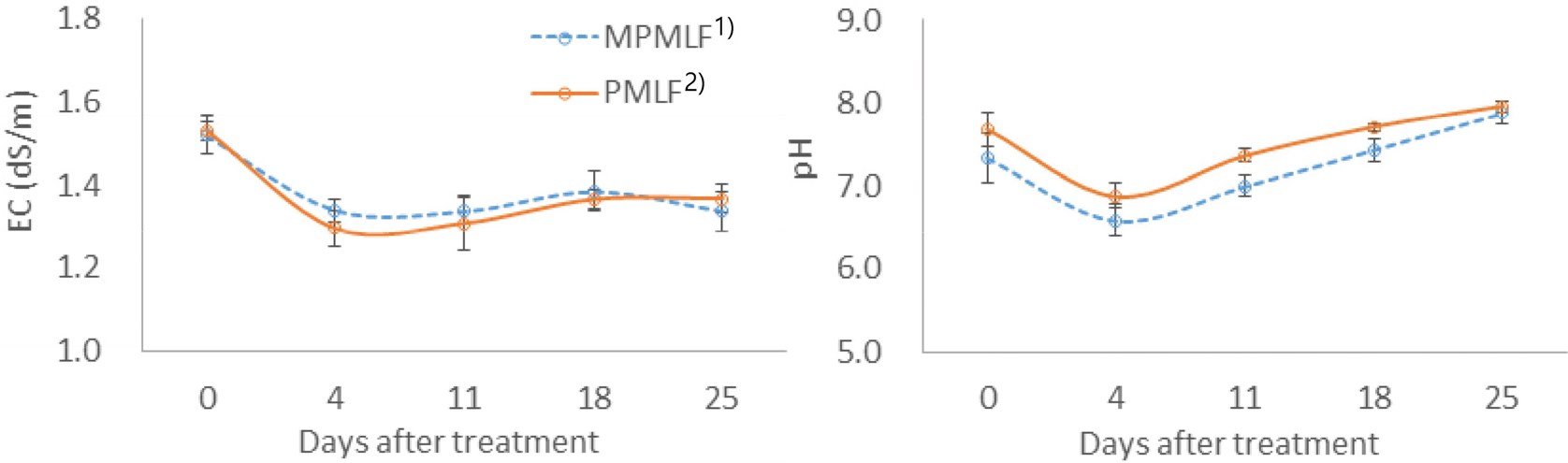
Fig. 1.
Changes in EC and pH of lettuce hydroponic drainage solution depending on the type of nutrient solution over the cultivation period. 1) and 2) See Table 2. Vertical bars indicate standard deviations.
The ion concentration analysis of the drainage (Fig. 2) revealed that, as outlined in Table 2, the contents of NO3-N, P, and Ca, which were deficient in PMLF, were relatively high in the MPMLF treatment. Their concentrations in the drainage decreased over time due to increased uptake by lettuce plants during cultivation. However, NH4-N, Mg, and Na did not differ significantly between treatments, while S and Cl content in the drainage increased as growth progressed. PMLF has higher Na and Cl content compared to chemical culture media for hydroponics (Lee et al., 2024b). These elevated Na and Cl levels are attributed to the addition of NaCl, an essential component of livestock feed, which is present in significant amounts in excrementitious matter (National Institute of Animal Science, 2022). Additionally, coir substrate, which has a naturally high Na and Cl content (Abad et al., 2005), contributes to these ion levels as Na and Cl are continuously leached over the cropping season (Lee et al., 2018). Consequently, continuous monitoring of Na and Cl content in the rhizosphere is recommended for future studies.
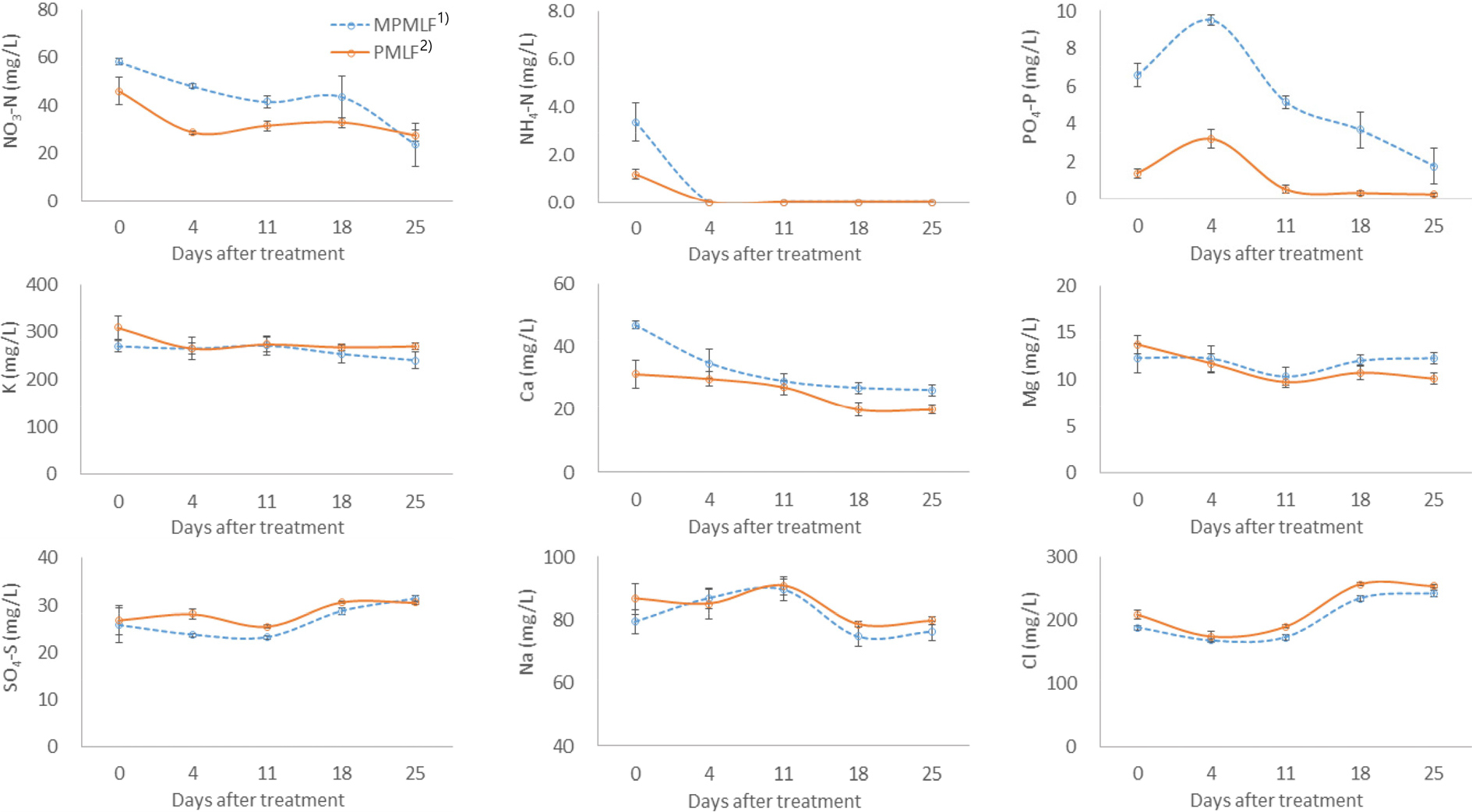
Fig. 2.
Changes in ion concentration of lettuce hydroponic drainage solution depending on the type of nutrient solution over the cultivation period. 1) and 2) See Table 2. Vertical bars indicate standard deviations.
The ionic concentrations of NO3-N, P, and Ca in the drainage were relatively high in the MPMLF treatment but decreased as growth progressed, highlighting the need to increase supplementation of these components. In particular, the NH4-N and P concentrations in PMLF were depleted by 11 days after treatment, indicating that the absolute supply was insufficient and growth-limiting.
The ion concentration analysis of lettuce plant extracts as a function of culture medium treatment (Table 5) showed that Ca, Mg, and P contents were higher in the MPMLF treatment compared to the PMLF treatment. Specifically, P concentrations were 3.51, 2.68, and 3.14 times higher in MPMLF, with levels of 144 mg/kg for Ezabel, 118 mg/kg for Ezatrix, and 132 mg/kg for Seonpungpochap, compared to 41, 44, and 42 mg/kg, respectively, in PMLF. The NO3-N concentration in the plant extract did not significantly differ between the two culture mediums; however, variations among varieties were observed (Zandvakili et al., 2019). Notably, the NO3-N content in the plant extract was less than 800 mg/kg across all treatment plots. This finding aligns with the report by Markiewicz et al. (2023) that utilizing PMLF containing Na and Cl in lettuce hydroponics can produce lettuce with low NO3-N content.
Table 5.
Ion concentrations in the sap of lettuce according to the type of nutrient solution (28 days after transplanting)
| Nutrient solution | Cultivar | Cation (mg/kg) | Anion (mg/kg) | |||||||
| K+ | Ca2+ | Mg2+ | Na+ | NO3--N | PO42--P | SO42--S | Cl- | |||
| MPMLF1) | Ezabel | 3,002 | 296 | 93 | 249 | 736 | 144 | 207 | 834 | |
| Ezatrix | 2,984 | 352 | 118 | 267 | 542 | 118 | 315 | 742 | ||
| Seonpungpochap | 2,952 | 292 | 92 | 256 | 726 | 132 | 256 | 515 | ||
| PMLF2) | Ezabel | 3,196 | 277 | 86 | 327 | 754 | 41 | 284 | 848 | |
| Ezatrix | 3,348 | 293 | 103 | 311 | 550 | 44 | 349 | 781 | ||
| Seonpungpochap | 3,381 | 293 | 89 | 309 | 671 | 42 | 340 | 669 | ||
| Nutrient solution | **3) | ** | * | ** | ns | ** | ** | ** | ||
| Cultivar | ns | ** | ** | ns | ** | ns | ** | ** | ||
| Nutrient solution*Cultivar | * | ** | ns | ns | ns | ns | ns | * | ||
As mentioned earlier, the PMLF used in both the previous study (Lee et al., 2024b) and this study was supplied by a facility with an energy recovery system in Kimhwa-eup, Cheorwon-gun, at different times. However, since the NH4-N concentrations varied significantly, the components of PMLF are likely to fluctuate over time, necessitating periodic ion analysis.
The results demonstrated that the addition of N, Ca, and P using Ca(NO3)2・4H2O, MgSO4・7H2O, and H3PO4 to PMLF stabilized the pH of the culture medium, corrected nutrient imbalances, and improved growth and yield. To address the nutrient imbalances limiting lettuce productivity, future studies should explore the effects of PMLF improvement using organic fertilizer resources. Additionally, various studies should focus on increasing the utilization of livestock waste, such as pig manure liquid fertilizer, to produce high-quality lettuce with low NO3-N content through organic methods leveraging the Na and Cl present in PMLF.
Summary
This study was conducted to determine the effects of nutrient amendment deficiency in lettuce hydroponics using pig manure liquid fertilizer. Regarding the characteristics of MPMLF, the content of Na, K, and Cl ions was lower than that in PMLF, while the content of NH4-N, NO3-N, Ca, and P was higher, effectively compensating for the imbalance between ions. The nutrient amendment effect from the addition of chemical fertilizers to PMLF was evident from the onset of growth. The fresh weights of all three lettuce varieties (Ezabel, Ezatrix, and Seonpungpochap) were more than twice as high in the MPMLF treatment plot compared to the conventional PMLF treatment plot 28 days after planting.
Changes in the ionic concentrations of NO3-N, P, and Ca in the drainage were relatively high in the MPMLF treatment but decreased as growth progressed, ultimately falling below the optimal concentration. The ionic content of lettuce extract was also more than 2.5 times higher in the MPMLF treatment plot compared to the PMLF treatment plot across all varieties. Additionally, the NO3-N content in the plant extract for all treatments was less than 800 mg/kg, confirming the potential for producing lettuce with low NO3-N content. Therefore, we believe that various complementary studies are required to enhance the utilization of livestock waste, such as pig manure liquid fertilizer, in the future.