


Introduction
Materials and Methods
Experimental Materials and Cultivation Management
Experimental Design and Transplanting Operation
Seedling Quality and Transplanting Performance Measurements
Statistical Analysis
Results and Discussion
Comparison of Nursery Environments Between Sites
Seedling Quality by Nursery Site and Seedling Age
Mechanical Transplanting Performance by Nursery Site and Seedling Age
Conclusion
Introduction
Recent declines in and aging of the farming population have increased the demand for mechanization in upland crop production, and the mechanization rate for sowing and transplanting remains at 12.2%, the lowest among all field operations (MAFRA, 2024). Much of this demand is currently met by imported machinery, which highlights the need for domestically developed equipment. For kimchi cabbage (Brassica rapa L. subsp. pekinensis (Lour.) Hanelt), the mechanization rate of field operations was 56.2% in 2023, with tillage and land preparation, plastic mulching, and pest control reaching 100.0%, 84.4%, and 96.5%, respectively, whereas transplanting and harvesting were both reported at 0.0% (KOSIS, 2024). This limitation is particularly critical for summer kimchi cabbage, which is cultivated in the highland areas of Gangwon Province during the hottest period of the year (Chae et al., 2024).
Automatic transplanters have been developed to address this labor requirement, but their field use remains limited (Choi et al., 2002; Tian et al., 2010). These machines operate through a continuous sequence in which seedlings are extracted from the tray, conveyed, and delivered to the planting unit; consequently, their performance depends strongly on seedling morphology and the extent of root development within the plug (Kang et al., 2017). Flexible trays designed for automatic transplanting are used instead of conventional rigid plastic trays, and the delivery mechanism requires compact and upright seedlings, with a plant height of approximately 7 cm reported as suitable for mechanical transplanting of vegetable seedlings (Jeon et al., 2021). Seedlings that do not satisfy these morphological and root development requirements can cause two contrasting types of transplanting defect. When root development within the plug is insufficient, the plug fails to retain its shape during extraction and the seedling remains in the tray, resulting in extraction failure. In contrast, excessively elongated shoots or widely spread lower leaves interfere with machine components or adjacent seedlings during conveyance and delivery, displacing the seedling from the planting cup. Successful mechanical transplanting therefore requires sufficient root plug formation while avoiding excessive shoot growth.
Previous studies have focused mainly on controlling excessive shoot growth. Trimming of overgrown leaves, application of plant growth regulators or calcium phosphate, and supplemental LED lighting have all been investigated as means of maintaining compact seedlings suitable for mechanical transplanting (Jang et al., 2017; Jeon et al., 2021; Lim et al., 2017). However, insufficient root plug formation and its contribution to extraction failure have received little quantitative attention. These approaches also require additional materials or specialized handling, which impose a considerable burden on smallholders cultivating limited areas, and management strategies that require no such inputs are therefore of greater practical value. Adjusting seedling age requires no additional treatment and may therefore provide a practical means of balancing extraction failure in younger seedlings against seedling displacement in older seedlings.
The relationship between seedling age and suitability for mechanical transplanting is also influenced by nursery microclimate. In lowland greenhouses during summer, elevated nursery temperatures promote excessive shoot elongation (Ohtaka et al., 2020). The small substrate volume of plug trays allows root-zone temperature to change rapidly with surrounding environment, and root development responds to both temperature intensity and exposure duration; moderately warm conditions promote root growth, whereas prolonged exposure to excessively high temperatures impairs root function (Levine et al., 2023). Temperature regimes can differ substantially between highland and lowland nurseries, potentially altering the relative rates of shoot growth and root plug formation at a given seedling age. According to the 1991-2020 climatological normals of the Korea Meteorological Administration, the mean summer air temperature is 20.3°C in Taebaek and 24.0°C in Chuncheon, illustrating the contrasting thermal conditions of the two regions (KMA, 2021).
Therefore, this study aimed to determine the effects of nursery site and seedling age on seedling quality and mechanical transplanting performance of summer kimchi cabbage using a automatic transplanter. Seedlings were produced at a highland site, Taebaek, and a lowland site, Chuncheon, and root plug formation was quantitatively evaluated using a root coverage index together with the morphological characteristics of the seedlings. This study examined whether transplanting performance declines at both younger and older seedling ages through extraction failure and seedling displacement, respectively, and whether the seedling age giving the highest performance differs between nursery sites. The results will provide seedling quality criteria for automatic transplanting and a basis for determining a suitable seedling age for each nursery region.
Materials and Methods
Experimental Materials and Cultivation Management
This experiment was conducted from 23 June to 23 July 2024 in glasshouses located in Baeksan-dong, Taebaek (37°08′51.9″ N, 129°01′56.5″ E; 635 m a.s.l.) and Sinbuk-eup, Chuncheon (37°57′03.8″ N, 127°45′11.2″ E; 96 m a.s.l.), Gangwon-do, Korea. ‘Chun Gwang’ (Sakata Korea, Seoul, Korea) was used as the test cultivar, and seeds were sown in 128-cell flexible plug trays for mechanical transplanting filled with a commercial substrate (Wonjo Mix, Nongkyung Co., Ltd., Jincheon, Korea). Irrigation and fertilization during the nursery period followed conventional grower practice and were managed identically at both nursery sites (Fig. 1A). The mechanical transplanting trial was conducted on 23 July 2024 in an open field at Jinbu-myeon, Pyeongchang, Gangwon-do, Korea. The field was formed into raised beds and covered with black plastic mulch film.
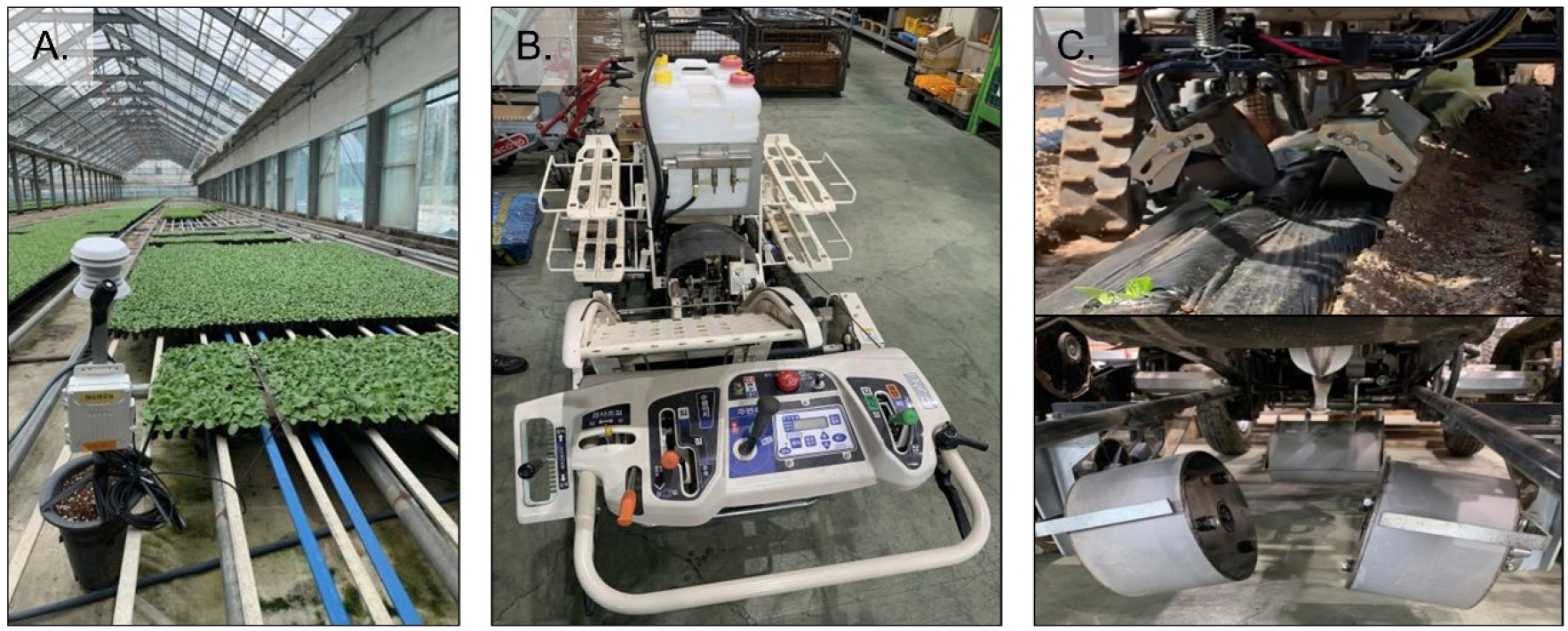
Experimental Design and Transplanting Operation
Seedling age was set at four levels of 20, 25, 28, and 30 days, calculated backward from the transplanting date, and combined with two nursery sites, Taebaek and Chuncheon, giving a total of eight treatments. Seeds were sown on 23 June, 25 June, 28 June, and 3 July so that seedlings reached ages of 30, 28, 25, and 20 days, respectively, at transplanting on 23 July 2024. A domestically produced automatic vegetable transplanter (PVZ1-70TDH, HSM Co., Ltd., Cheonan, Korea) was used for mechanical transplanting (Fig. 1B, C). The transplanter was operated at a travel speed of 3.6 km・h-1 and a seedling feeding rate of 6,500 plants・h-1, with a row spacing of 68 cm, a plant spacing of 40 cm, and a planting depth of 5 cm. Machine settings and the operator were kept identical across all nursery sites and seedling ages so that differences in transplanting performance among treatments could be attributed to seedling quality.
Seedling Quality and Transplanting Performance Measurements
Seedling quality was assessed by measuring plant height, leaf width, leaf number, lower leaf angle, root coverage index, fresh weight, dry weight, and leaf firmness. Lower leaf angle was measured with a protractor as the angle between the growing point and the largest lower leaf. Root coverage index was evaluated by three evaluators using the same predefined scoring criteria. The entire surface of the plug cell was taken as 100%, and the proportion of that surface on which roots were visible was estimated visually and rated on a four-point scale, where a rating of 1 corresponded to less than 30%, 3 to 30-50%, 5 to 50-70%, and 7 to 70% or more. Leaf firmness was measured at the midrib of the largest lower leaf using a texture analyzer (CT3, Brookfield Engineering, Middleboro, MA, USA) fitted with a 5 mm diameter probe. Compactness, an index representing seedling vigor, was calculated as fresh weight divided by plant height and expressed in mg・cm-1 (Zhou et al., 2022).
Mechanical transplanting performance was evaluated as the transplanting rate and the missing plant rate. After the transplanting operation had been completed, the number of successfully transplanted plants was counted along the beds and expressed as a percentage of the total number of tray cells included in the transplanting test, and the missing plant rate was calculated by subtracting the transplanting rate from 100%. To characterize failure events occurring during transplanting, extraction failures and seedling displacements were recorded during operation, and each was expressed as a percentage of the total number of tray cells included in the transplanting test. Extraction failure was defined as the case in which the transplanter failed to extract the seedling from the tray and the substrate remained in the cell, and seedling displacement as the case in which an extracted seedling left the planting cup during conveyance and delivery. Because these failure events were recorded during operation, whereas the missing plant rate was determined after completion of transplanting, the two failure rates are not additive components of the missing plant rate. Environmental conditions during the nursery period were monitored using automatic data loggers (HOBO, Onset Computer Corp., Bourne, MA, USA), which recorded air temperature, root-zone temperature, relative humidity, and irradiance inside the nursery facilities. Cumulative air temperature and cumulative root-zone temperature were calculated as the sum of the daily mean temperatures over the nursery period and expressed in °C・d.
Statistical Analysis
Seedling quality was assessed in three replicates of ten plants per treatment, with each replicate obtained from a different plug tray within the same glasshouse at each nursery site. Transplanting performance was assessed in two replicates per treatment, each consisting of one 128-cell tray. Cells in which no seedling was present were not replanted before the transplanting test because replanting could alter extraction characteristics and bias the evaluation of transplanting performance. These cells were excluded from the denominator used for calculating transplanting and failure rates. Statistical analyses were conducted using R software version 4.3.0 (R Core Team, Vienna, Austria). ANOVA was performed on seedling quality data to test the effects of nursery site, seedling age, and their interaction, followed by Duncan’s multiple range test (DMRT) for mean separation at the 5% significance level (p < 0.05), utilizing the ‘agricolae’ package (version 1.3.7) (Mendiburu., 2019). Because each nursery site consisted of a single glasshouse, the nursery-site factor was not replicated at the facility level. Therefore, differences associated with nursery site are interpreted as comparisons between the two nursery facilities examined in this study rather than as general effects of highland and lowland nursery environments. Data visualization and graphical outputs were generated with the ‘tidyverse’ suite of packages (version 2.0.0) (Wickham et al., 2019).
Results and Discussion
Comparison of Nursery Environments Between Sites
Air temperature inside the glasshouses followed a similar diurnal pattern at both sites, and daytime maximum temperatures frequently exceeded 35°C at both nurseries (Fig. 2A). The two sites differed less in maximum temperature itself than in the duration of high-temperature exposure and in root-zone temperature conditions. Over the 30-day nursery period, the cumulative time during which air temperature exceeded 35°C was 37.9 h at Chuncheon and 8.5 h at Taebaek, and mean air temperature was consistently higher at Chuncheon than at Taebaek, averaging approximately 26°C and 25°C, respectively (Table 1).
The clearest difference between the two sites was found in root-zone temperature (Fig. 2B). At Chuncheon, root-zone temperature closely followed the fluctuation in air temperature and exceeded 35°C for 13.2 to 31.6 h depending on seedling age, whereas no such exposure occurred in any treatment at Taebaek (Table 1). Mean root-zone temperature was approximately 26°C at Chuncheon and 23°C at Taebaek. Over the 30-day nursery period, the cumulative root-zone temperature reached 782°C・d at Chuncheon and 686°C・d at Taebaek. Root-zone temperature is recognized as a major environmental factor affecting root elongation and physiological activity (Levine et al., 2023; Luo et al., 2020). It was also the environmental factor that differed most clearly between the two nurseries.
Relative humidity showed a similar diurnal pattern at both sites, decreasing during the day and approaching saturation at night (Fig. 2C). Maximum irradiance on clear days was similar at the two sites, reaching 700 to 900 W・m-2 (Fig. 2D), whereas the cumulative solar radiation over the 30-day nursery period was higher at Chuncheon (224 MJ・m-2) than at Taebaek (172 MJ・m-2) (Table 1). Kimchi cabbage is a cool-season crop with an optimum growth temperature of approximately 18 to 20°C, and high temperatures have been reported to alter its growth and physiological responses, including increased leaf elongation and reduced activity of the photosynthetic apparatus (Chae et al., 2024; Hwang et al., 2003; Oh et al., 2014). The Chuncheon nursery therefore represented an environment under greater high-temperature load than Taebaek. The two nurseries differed in several environmental variables, including air temperature, root-zone temperature, and cumulative solar radiation. Differences observed between the sites are accordingly interpreted as overall differences between the two nursery environments rather than as the effect of root-zone temperature alone.
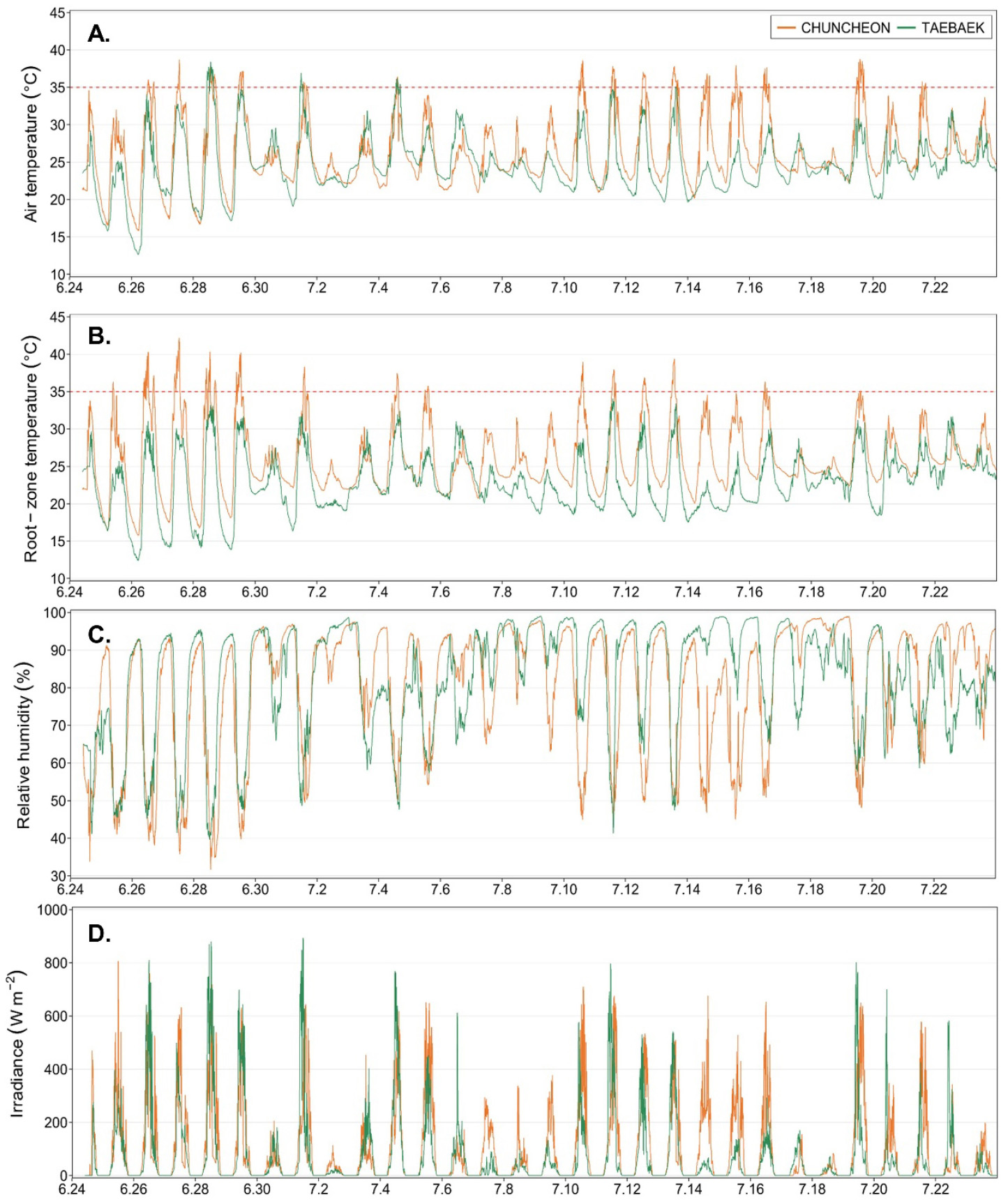
Fig. 2.
Comparison of (A) air temperature, (B) root-zone temperature, (C) relative humidity, and (D) irradiance inside the Kimchi cabbage seedling nursery facilities between two regions (Chuncheon and Taebaek). In (A) and (B), the red dashed line indicates 35°C, above which high-temperature stress occurs in Kimchi cabbage.
Table 1.
Cumulative environmental conditions inside the summer Kimchi cabbage seedling nursery facilities by seedling age at Chuncheon and Taebaek
Seedling Quality by Nursery Site and Seedling Age
Seedling quality responded differently to seedling age at the two nursery sites (Table 2, Fig. 3). A significant difference in plant height was observed between the two nursery sites, with greater values at Chuncheon than at Taebaek at all seedling ages. Plant height increased significantly with seedling age at Taebaek, reaching 6.1 cm at 30 days, whereas at Chuncheon it remained consistently high from 20 days onward. Leaf number showed the opposite pattern, with 8.8 and 9.3 leaves per plant at 28 and 30 days at Taebaek compared with 6.2 and 6.8 leaves at Chuncheon.
Table 2.
Seedling quality according to nursery site and seedling age for mechanical transplanting of summer kimchi cabbage ± SEM (n = 3)
|
Nursery Site |
Seedling age (days) |
Plant height (cm) |
Leaf width (cm) |
Number of leaves (plant-1) |
Lower leaf angle (°) |
Root coverage indexz |
Fresh weight (g) |
Dry weight (g) |
Leaf firmness (kg cm-2) |
Com- pactness (mg cm-1) |
| Taebaek | 20 | 4.7 ± 0.03 dy | 3.1 ± 0.02 c | 6.2 ± 0.06 d | 53.0 ± 2.0 a | 3.0 ± 0.12 d | 0.7 ± 0.05 c | 0.050 ± 0.001 a | 0.092 ± 0.003 b | 154.3 ± 12.0 c |
| 25 | 5.1 ± 0.13 c | 3.1 ± 0.06 c | 7.8 ± 0.13 c | 49.0 ± 2.1 a | 5.3 ± 0.07 c | 1.2 ± 0.04 bc | 0.061 ± 0.006 a | 0.109 ± 0.004 b | 242.9 ± 8.04 bc | |
| 28 | 5.6 ± 0.05 b | 3.4 ± 0.03 b | 8.8 ± 0.03 b | 49.0 ± 1.0 a | 5.9 ± 0.13 b | 1.5 ± 0.07 b | 0.064 ± 0.023 a | 0.139 ± 0.006 a | 277.0 ± 10.0 b | |
| 30 | 6.1 ± 0.12 a | 3.6 ± 0.05 a | 9.3 ± 0.18 a | 46.3 ± 3.8 a | 6.4 ± 0.12 a | 2.3 ± 0.36 a | 0.072 ± 0.027 a | 0.131 ± 0.009 a | 377.8 ± 52.9 a | |
|
Chun- cheon | 20 | 6.8 ± 0.38 a | 3.5 ± 0.11 a | 4.8 ± 0.15 c | 43.1 ± 2.7 b | 4.8 ± 0.42 a | 0.4 ± 0.04 c | 0.021 ± 0.005 a | 0.115 ± 0.001 b | 51.30 ± 5.71 c |
| 25 | 7.4 ± 0.40 a | 3.5 ± 0.10 a | 5.8 ± 0.07 b | 46.3 ± 0.9 ab | 6.3 ± 0.35 a | 0.6 ± 0.10 c | 0.028 ± 0.012 a | 0.121 ± 0.001 b | 85.47 ± 10.9 bc | |
| 28 | 8.0 ± 0.34 a | 3.9 ± 0.11 a | 6.2 ± 0.12 b | 52.0 ± 1.5 a | 6.1 ± 0.35 a | 1.1 ± 0.06 b | 0.040 ± 0.001 a | 0.128 ± 0.002 a | 137.8 ± 13.0 ab | |
| 30 | 8.2 ± 0.45 a | 3.8 ± 0.11 a | 6.8 ± 0.09 a | 49.0 ± 1.5 ab | 6.3 ± 0.37 a | 1.4 ± 0.16 a | 0.039 ± 0.006 a | 0.128 ± 0.003 a | 178.0 ± 28.6 a | |
| Nursery site (A) | ***x | *** | *** | ns | ** | *** | ** | ns | *** | |
| Seedling age (B) | ** | *** | *** | ns | *** | *** | ns | *** | *** | |
| A × B | ns | ns | *** | * | * | ns | ns | ** | ns | |
zRoot coverage index was rated on a discrete scale of 1, 3, 5, and 7 according to the extent of root coverage on the plug cell surface (1, lowest; 7, highest)
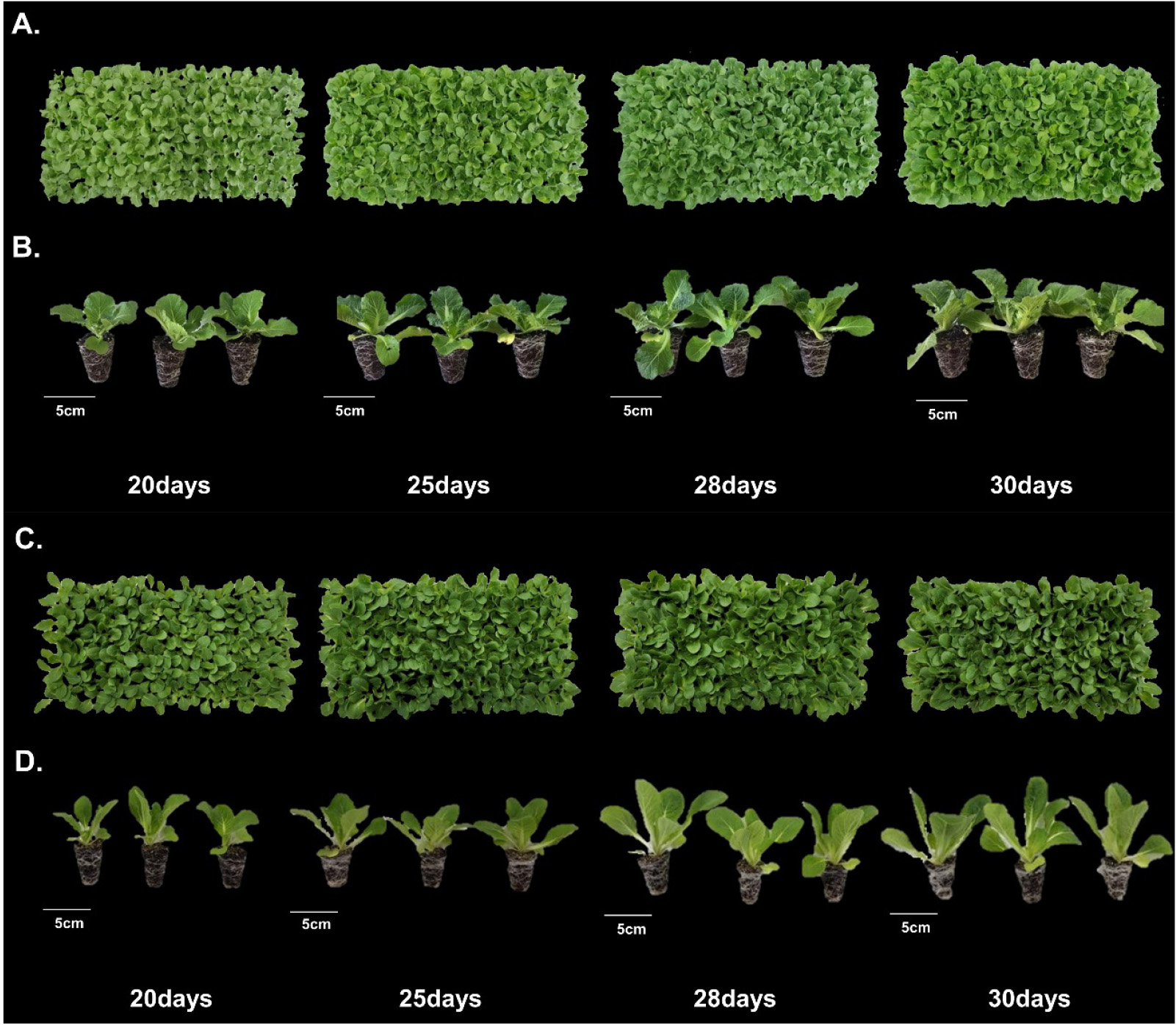
Fresh weight and compactness diverged in the same direction. At Taebaek, fresh weight increased from 0.7 g at 20 days to 2.3 g at 30 days, and compactness rose from 154.3 to 377.8 mg・cm-1. At Chuncheon, fresh weight remained lower throughout, increasing from 0.4 to 1.4 g, and compactness reached only 178.0 mg・cm-1 at 30 days, less than half the value at Taebaek. Seedlings at Chuncheon therefore had low fresh weight and compactness relative to their plant height, indicating a morphology in which elongation growth accounted for a greater proportion of development, consistent with the appearance shown in (Fig. 3). Previous studies have shown that prolonged high-temperature conditions can alter leaf development and suppress overall growth in kimchi cabbage, suggesting that differences in thermal conditions may partly explain the greater elongation and lower biomass accumulation observed at Chuncheon (Wi et al., 2020).
Root coverage index showed a contrasting course between the two sites. At Taebaek, it was low at 3.0 at 20 days and increased significantly with seedling age to 5.3 at 25 days, 5.9 at 28 days, and 6.4 at 30 days. At Chuncheon, it had already reached 4.8 at 20 days, comparable to the value of 25-day-old seedlings at Taebaek, and did not differ significantly among seedling ages thereafter, ranging from 4.8 to 6.3. Root establishment therefore proceeded earlier at Chuncheon than at Taebaek within the range of seedling ages examined, and this difference was associated with the difference in root-zone temperature between the two nurseries (Table 1).
Lower leaf angle showed opposite patterns at the two sites, increasing significantly from 43.1° at 20 days to 52.0° at 28 days before declining at Chuncheon, whereas at Taebaek it followed a decreasing trend from 53.0° at 20 days to 46.3° at 30 days without significant differences among seedling ages. Leaf firmness increased with seedling age at both sites. Significant interactions between nursery site and seedling age were found for leaf number, lower leaf angle, root coverage index, and leaf firmness (Table 2), indicating that the pattern of change in seedling quality with seedling age depended on the nursery site. Although cumulative solar radiation and cumulative temperature were higher at Chuncheon, these greater cumulative environmental inputs did not result in greater biomass. Heat stress has been reported to reduce fresh and dry weight and impair photosynthetic performance in Chinese cabbage seedlings (Quan et al., 2022), suggesting that the greater high-temperature exposure at Chuncheon may have partly offset the potential benefit of higher cumulative solar radiation. These results show that root establishment proceeded earlier and shoot elongation was greater at Chuncheon than at Taebaek.
Mechanical Transplanting Performance by Nursery Site and Seedling Age
Transplanting rate reached a maximum at an intermediate seedling age at both sites and declined thereafter, but the seedling age at which the maximum occurred differed between sites (Fig. 4). At Taebaek, transplanting rate rose from 91.4% at 20 days to 93.0% at 25 days and 94.1% at 28 days, and then decreased to 86.7% at 30 days. At Chuncheon, it rose from 91.0% at 20 days to 96.8% at 25 days, the highest value among all treatments, and then decreased to 85.2% at 28 days and 83.6% at 30 days. Missing plant rate was lowest at 28 days at Taebaek (5.9%) and at 25 days at Chuncheon (3.2%). The two major types of transplanting failure responded to seedling age in opposite directions (Fig. 5). Extraction failure rate was highest at the shortest seedling age of 20 days at both sites, reaching 15.6% at Taebaek and 3.7% at Chuncheon. At Taebaek it remained at 6.3% at 25 days before decreasing to 1.2% at 28 days and 2.0% at 30 days, whereas at Chuncheon it remained low from 25 days onward, ranging from 0.8 to 2.8%. Seedling displacement rate, in contrast, increased with seedling age, rising gradually from 2.3 to 6.6% at Taebaek but markedly at Chuncheon, from 2.8% at 25 days to 12.0% at 28 days and 13.6% at 30 days. Transplanting performance was therefore best not at the seedling age at which any individual seedling quality trait was maximized, but within the range of seedling ages where extraction failure and seedling displacement were both low.
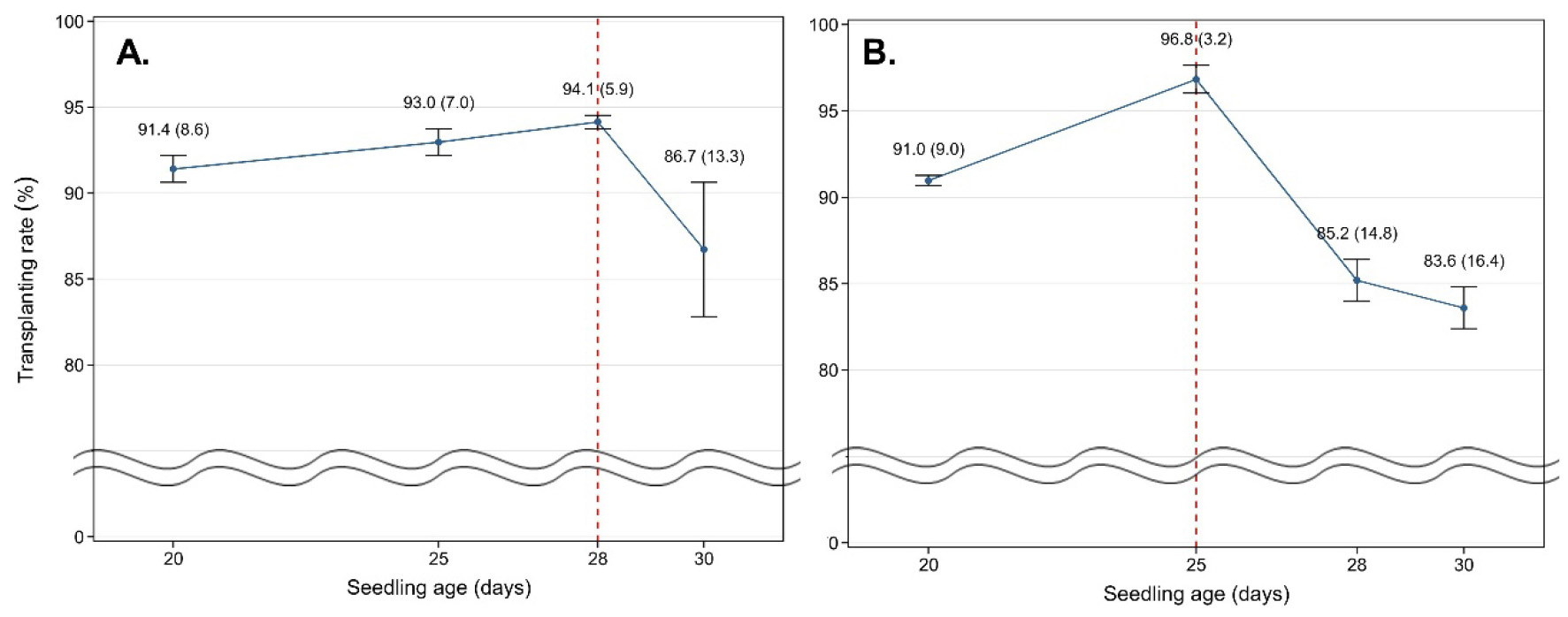
Fig. 4.
Transplanting rate of summer kimchi cabbage as affected by nursery site and seedling age. (A) Taebaek, (B) Chuncheon. Values are means of two replicates and error bars indicate standard errors. Values in parentheses represent the missing plant rate, calculated by subtracting the transplanting rate from 100%. Red dashed lines indicate the seedling ages at which the highest transplanting rates were observed at each nursery site.
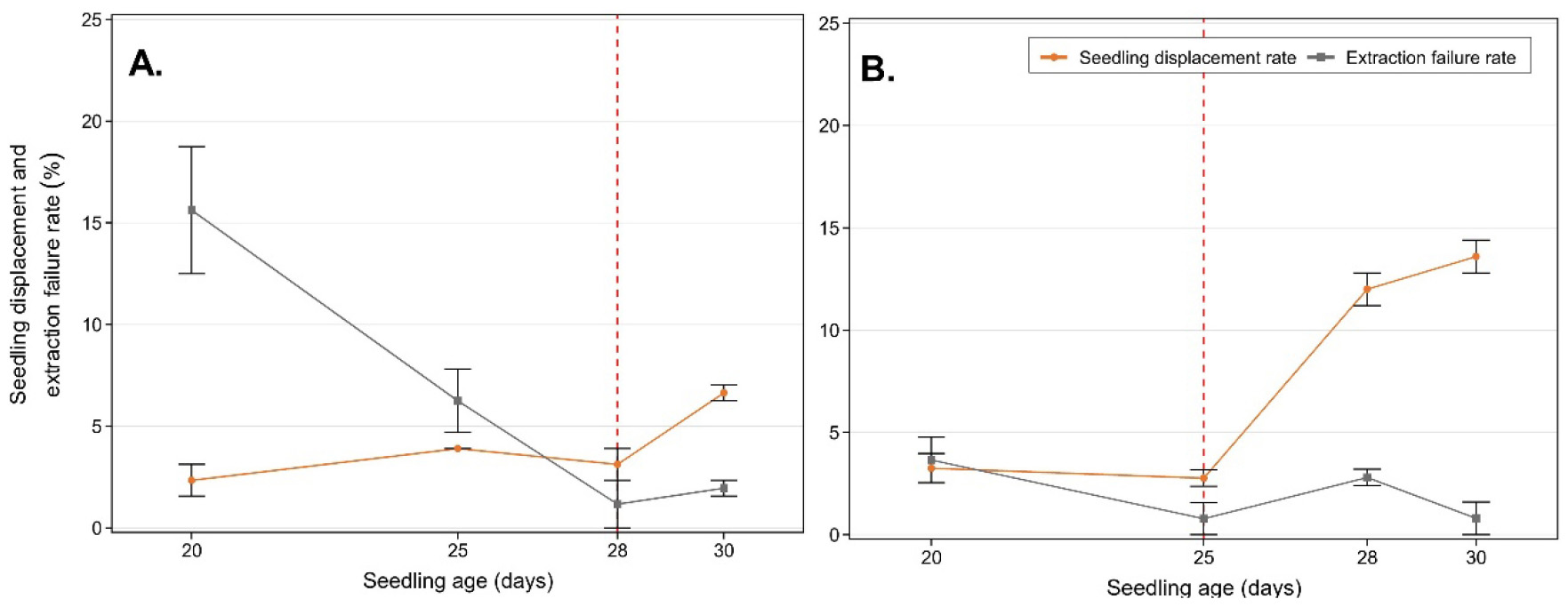
Fig. 5.
Seedling displacement rate and extraction failure rate of summer kimchi cabbage as affected by nursery site and seedling age. (A) Taebaek, (B) Chuncheon. Values are means of two replicates and error bars indicate standard errors. Red dashed lines indicate the seedling ages at which the highest transplanting rates were observed at each nursery site.
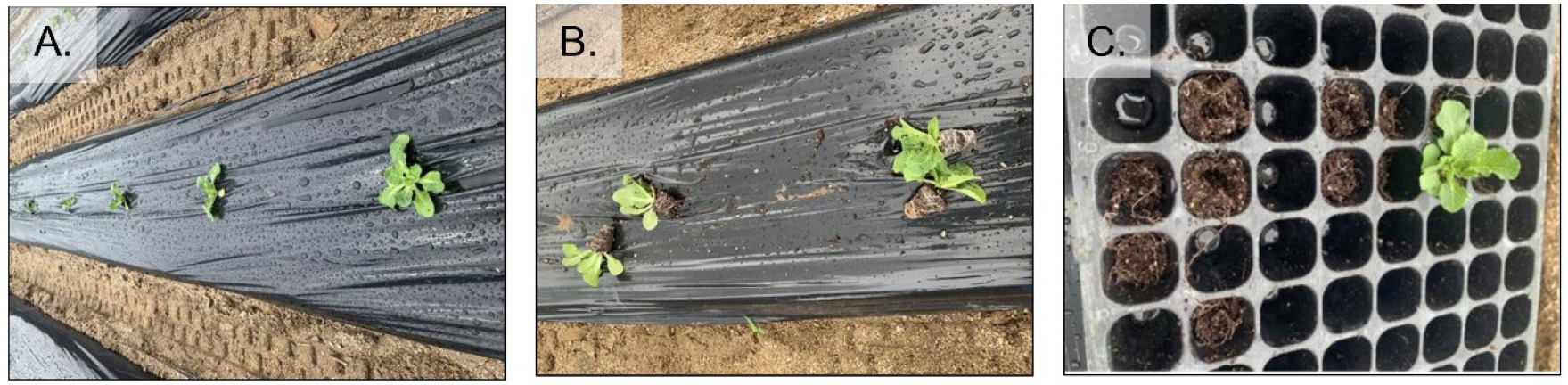
Treatments with high extraction failure rates corresponded to those with low root coverage indices. In 20-day-old seedlings at Taebaek, the root coverage index was 3.0 (Table 2), indicating that roots had not reached even half of the plug cell surface, and cases were observed in which the substrate collapsed as the extraction pin entered the cell, leaving the seedling in the tray (Fig. 6C). The density and distribution of roots in plug seedlings determine the cohesion between the substrate and the root plug, and substrate collapse during automatic extraction has been reported to cause extraction failure and missing plants (Kang et al., 2017). In the present study, extraction failure rate was 6.3% at 25 days at Taebaek, where the root coverage index was 5.3, but decreased to approximately 2% from 28 days onward, when the index was 5.9 or higher, indicating that greater root coverage was associated with lower extraction failure.
High seedling displacement rates were observed in treatments with tall seedlings and wide lower leaf angles. Seedlings at Chuncheon were 8.0 cm tall at 28 days and 8.2 cm at 30 days, the tallest among all treatments, with lower leaf angles of 52.0 and 49.0°, and entanglement of leaves between adjacent seedlings was observed during conveyance from the extraction unit to the planting hopper. Seedlings that failed to settle in the hopper fell onto the mulch film rather than into the planting hole (Fig. 6B). In contrast, 20-day-old seedlings at Taebaek had a lower leaf angle of 53.0° but were only 4.7 cm tall, and their seedling displacement rate was 2.3%, showing that seedling displacement arose from the combination of lower leaf angle with plant height rather than from lower leaf angle alone. Excessive leaf expansion with increasing seedling age has been reported to cause interference with adjacent seedlings during automatic transplanting (RDA, 2025). The long shoots and widely expanded leaves of 28- and 30-day-old seedlings at Chuncheon were therefore considered to have increased leaf entanglement during conveyance and to have been the main cause of seedling displacement. At Taebaek, shoot elongation was gradual and increasing seedling age was expressed as greater leaf number rather than greater plant height, so that the seedling displacement rate at 30 days was 6.6%, less than half the value at Chuncheon.
These results show that seedling age suitable for mechanical transplanting is limited by insufficient root establishment at younger ages and by excessive shoot elongation at older ages, and that this range differed between the two nursery sites. Under the present experimental conditions, the highest transplanting rates were obtained at 28 days at Taebaek and 25 days at Chuncheon, where plant height was 5.6 and 7.4 cm, lower leaf angle 49.0 and 46.3°, and root coverage index 5.9 and 6.3, respectively. Leaf number in these two treatments differed considerably between sites, at 8.8 leaves per plant at Taebaek and 5.8 at Chuncheon, and showed no consistent relationship with transplanting performance. Because seedling ages were established by staggering the sowing dates while keeping the transplanting date identical, the treatments experienced partly different nursery periods, and an influence of their distinct environmental histories on the observed responses cannot be excluded.
Conclusion
This study was conducted to determine the effects of nursery site and seedling age on seedling quality and transplanting performance in mechanical transplanting of summer kimchi cabbage using a domestically produced automatic transplanter (PVZ1-70TDH). Root-zone temperature exceeded 35°C for 13.2 to 31.6 h at Chuncheon but never at Taebaek, and this difference was accompanied by contrasting patterns of seedling development at the two sites. Seedlings at Chuncheon had already reached a root coverage index of 4.8 at 20 days and subsequently underwent rapid shoot elongation, attaining a plant height of 8.0 cm at 28 days, whereas seedlings at Taebaek established roots more slowly but elongated more gradually. Transplanting failure arose from two opposing causes. At shorter seedling ages, insufficient root establishment caused the root plug to collapse, resulting in extraction failure, which reached 15.6% at 20 days at Taebaek. At longer seedling ages, shoot elongation and leaf interference increased seedling displacement, which reached 13.6% at 30 days at Chuncheon. Transplanting rate was consequently highest at 28 days at Taebaek (94.1%) and at 25 days at Chuncheon (96.8%), corresponding to the seedling ages at which both extraction failure and seedling displacement were low. Seedlings at these ages had a plant height of 5.6 and 7.4 cm, a lower leaf angle of 49.0 and 46.3°, and a root coverage index of 5.9 and 6.3, respectively Extraction failure was approximately 2% in treatments with a root coverage index of 5.9 or higher, indicating an association between greater root coverage and lower extraction failure under the present experimental conditions. Under the conditions tested in this study, the highest transplanting rates were observed at 28 days at the Taebaek nursery and at 25 days at the Chuncheon nursery. These treatments combined relatively developed root coverage with low extraction failure and seedling displacement. Transplanting rates above 94% were observed at these seedling ages without additional nursery treatments, providing practical information for determining suitable seedling ages for mechanical transplanting of kimchi cabbage under similar conditions.