


Introduction
Modified atmosphere packaging (MAP) is a useful packaging system that can change gaseous composition within a package. It depends on the relations between the respiration of the product and the allowance of gases by the packaging that leads to an atmosphere higher in carbon dioxide and lower in oxygen (Fonseca et al., 2002; Mahajan et al., 2007).
The practical application of modified and controlled atmospheres has grown more than 50 years ago, contributing appreciably to prolong the postharvest life and maintain the quality of a variety of fruits and vegetables. Therefore, changing the atmosphere occurs must have a mixture of factors that manipulate the permeability of the commodity packaging and respiration in order to achieve an atmosphere of great equilibrium for the maintenance of the product. This balance is achieved when the respiration of the product consumes the same amount of O2 entering the packaging and the production of CO2 by respiration is equal to the amount that leaves the packaging (Day, 1996).
Modified atmosphere packaging can increase the concentration level of CO2; diminish the level of O2, ethylene generation rate and physiological disorders. For instance, it can suppress chemical, enzymatic and microbiological mechanisms accompanying with the rot of fresh products, thus reducing the use of other additional treatments such as chemical or thermal process such as freezing, dehydration, and sterilization (Kader et al., 1989; Gorris and Tauscher, 1999; Saltveit, 1997; Fonseca et al., 2002).
We have done preliminary study by using 30 µm polyethylene film thickness at storage temperature of 10ºC. However, there was formation of fog in the package and as result it affected the qualities and shelf life of cherry tomato. Therefore, this study was designed to select polyethylene film for MAP storage of cherry tomato at 10ºC.
Materials and Methods
Cherry tomato (Lycopersicon esculentum Mill. var. ‘Unicon’) fruits were harvested at the pink and red maturity stages using biological color chart of USDA (1991) from private farm in Gangwon Province of South Korea. After harvest, fruits were directly transported to postharvest quality and management laboratory. Immediately, fruits were washed with cold water and external blemishes were removed and the remaining fruits were graded and sealed with different low density polyethylene (LDPE) film and polyethylene (PE) film in 750 mL volume container.
The treatments were conducted by using low density polyethylene (40 µm and 30 µm LDPE) and polyethylene (30 µm PE) films manufactured by C&K PROPACK CO., LTD and two maturity stages (pink and red) in a completely randomized design (CRD) with 5 replication. 16 fruits were kept in each container. The treatments were stored at 10ºC and 85±5% Relative humidity (RH). 6 samples were measured throughout the storage day with 3 days interval from each treatment. Evaluations were made by keeping the packed cherry tomato fruits in an evaluation room.
Total soluble solids (TSS) was measured using digital refractor meter (Atago U.S.A. Inc., U.S.A.) and results were read directly in °Brix. The titratable acidity (TA) was measured by using DL 22 Food & Beverage Analyzer (Metter Toledo Ltd., Korea) and results were expressed in mg/100g. Measurement of firmness was done by using a Rheo meter (Sun Scientific Co. Ltd. Japan) with maximum force of 10 kg and a 3 mm diameter round stainless steel probe having a flat end. The results were expressed in newton (N). Weight loss was calculated by subtracting each day observation of weight of the fruits from the initial weight and results were expressed in percent (%). Surface color (Hunter a* value) was recorded along the equatorial axes of the fruit and three readings were taken from each fruit using Chroma meter, model CR- 400 (Minolta, Japan). Lycopene content was measured using spectrophotometer (Thermo fisher scientific, Madison, WI 53711, USA) at 503 nm and measurements were described according to Fish et al. (2002). Hexane was used as blank and results were expressed as mg/kg. Ethylene production rate was measured using GC2010 Shimadzu gas chromatograph (Shimadzu Corporation, Japan) equipped with a BP 20 Wax column (30 m × 0.25 mm × 0.25 µm, SGE Analytical Science, Australia) and a flame ionization detector (FID). The detector and injector were operated at 127°C, the oven temperature was set at 50°C, and the carrier gas (N2) flow rate was 0.67 mL/S (Park et al., 2000). The result was expressed as µL/kg/hr. Respiration rate was analyzed using PBI Dan-sensor (Check mate 9900, Denmark) gas analyzer. The result was expressed as mg CO2/ kg/hr. Data were analyzed by analysis of variance (ANOVA) at p<0.05 using SAS (SAS/STAT® 9.1, SAS Institute Inc., Cary, NC, USA) statistical software.
Results and Discussion
The result of the present study showed that there was no significant (P>0.05) difference between film thickness in pink maturity stage during the entire storage period stored at 10ºC (Table 1). In case of red maturity stage, there was no significant difference between films until 6th day however; there was significant difference between films on 9 day and 12 day (Table 1). This indicated that film thickness doesn’t affect the TSS of cherry tomato ‘Unicon’ fruit during storage. Similar results were reported by Alsadon et al. (2004); in their report TSS was not affected by temperature and packaging materials throughout the storage period.
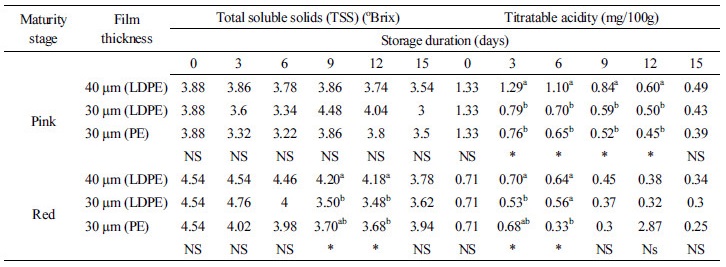
As shown in table 1, there was a significant (P<0.05) difference between film thickness in titratable acidity of pink cherry tomatoes. However, at final day all films showed similar results. Acidity is an important factor which can indicate the maturity of the fruit, the acidity decrease as ripening of the fruit progresses. Opiyo and Ying (2005) reported that titratable acidity increased with fruit maturity and then it decreases through storage period. The 40 µm LDPE film reduced the degradation of acidity in pink maturity stage during the entire storage period. At harvest, the titratable acidity values were 1.33 mg/100gand 0.71mg/100g in pink and red maturity stages respectively.On the 15th day, the titratable acidity decreased to 0.49 mg/100g, 0.43 mg/100g and 0.39 mg/100g in 40 µm LDPE, 30 µm LDPE and 30 µm PE films respectively in pink maturity stage. In case of red maturity stage, titratable acidity decreased from 0.71 mg/100g to 0.34 mg/100g, 0.3 mg/100g and 0.25 mg/100g in 40 µm LDPE, 30 µm LDPE and 30 µm PE film respectively.
Color change is one of the most important quality attributes for costumers. According to the present study, 40 µm LDPE was significantly (P<0.05) delayed the color change (Hunter ‘a’ value) stored at 10ºC in pink maturity stage (Table 2). There was no significant difference at harvest day and 3rd day between LDPE packed fruits. After 3rd day, pink maturity stage tomatoes packed with 30 µm LDPE and 30 µm PE showed fast color development and reached its peak on 9th day with Hunter`s a* values of 9.69 and 9.02 respectively. Afterwards, there was discoloration in both films in pink maturity stage. This result is in line with the finding of Saguy and Mannheim (1975) who reported that color changes were accelerated as the fruit reached climacteric peak. Whereas, there was slow color development of fruits packed with 40 µm LDPE and reached its peak on 15th day with hunter’s value of 10.45 in pink maturity stage. De-greening is an important feature of many climacteric fruits which result in quality loss for vegetables and increasing palatability for fruits like tomato. De-greening during the senescence of green vegetables and color change due to carotenoid synthesis for fruits can be reduced by diminished O2 level and elevated CO2 level (Ku and Wills, 1999). In this study, for red maturity stage, 40 µm LDPE film was significantly (P<0.05) delayed the discoloration of the fruit (Table 2). 40 µm LDPE film kept the redness better than 30 µm (LDPE) and 30 µm (PE) during the entire storage period. There was formation of fog and high moisture in the package in 30 µm (LDPE) and 30 µm (PE) films; as a result it caused discoloration of the packed fruits.
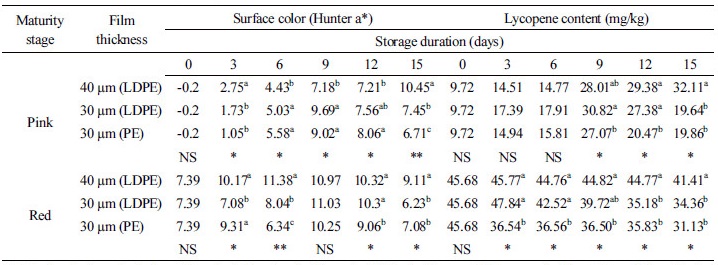
Lycopene is one of the main carotenoid which is found in red tomato fruit. There was significant (P<0.05) difference between films in both maturity stages stored at 10ºC (Table 2). In pink maturity stage, there was no significant difference between films during the first 6 days. After 6 day both 30 µm (LDPE) and 30 µm (PE) showed fast synthesis of lycopene compared to 40 µm (LDPE). Nasrin et al. (2008) reported that low density polyethylene has a capacity to create modified atmosphere with good ventilation system by increasing CO2 and decreasing O2 and delayed ripening of sealed fruits. As a result, lycopene synthesis also delayed. In pink maturity stage, at harvest the amount of lycopene was 9.72 mg/kg and increased to 30.82 mg/kg and 27.07 mg/kg on 9th day in 30 µm (LDPE) and 30 µm (PE) respectively. In case of 40 µm (LDPE) film, lycopene was increased from 9.72 mg/kg to 32.11 mg/kg on 15th day in pink maturity stage. This indicated that fruits packed with 40 µm (LDPE) showed an increasing trend. This result is supported by the finding of Watada et al. (1976) who reported the lycopene content up to 46.7 µg/g at the fully ripened stage. Similarly, 40 µm (LDPE) packed fruits showed better lycopene accumulation followed by 30 µm (LDPE) and 30 µm (PE) films. 30 µm (LDPE) and 30 µm (PE) showed slight reduction of lycopene accumulation starting from 12 day and 9 day on both maturity stages respectively. Because lycopene accumulation is highly related with red color formation, if discoloration happened lycopene accumulation also reduced. Therefore, 40 µm (LDPE) was better for cherry tomato packaging than the other films in maintaining lycopene accumulation on both maturity stages. This result is in agreement with Yang and Chinnan (1988) found that modified atmosphere packaging can inhibit ripening of some horticultural products such as tomato even during its later stages.
Firmness was affected by the packaging films during the storage period. There was significant (P<0.05) difference between films in both maturity stages (Table 3). After 3 days storage, fruits sealed with 30 µm (LDPE) and 30 µm (PE) films were softer in both maturity stages compared to 40 µm (LDPE) film. According to Azene et al. (2014) high density polyethylene (HDPE) and LDPE films maintained firmness of papaya better than other packaging materials during storage. In pink maturity stage, the initial fruit firmness was 10.23 N in all films. However, there was rapid reduction of firmness from 10.23 N to 6.52 N and 6.65 N in 30 µm (LDPE) and 30 µm (PE) respectively on 15th day whereas, 40 µm (LDPE) film showed slow reduction from 10.23 N to 9.05 N on 15th day. This result is in agreement with the finding of Kader (1986) studied that phytochemical and compositional changes such as firmness, color and flavor can be decreased due to the MAP during storage.
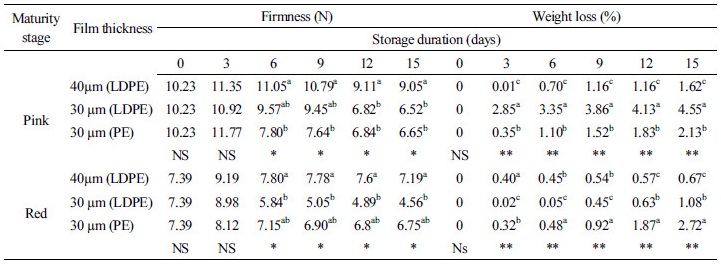
There was highly significant (p<0.05) difference between films on weight loss in both maturity stages during the storage period (Table 3). In pink maturity stage, the weight loss of fruits packed with 30 µm (LDPE) and 30 µm (PE) was higher (4.55%) and (2.13%) respectively, at 15th day of storage. While the weight loss of fruits packed with 40 µm (LDPE) film was lower (1.62%) at 15th day of storage. This indicated that cherry tomatoes packed with 40 µm LDPE film and stored at 10ºC can be stored for two weeks (15 days) with low weight loss compared to 30 µm (LDPE) and 30 µm (PE) films. This result is supported by the finding of Povratanak (2015) reported that tomatoes packed with LDPE showed extended storage life with very low weight loss and can stored more than 9 days under refrigerating. Similar results also reported by Gonzalez et al. (1990), Lazan et al. (1990), Workneh and Woldetsadik (2004) and Nath et al. (2011) lower weight loss of fruits in the package could be due to slow rate of ripening and inhibition of high water loss. However, in all MAP films, weight loss was lower in red maturity stage compared to pink maturity stage particularly, 40 µm showed low weight loss during the entire storage period.
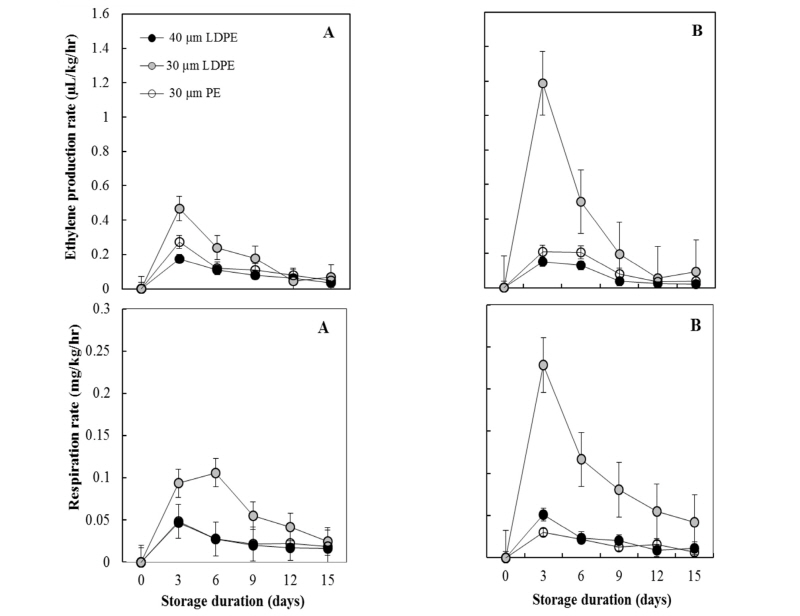
Cherry tomato fruits packed with 40 µm (LDPE) film showed low ethylene production rate and respiration rate compared to 30 µm (LDPE) and 30 µm (PE) in both maturity stages (Fig. 1A and B). Comparatively, there was high ethylene production rate on 12th day in 30 µm (PE) followed by 30 µm (LDPE) in both maturity stages (Fig. 1). As the figure showed all fruits packed with LDPE and PE films reached in its peak at 3rd day. However, 40 µm LDPE film showed low ethylene production rate in both maturity stages. Cherry tomato fruits packed with 40 µm LDPE film showed low ethylene production rate in both maturity stages throughout the storage period. In pink maturity stage, the highest ethylene production rate was recorded from 30 µm (PE) (0.47µL/kg/hr) on 3rd day. Similarly, fruits packed with 40 µm and 30 µm (LDPE) ethylene production rates were 0.18 µL/kg/hr and 0.27 µL/ kg/hr respectively. In case of red maturity stage, there was high ethylene production rate compared to pink maturity stage on 3rd day (1.19 µL/kg/hr) in 30 µm (PE) film followed by 30 µm and 40 µm (LDPE) respectively. Respiration rate showed same trend with ethylene production rate in all films in both maturity stages during the entire storage period. Burg and Burg (1967) and Abeles et al. (1992) reported that elevated CO2 and low concentration of O2 has a capacity to reduce the rates of ripening and senescence primarily by decreasing the synthesis of ethylene production rate and respiration rate.
In conclusion, MAP can slow down the metabolic activities of the product and 40 µm LDPE film showed better performance as compared to 30 µm LDPE and 30 µm PE in terms of avoiding fog formation during the entire storage period. Apart from avoiding formation of fog during storage, 40 µm LDPE film was best for extending the shelf life by maintaining the quality parameters that have been examined by reducing O2 and increasing CO2 composition in the package throughout the storage period. In addition, 40 µm LDPE film can be used for best MAP to meet consumers need and to prolog the time frame for buyer and seller. It would be also nice for export purpose since no formation of fog and possible to look at the situation of the fruit while transporting. Therefore, cherry tomato can be stored with 40 µm LDPE packaging film under 10ºC for extending the shelf life and decreasing the losses of quality during storage.