


Introduction
Materials and Methods
Survey of Pest and Disease Occurrence in Cultivation Areas
Comparison of the Control Efficacy of Registered Pesticides against Common Scab
Results and Discussion
Analysis of Pest and Disease Occurrence Patterns at the Pungnong Cultivation Sites
Selection of Control Agents against Common Scab
Introduction
The potato (Solanum tuberosum L.) is one of the major food crops cultivated worldwide, with global potato production reaching 390 430 thousand metric tons over a cultivated area of 17 076 thousand ha in 2024. By continent, Asia accounted for 205 385 thousand metric tons, representing 52.6% of the global production, while Europe accounted for 101 279 thousand metric tons, representing 25.9%. Together, Asia and Europe therefore accounted for approximately 78.6% of global potato production in 2024 (FAOSTAT, 2025). In South Korea, the potato cultivation area and production reached 19 449 ha and 524 012 metric tons, respectively, in 2024, with a yield of 2695 kg per 10 a. Gangwon State, primarily in the high-altitude and East Coast regions, is a major potato-growing area in which both seed and table potatoes are produced, generating 173 992 metric tons in 5650 ha in 2024, which accounts for 29% of the national cultivation area and 33% of the national production (Gangwon State, 2025).
The Gangwon State Agricultural Research & Extension Services has continuously pursued the development of new potato varieties to enhance the competitiveness of the local potato industry and to discover varieties that are more suited to the local growing environment. Since filing the ‘Ok’ variety in 2006, the institute has filed for or registered a total of eight varieties to date, including Oryun, Jahwang, Pungnong, Jami, Yeokgang, Saeal, and Mibaeg. ‘Pungnong’ is a variety that was bred using ‘Daeseo’ as the maternal line (seed parent) and ‘Geumseo’ as the paternal line (pollen parent) and has excellent storage properties and versatility for both fresh consumption and processing. ‘Pungnong,’ is thus a key variety under promotion by the Gangwon State Agricultural Research & Extension Services. However, its variety protection was applied for only in 2016 and officially registered in 2019, and since Pungnong has been in circulation for a shorter period and has been cultivated on a more limited scale compared to existing varieties such as Sumi and Dubaek, data concerning the types and patterns of pests and diseases affecting the variety remain limited. To ensure the successful adoption of newly bred varieties, it is essential that comprehensive agronomic guidelines are provided along with targeted management strategies for major recurring pests and diseases in the field. Therefore, the collation of field data concerning the pest and disease occurrence for the variety is crucial if agronomic management standards are to be in established and the adoption of ‘Pungnong’ expanded.
Potatoes are susceptible to a variety of pests and diseases. The Agricultural Technology Guide classifies potato pests and diseases into fungal diseases, bacterial diseases, viral diseases, physiological disorders, insect pests, and weeds (RDA, 2020). Major fungal diseases include late blight, early blight, wilt, black scurf, powdery scab, dry rot, gray mold, and sclerotinia rot, while bacterial diseases include soft rot, black leg, scab, and bacterial wilt. PVY, Potato leafroll virus (PLRV), Potato virus X (PVX), Potato virus S (PVS), Potato virus M (PVM), Tobacco rattle virus (TRV), and Potato spindle tuber viroid (PSTVd) are also identified as major viral and viroid diseases that pose problems in potato cultivation. Insect pests such as green peach aphids, wireworms, beet armyworms, 28-spotted potato ladybird beetles, potato tuber moths, American serpentine leafminers, melon thrips, and nematodes have also been shown to cause damage during potato cultivation (RDA, 2020).
Among these, PVY is a representative potato viral disease that is transmitted non-persistently by aphids and is associated with various symptoms such as mosaic, yellow spots, and necrosis depending on the variety and growing conditions. The Agricultural Technology Guide states that PVY is transmitted by approximately 40 species of aphids, including the peach aphid, and it is the second most damaging and prevalent viral disease after PLRV (RDA, 2020). Kim and Kwon (2019) analyzed a 40-year dynamic (1977-2017) of aphid population at seed potato cultivation sites in Pyeongchang and reported a potential increase in aphid populations and expansion of their distribution due to rising temperatures. This suggests the need for continuous monitoring and management of aphid-borne viral diseases in the potato-growing areas of the Gangwon region.
Common scab is a representative soil-borne bacterial disease that is caused by Streptomyces spp. It occurs in most potato-growing regions and significantly affects the marketability of tubers by degrading the visual quality. Common scab forms circular or irregular lesions on the surface of the tubers and manifests as cork-like surface lesions, cushion-shaped protrusions, or sunken lesions that extend into the interior of the tuber. Since this disease does not exhibit distinct above-ground symptoms and affects tubers directly, its presence is generally not detected until harvest. Furthermore, because the pathogen can be introduced via seed potatoes and disease development is driven by a complex interplay of factors such as continuous cropping, soil moisture, soil pH, cultivar susceptibility, and environmental conditions during tuberization control, the disease is extremely difficult to control once established.
Various methods for controlling common scab, such as the breeding of resistant varieties, soil moisture management, soil pH adjustment, crop rotation, and chemical treatments have been examined. However, a comprehensive approach that incorporates multiple control measures is necessary for reliable management (Dees and Wanner, 2012). Studies have also been conducted examining the distribution and pathogenicity of the common scab pathogen in South Korea (Park et al., 2003), and the potential for chemical control has been reported (Park et al., 2002). However, data describing the occurrence patterns of pests and diseases in fields planted with ‘Pungnong, ’which was developed in the Gangwon region, and on the field efficacy of registered pesticides for controlling common scab are lacking. The evaluation of pesticide efficacy against common scab in this study was not based on the premise that ‘Pungnong’ is particularly susceptible to the disease, but was rather conducted because common scab is a soil-borne disease that directly affects the visual quality and marketability of tubers. It was also deemed necessary to evaluate the efficacy of registered pesticides that can be used in the field to ensure the stable distribution of ‘Pungnong’. In particular, due to the difficultly in diagnosing common scab based on above-ground symptoms, resulting in reduced marketability after harvest, information on the efficacy of pesticides is crucial as a reference for the cultivation and management of newly introduced varieties.
This study was thus conducted at Pungnong potato cultivation sites in the Gangwon region over the period 2024 to 2025 to investigate the occurrence patterns of major pests and diseases affecting the variety. Specifically, the control efficacy of existing registered pesticides for common scab was compared and evaluated to provide foundational data for pest and disease management with the aim of ensuring the stable cultivation and expanding the distribution of Pungnong while also providing guidance on the use of common scab control agents.
Materials and Methods
Survey of Pest and Disease Occurrence in Cultivation Areas
To investigate the occurrence patterns of pests and diseases affecting the Pungnong variety, a survey was conducted at demonstration sites from 2024 to 2025 in collaboration with the Technology Extension Section of the Gangwon State Agricultural Research & Extension Services. The survey targeted the Pungnong demonstration sites in the Wonju and Samcheok regions in 2024 and the Yeongwol and Yanggu regions in 2025.
Surveys were conducted at various growth stages, beginning approximately 30 days after sowing, and included the underground stem elongation stage, tuber formation stage, tuber enlargement stage, maturity stage, and harvest stage. The incidence of pests and diseases was calculated via visual inspection of the entire area of each field within the demonstration site. No separate fixed survey plots or replicate plots were established; instead, surveyors inspected each field to identify the presence and extent of disease symptoms or insect damage, and the field-level incidence was estimated as the proportion of the total field area in which disease or pest occurrence was observed. Therefore, the incidences presented in this study do not represent the incidence per plant based on a specific number of surveyed plants, but rather the field-level incidence derived from a visual assessment of entire fields. Diseases were investigated primarily through visual observation of symptoms, and pathogens were identified via the parallel use of PCR analysis and fungal culture. The PowerChek™ PVX, PVY, PLRV Real-time PCR Kit (KogeneBiotech, Seoul, Korea) was used for virus detection, for which template nucleic acids were extracted from plant leaf samples and the real-time PCR reaction mixture prepared by combining 15 µL of PVX, PVY, and PLRV RT-PCR premix with 5 µL of template nucleic acid to yield a total volume of 20 µL. The prepared mixture was then processed on the QuantStudio 5 Real-Time PCR System (Applied Biosystems, Thermo Fisher Scientific, USA) under the following:15 min at 50°C, 5 min at 95°C, 5 cycles of 10 s at 95°C and 30 s at 60°C, 40 cycles of 10 s at 95°C, and finally 30 s at 60°C. Fluorescence detection was performed at the 60°C step according to the manufacturer’s instructions. For the detection of target viruses, PVX was detected in the FAM channel, PVY in the JOE or VIC channel, and PLRV in the ROX channel, while the internal control was detected in the Cy5 channel. The test results were then interpreted according to the manufacturer’s criteria, with PVX, PVY, and PLRV considered positive when Ct values of < 31.4, 33.7, and 31.4, respectively, were obtained. For fungal diseases, leaf samples showing symptoms were collected, placed in a humid chamber, and examined for spore formation. The surfaces of infected leaves were then sterilized with 70% alcohol, inoculated in a Petri dish lined with filter paper, and maintained in a humid environment before incubating at 27°C for 2-3 days in an LSI-150M incubator (LabTech, Korea). After incubation, spores that formed on the lesion sites were observed using an Axioscope 5 microscope (ZEISS, Germany) and the pathogen identified based on the morphological characteristics of the spores. Pests were surveyed primarily by their presence within a field and the damage caused.
Comparison of the Control Efficacy of Registered Pesticides against Common Scab
Field efficacy trials were conducted on pesticides expected to be effective against common scab in 2024, with test pesticides from among commercially available pesticides already registered for common scab control and those currently registered and sold as soil-applied treatments for potatoes selected. The field trials were conducted on a field within the Potato Research Institute that had experienced a high incidence of common scab the previous year. The test variety, ‘Pungnong,’ a variety that was developed in the Gangwon region, was planted on April 4 and harvested on July 15. Test plots totaled 21 m² and were arranged in a randomized block design with three replicates, while treatment plots comprised plots treated with the reference pesticides and plots that remained untreated.
The pesticides benomyl-thiram wettable powder (WP), flusulfamide suspension concentrate (SC), fludioxonil flowable concentrate for seed treatment (FS), and fluazinam granules (GR) were tested, with the addition of sulfur fertilizer also performed to evaluate its effect on improving the soil conditions. All pesticide applications were conducted prior to sowing and the treatment methods classified into seed treatment and soil treatment according to the formulation and registered usage instructions of each pesticide. For benomyl-thiram WP, 36 g was applied to 7.2 kg of seed per replicate prior to sowing. For fluoxonil FS, 61.2 mL of the product was diluted in 7.2 L of water per 7.2 kg of seed and applied to the seeds before sowing. For flusulfamide SC, 13.6 mL of the product per replicate was diluted in 3.4 L of water and applied to the soil before sowing, followed by incorporation. For fluazinam GR, the product was applied at a rate of 136 g per replicate to the soil before sowing, followed by incorporation. For sulfur fertilizer, 30 g per replicate was applied to the soil before sowing and then incorporated. Disease severity, diseased tuber rate, total yield, and marketable yield were assessed at harvest. The common scab incidence survey was conducted following the method described by Kim et al. (2012), in which the disease severity of tubers weighing 50 g or more in each treatment plot was evaluated based on the percentage of surface lesion area: 0 (no lesions), 1 (0.1-< 5%), 2 (5-< 10%), 3 (10-< 20%), and 4 (≥ 20%) immediately after harvest. The diseased tuber rate was calculated as a percentage by dividing the number of tubers with lesions by the total number of tubers surveyed, and the disease severity was calculated as [{Σ(each disease severity index × the number of tubers with that index)} / (total number of tubers surveyed × the highest disease severity index of 4)] × 100. The total yield was calculated by surveying the total weight of harvested tubers for each treatment plot and converting it to kg/10 a, while the marketable yield was calculated as a percentage by dividing the weight of tubers corresponding to lesion area indices 0-2 by the total tuber weight, and the control efficiency was calculated as the percentage reduction in disease severity in the treated plots compared to the untreated control. Analysis of variance was performed on the disease severity, diseased tuber rate, total yield, and marketable yield using statistical analysis software, and differences between treatment means were compared at a 5% significance level using Duncan’s multiple range test (Kim et al., 2012).
Results and Discussion
Analysis of Pest and Disease Occurrence Patterns at the Pungnong Cultivation Sites
Investigation of the pest and disease occurrence patterns at the Pungnong demonstration sites in the Gangwon region from 2024 to 2025 indicated PVY as the most frequently detected major disease (Table 1). Real-time PCR also found PVY in samples suspected of viral infection, confirming it as a major viral disease in the cultivation sites (Table 2). The virus was primarily detected between the tuber formation stage and the tuber enlargement stage in the Wonju and Samcheok demonstration sites in 2024 (Table 1), where the field-level incidence ranged from 3 to 100%, with some fields showing high incidences of 60 to 100% in Wonju and 10 to 60% in Samcheok. Various symptoms such as leaf stunting and spots were observed in some of the fields in Wonju, while aphids were present throughout some of the fields in Samcheok, suggesting that vector control may not have been carried out in a timely manner.
Table 1.
Occurrence of diseases and pests in ‘Pungnong’ potato fields in Gangwon State from 2024 to 2025
| Year |
Serial No. | Region | Address |
Survey date (growth stage) | Disease/pest |
Field-level occurrence (%)1) |
| 2024 | 1 | Wonju | Hojeo-myeon |
Jun. 18 (Tuber bulking stage) | PVY | 3 |
| 2 | 100 | |||||
| 3 | 70 | |||||
| 4 | Sillim-myeon | 60 | ||||
| 5 | Samcheok | Miro-myeon |
Jun. 27 (Tuber bulking stage) | PVY | 30 | |
| 6 | 60 | |||||
| 7 | 10 | |||||
| 2025 | 8 | Yeongwol | Hanbando-myeon |
Jun. 26 (Tuber bulking stage) | PVY/Popillia flavosellata | 55/20 |
| 9 | Jucheon-myeon | PVY | 70 | |||
| 10 | PVY | 50 | ||||
| 11 | PVY/Early blight | 90/45 | ||||
| 12 | Yanggu | Haean-myeon |
Jul. 22 (Tuber bulking stage) | PVY/Early blight | 35/10 | |
| 13 | Yanggu-eup | PVY | 70 | |||
| 14 | PVY | 30 |
PVY was also identified as a major disease in the Yeongwol and Yanggu demonstration sites in 2025 (Table 1), with uniform detection in all surveyed fields and field-level incidences ranging from 50 to 90% in Yeongwol and 30 to 70% in Yanggu. The seed tubers planted in Yanggu were supplied by the research institute; thus, the detected PVY infection in these fields was more likely due to primary infection via vector insects in the field after sowing or sap transmission during field operations rather than infection within the seed tubers themselves.
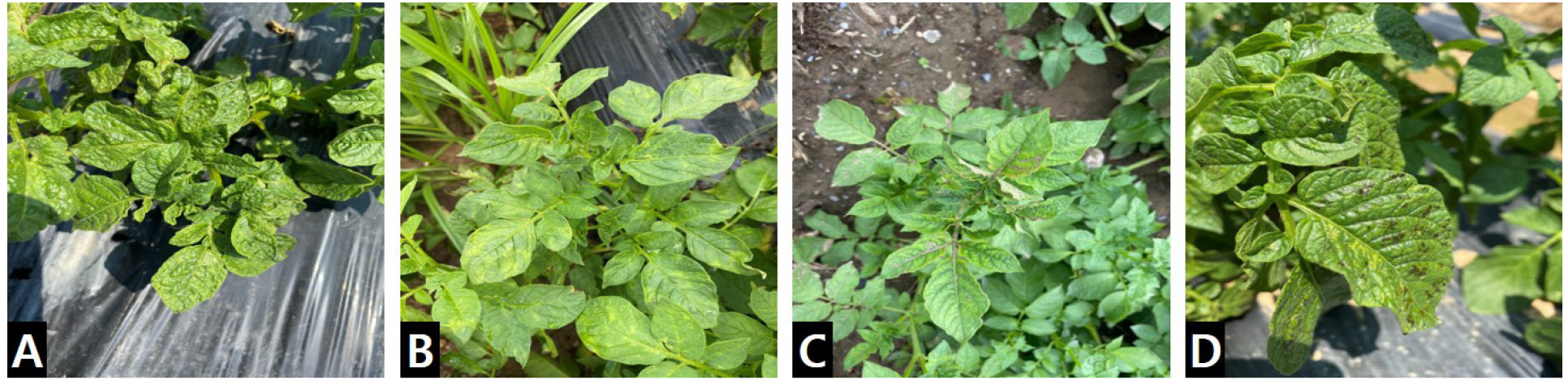
The repeated detection of PVY in this survey in 2024 and 2025 is consistent with previous reports indicating PVY as a major viral disease in potato cultivation (Salazar, 1996). The Pungnong demonstrated various symptoms such as chlorosis, chlorotic spots, and leaf curling (Fig. 1), suggesting that the manifestation of symptoms may vary depending on the PVY strain, the susceptibility of the variety, and the timing of infection (de Bokx and Huttinga, 1981; Le Romancer et al., 1994). Lee et al. (2013) also reported that symptoms may different depending on the variety. PVY is a representative potato viral disease that is transmitted non-persistently by aphids, and the occurrence of vector insects in potato fields may be closely related to the spread of the virus in the field (RDA, 2020; Salazar, 1996). The Agricultural Technology Guide states that PVY is a viral disease that causes significant damage to potato crops and is transmitted by approximately 40 species of aphids, including the green peach aphid (RDA, 2020). Kim and Kwon (2019), who analyzed long-term aphid population dynamics in domestic seed potato fields in South Korea, reported a potential increase in aphid populations and expansion of their distribution due to the global warming. In our study, aphid infestations and high PVY incidence were observed together in some fields. However, since the quantitative correlation between aphid density and PVY incidence was not analyzed in this study, it is difficult to conclude a direct causal relationship between the two factors. However, the non-persistent transmission characteristics of PVY suggests that its spread within a field increases when infected plants and vector insects are present simultaneously. Therefore, to manage PVY in the Pungnong cultivation areas, it is deemed necessary to establish a management system that combines the use of disease-free seed potatoes with the monitoring of aphid populations from the early stages of growth, along with the removal of infected plants and the control of vector insects.
Table 2.
Detection of Potato virus Y (PVY) in ‘Pungnong’ potato fields in Gangwon
| Year | Serial No. | Region | Address | Ct value1) |
| 2024 | 1 | Wonju | Hojeo-myeon | 13.5 |
| 2 | Hojeo-myeon | 13.2 | ||
| 3 | Hojeo-myeon | 19.9 | ||
| 4 | Sillim-myeon | 10.2 | ||
| 5 | Samcheok | Miro-myeon | 14.2 | |
| 6 | Miro-myeon | 15.1 | ||
| 7 | Miro-myeon | 10.4 | ||
| 2025 | 8 | Yeongwol | Hanbando-myeon | 12.3 |
| 9 | Jucheon-myeon | 7.8 | ||
| 10 | Jucheon-myeon | 8.4 | ||
| 11 | Jucheon-myeon | 9.6 | ||
| 12 | Yanggu | Haean-myeon | 7.4 | |
| 13 | Yanggu-eup | 9.3 | ||
| 14 | Yanggu-eup | 7.2 |
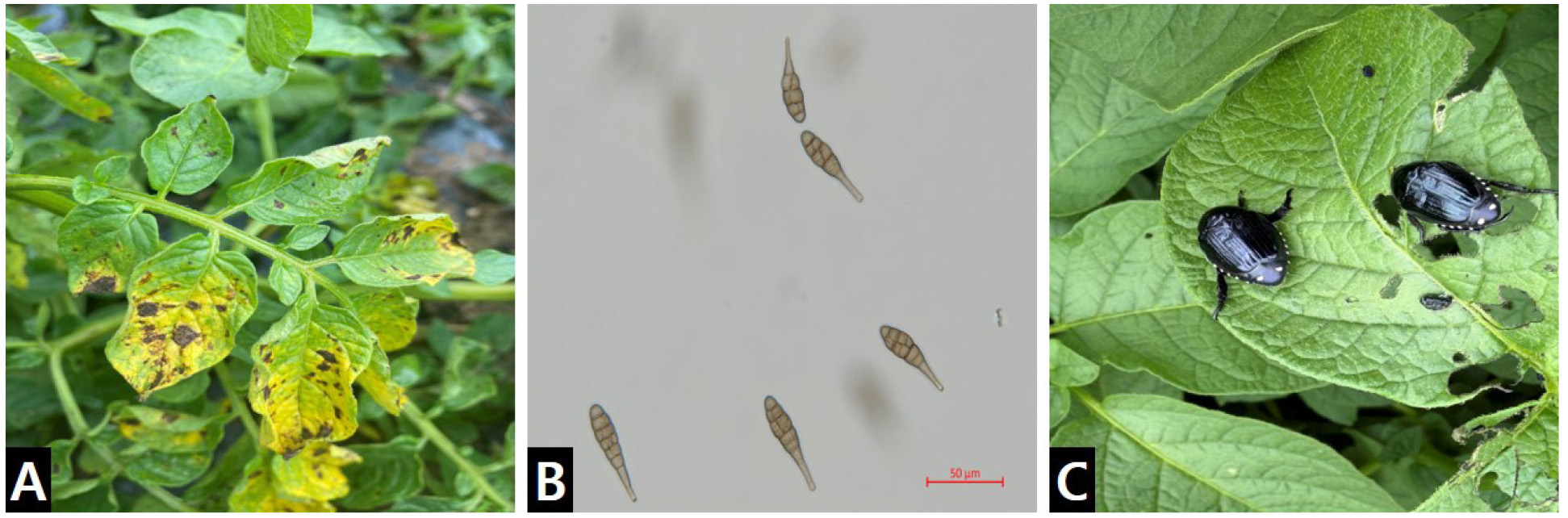
Early blight was also detected in some fields in Yeongwol and Yanggu in 2025, with field-level incidences of 45 and 10%, respectively (Table 1, Fig. 2A, B). Potato early blight, caused by Alternaria solani, is a major foliar disease for which the incidence and severity of damage can vary depending on the growing environment and the resistance of the variety (Xue et al., 2019). In this study, early blight was mainly observed during the late growth stage or after tuber enlargement. Considering the increasing likelihood of exposure to high temperatures during the potato growing season in recent years, the significance of this disease is likely to increase in the future, rendering it necessary to strengthen the surveillance for fungal diseases during the late growth stage and continuously investigate the relationship between the timing of occurrence, the extent of damage, and meteorological factors at the Pungnong cultivation sites.
Regarding pests, the chafer beetle (Popillia flavosellata) was identified at the Yeongwol demonstration site in 2025, with a field-level incidence rate of approximately 20% (Table 1, Fig. 2C). The Agricultural Technology Guide (RDA, 2020) lists aphids, wireworms, beet armyworms, 28-spotted ladybird beetle, potato tuber moths, American serpentine leafminers, melon thrips, and nematodes as potato pests; however, the chafer beetle is not considered a major potato pest. Although this study did not directly confirm yield reductions or tuber damage due to the chafer beetle, feeding by adult beetles on aboveground parts could potentially lead to a reduction in leaf area. Therefore, the chafer beetle Popillia flavosellata was documented as a potential pest in Pungnong fields, and further investigation is required to determine whether it will recur, as well as to identify the affected parts and the extent of the damage caused.
Selection of Control Agents against Common Scab
The results of the field trials for common scab in the Pungnong variety in 2024 indicated the best outcomes for the treatment plot in which fluazinam GR was applied, in which a disease severity of 35.6%, diseased tuber rate of 81.0%, total yield of 4988.3 kg/10a, and marketable yield rate of 82.0% were observed (Table 3). The treatment plot using flusulfamide SC showed a disease severity of 48.0%, diseased tuber rate of 89.3%, total yield of 4529.3 kg/10a, and marketable yield rate of 65.7%, demonstrating the second-best efficacy after fluazinam GR. In contrast, the untreated control plot showed a disease severity of 91.7%, diseased tuber rate of 100.0%, and marketable yield of 7.3%, indicating severe damage from common scab. Statistical analysis revealed that the disease severity was significantly lower in the fluazinam GR treatment plot as compared to the untreated plot, the fludioxonil FS treatment plot, and the sulfur fertilizer treatment plot, while no significant difference was observed compared with the benomyl-thiram WP and flusulfamide SC treatment plots (Table 3). The lowest diseased tuber rate was observed in the fluazinam GR treatment plot, which was significantly lower than that in the untreated and the fluoxonil FS treatment plots. The highest marketable yield was obtained for the fluazinam GR treatment plot, which was significantly higher than that observed in the untreated, fludioxonil FS treatment, and the sulfur fertilizer treatment plots. No clear significant differences were observed for total yield among the applied treatments. Therefore, it is assumed that chemical treatment had a greater impact on reducing the disease severity and improving the marketable yield in potatoes affected by common scab than on total yield. These results show that common scab can significantly affect the external quality and marketability of tubers in Pungnong cultivation areas, and that the appropriate chemical treatment can be a key factor in improving the marketable yield.
Table 3.
Effect of registered chemicals on potato common scab in ‘Pungnong’ potato
| Treatment |
Disease severity (%) |
Diseased tuber rate (%) |
Total yield (kg/10 a) |
Marketable yield (%) |
| Benomyl + thiram WP | 60.7bc1) | 93.7ab | 4,324ab | 56.2abc |
| Flusulfamide SC | 48.0bc | 89.3ab | 4,529.3ab | 65.7ab |
| Fludioxonil FS | 72.7ab | 99.7a | 4,786.3ab | 23.8bc |
| Fluazinam GR | 35.6c | 81.0b | 4,988.3b | 82.0a |
| Sulfur fertilizer | 70.7ab | 92.7ab | 3,907.7b | 32.3bc |
| Control (Untreated) | 91.7a | 100.0a | 4,364.3ab | 7.3c |
| CV | 22.2 | 10.0 | 11.6 | 50.4 |
The efficacy of fluazinam in controlling common scab has also been reported in previous studies. In examining the importance of seed and soil-borne sources of common scab, Wilson et al. (1999) reported high efficacy for fluazinam, flusulfamide, fenpiclonil, pentachloronitrobenzene, and mancozeb in reducing the incidence of common scab in seed tubers. Furthermore, Santos-Cervantes et al. (2017) reported the potential of fluazinam for controlling common scab caused by Streptomyces acidiscabies under laboratory, greenhouse, and field conditions. In the 2024 field trial performed in this study, the fluazinam GR treatment field exhibited lower disease severity and higher marketability as compared to the untreated plot and plots treated with other fungicides, also indicating the potential of fluazinam for controlling common scab.
However, while the fluazinam GR-treated plots showed the best outcomes in terms of disease severity and marketability, the diseased tuber rate remained high at 81.0%. This seemed to be because the diseased tuber rate and the disease severity are different evaluation indicators. While the diseased tuber rate counts any tuber with even the slightest lesion on its surface, disease severity is an indicator that evaluates the degree of damage by indexing the percentage of the tuber surface covered by lesions. Therefore, the fluazinam GR treatment is considered to have been effective in reducing the spread of lesions and the extent of damage rather than completely suppressing the occurrence of common scab. In particular, since this trial was conducted in fields where common scab was prevalent in the previous year, the lesions that formed on some tubers even in the treated plots resulted in a high diseased tuber rate. However, it is judged that the relatively small lesion area indicates reduced disease severity and an improvement in the marketable yield. Common scab is a disease caused by a complex interplay of factors, including the soil pathogen density, soil moisture, soil pH, susceptibility of the variety, and environmental conditions during tuber formation, rendering reliable control through a single control measure alone unlikely (Dees and Wanner, 2012). Therefore, while fluazinam GR shows potential as a promising registered pesticide for controlling common scab in Pungnong, it is advisable to use this treatment within an integrated pest management system that combines the use of disease-free seed tubers, soil moisture management, soil pH management, and crop rotation with chemical treatment rather than relying on pesticide application alone for reliable control.