


Introduction
Literature Reviews
Materials and Methods
Overview of Selected Countries
Data and Variables
Analytical Model
Results
Discussions
Introduction
In recent years, the global community has witnessed the instability of agri-food supply chains due to events such as the Russia-Ukraine war and the COVID-19 pandemic, underscoring the heightened importance of food security. While such shocks are unpredictable, the growing frequency of extreme weather events—including droughts, floods, heatwaves, and cold spells—may pose a more persistent and severe threat to national food security. This is largely due to the cumulative and escalating impact of climate change on agriculture. Climate change, driven by global warming, is advancing at an accelerating and unpredictable rate. According to the United Nations Office for Disaster Risk Reduction (UNDRR), the number of climate-related disasters and the associated property damage from 2000 to 2019 is projected to increase by 1.7 times compared to the previous two decades (UNDRR, 2020).
Agriculture is inherently vulnerable to climate-induced risks and changes in land conditions. Abnormal increases in temperature, reduced sunshine duration, and more frequent weather anomalies directly diminish agricultural productivity and yields. Moreover, shifts in land and ecosystem characteristics can reduce crop quality, further weakening agriculture and its related industries. Indirect effects may also arise due to the degradation in the quality of labor and capital. Between 2008 and 2018, Asia and the Pacific suffered approximately USD 207 billion in crop and livestock production losses—accounting for 74% of the global total—with lower-middle-income Southeast Asian developing countries alone accounting for USD 21 billion of those losses (ADO, 2021). Although climate change impacts agriculture worldwide, developing countries are disproportionately affected due to their geographic vulnerability and fragile socioeconomic systems (Hong, 2016). Most developing nations rely heavily on agriculture based on natural resources and are often located near coastlines, exposing large populations to climatic shocks. However, they frequently lack the institutional and financial capacity to respond effectively (Lee, 2014).
Although agricultural crises caused by climate change are a global concern, the degree of vulnerability differs by country. According to the report of Climate Change 2014 (IPCC, 2014), vulnerability refers to the degree to which individuals or systems are susceptible to or unable to cope with the adverse effects of climate change. Therefore, national-level differences in policy, budget allocation, industrial structure, and ecosystem resilience can lead to varied levels of climate vulnerability.
This study aims to examine cross-country differences in agricultural productivity in relation to direct and indirect variables associated with climate change. Key explanatory variables include the Land Cover Warning Index, which reflects land use and cover change, surface temperature anomalies, and the Climate Vulnerability Index, which represents each country’s capacity to adapt to climate risks. To assess the differential impacts of climate change on agriculture, both developed and developing countries were selected. The developing countries include Indonesia, Malaysia, and the Philippines—Southeast Asian nations situated in tropical rainforest climate zones with high climate vulnerability. The developed countries are Germany, the United Kingdom, and France, all of which belong to the OECD Development Assistance Committee (DAC) and represent a range of maritime to continental climates with strong agricultural sectors. As a comparative measure of agricultural performance, the Total Factor Productivity (TFP) index was employed. A path analysis model was used to analyze the complex direct and indirect relationships among climate variables and agricultural productivity.
By analyzing how various climate change variables and national climate vulnerabilities influence agricultural production, this study emphasizes the need for differentiated national strategies and international cooperation in addressing climate change within the agricultural sector.
Literature Reviews
Agriculture, which must utilize limited natural resources efficiently, is highly sensitive to climate change. Worldwide, numerous studies have examined the impact of climate change on agriculture, focusing on various aspects such as changes in crop production and productivity, agricultural ecosystems, and the agri-food industry’s interrelated sectors.
Among country-specific studies, Noh (2019) analyzed the impact of climate change on per-unit crop yields and productivity across different climatic zones in China. The study classified 29 regions—selected based on the availability of climatic and yield data—into six zones and examined four major crops: rice, corn, wheat, and soybeans. Using average temperature and rainfall data from April to October, the study applied kernel regression and partially linear models. The results showed that while rice and soybeans were significantly influenced by average climatic conditions throughout the growing season, corn and wheat were more affected by extreme weather during specific periods.
Mendelsohn (2014) investigated the impact of climate change on Asian countries, which account for two-thirds of global agricultural GDP. Using climate sensitivity coefficients derived from Chinese crop data, he estimated the effects of rising temperatures across other Asian countries. The study projected that if the average temperature rises by 1.5°C, the net annual agricultural income in Asia could decrease by USD 92.6 billion (13%), and by 3°C, the loss could reach USD 195 billion (28%), with India, Cambodia, and Bhutan experiencing the most substantial reductions.
Bindi and Olesen (2010) examined the effects of climate change on European agriculture. Their regional analysis predicted that Northern Europe would benefit from rising temperatures through increased productivity and expanded crop-suitable areas, while Southern Europe would experience reduced agricultural productivity due to water scarcity and extreme events such as heatwaves, droughts, and storms.
In South Korea, studies such as those by Jeong (2018), Kim and Lee (2011), Kim (2021), Lee et al. (2008), Lee (2011), Myung (2022) and Park (2016) have analyzed the impact of climate change on agricultural production and productivity using various meteorological variables. These include temperature, precipitation, and frequency of extreme weather alerts. The findings suggest that these variables directly reduce crop and fruit production and productivity, and indirectly impact agricultural output by altering soil microbial conditions and increasing vulnerability to pests and diseases. Collectively, these studies highlight the importance of region-specific strategies for adapting to climate change in agriculture.
Kwon and Lee (2012) estimated changes in agricultural productivity by country, considering climate change scenarios and trade liberalization. Although agriculture represents a small portion of most national economies, the results indicated that climate change would lead to declines in GDP and increases in consumer price indices, particularly in Southeast Asian and African developing countries.
Fischer et al. (2002) emphasized the vulnerability of social, economic, and environmental systems due to the degradation of natural resources caused by climate change. They stressed the agricultural sector’s vulnerability, warning that these effects could threaten food security and the global food system, thus necessitating comprehensive response strategies.
Mahato (2014) distinguished between weather as a short-term phenomenon and climate as a long-term pattern, analyzing how both influence the quantity and quality of agricultural and food production. He argued that long-term climate change first affects plant physiology and ultimately undermines agricultural and food production systems.
Nath and Behera (2011) classified the impacts of greenhouse gases on air, water, and land and compared their effects on agriculture in developing and developed countries. They noted that developing countries face significant challenges due to the lack of basic infrastructure, technology, and financial resources necessary for responding to climate change. The study emphasized the importance of cross-sectoral cooperation involving international organizations and NGOs to effectively address climate change impacts on agriculture.
While most previous studies have analyzed the relationship between climate change and agriculture using direct variables such as average temperature, rainfall, and humidity, this study takes a broader and more integrated approach. Specifically, it incorporates changes in land cover—an important factor influencing surface temperature—to examine both the direct effects of climate change on agriculture and the interrelationships among climate variables. In addition, by employing the Climate Vulnerability Index, the analysis captures the indirect and systemic pathways through which climate change affects agricultural productivity, offering a more holistic understanding of vulnerability. This approach differs from earlier research that often focuses on the effects of climate change on agricultural productivity within individual countries or regions, many have focused either on single-country case studies or on broad global assessments that overlook regional heterogeneity. This study differs by adopting a comparative framework that colligate tropical, developing economies in Southeast Asia with temperate, developed countries in Europe. By selecting countries with distinct climate systems and agricultural structures, this research highlights how vulnerability and adaptive capacity vary across development contexts.
Materials and Methods
Overview of Selected Countries
To assess the impact of climate change on agricultural productivity across different development contexts, this study selected Indonesia, Malaysia, and the Philippines as representative developing countries, and France, Germany, and the United Kingdom as developed counterparts.
Indonesia, Malaysia, and the Philippines share tropical climates and are highly vulnerable to extreme weather events such as typhoons and droughts. Their agricultural sectors are largely composed of small-scale, family-run farms, which are particularly susceptible to climate variability. Indonesia, the world’s largest archipelagic state, has a tropical monsoon climate that supports crops like palm oil, rubber, and cocoa, but its dependence on seasonal rainfall increases yield volatility (Cho, 2017). Malaysia, located near the equator, has extensive tropical rainforests and cultivates palm oil, rubber, cocoa, and other tropical crops on about 23% of its land (Kwon, 2009; Lim, 2003). The Philippines, composed of over 7,000 islands, exhibits diverse microclimates that support a range of crops including rice, corn, coconuts, and abaca, though most farming remains small-scale and subsistence-based (Kim, 2017).
In contrast, France, Germany, and the UK experience temperate climates, with more resilient, industrialized agricultural systems. France benefits from a favorable climate and regional diversity, with nearly half of its land used for agriculture and a wide variety of crops produced (Ahn, 2016). Germany, with 48% of its land under cultivation, is a global leader in dairy and agri-food exports (Cho, 2014; Park, 2021). The UK, with its maritime climate and 70% agricultural land use, supports cereal production in the east and livestock farming in the grassland-dominated west (Yoon, 2013).
Additionally, these European countries have been active in supporting agricultural development in Southeast Asia. For instance, France contributed approximately USD 12 million annually in agricultural ODA to the region between 2019 and 2021 (OECD, 2024).
Data and Variables
This study utilizes data spanning from 1995 to 2021 to analyze the impact of climate change on agricultural productivity. The Climate Altering Land Cover Index (CALCI), surface temperature change, and the Climate Vulnerability Index are treated as exogenous variables, while the agricultural productivity index serves as the endogenous variable within the path analysis model. Table 1 presents the sources of all datasets used in the analysis.
Table 1
Data source
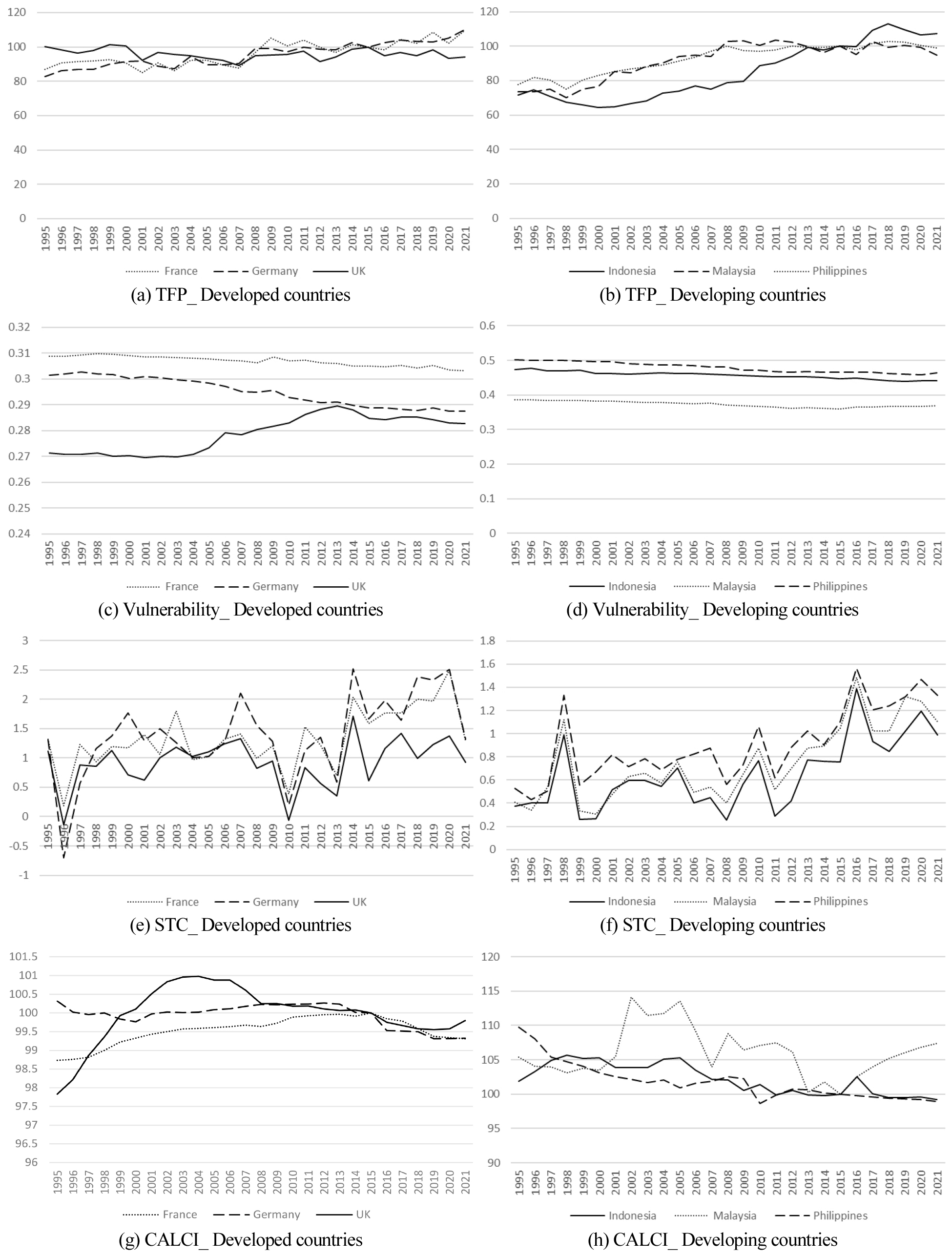
The agricultural productivity indicator employed in this study is the Total Factor Productivity (TFP) index, sourced from the Economic Research Service (ERS) of the United States Department of Agriculture (USDA). The TFP index accounts for multiple inputs used in agricultural production—such as land, labor, capital, and materials—thus offering a comprehensive measure that is useful for cross-country comparison of agricultural performance. Between 1995 and 2021, TFP trends in France, Germany, and the United Kingdom appeared more stable compared to those in Indonesia, Malaysia, and the Philippines (see Fig. 1(a), (b)).
The climate vulnerability index varies depending on the scope of the components included in the measurement. This study employs the country-level index published by the Notre Dame Global Adaptation Initiative (ND-GAIN) at the University of Notre Dame. The ND-GAIN vulnerability index encompasses critical life-supporting sectors relevant to both human survival and agricultural productivity, including food, water, health, ecosystem services, human habitat, and infrastructure. A vulnerability value closer to 1 indicates higher vulnerability to the impacts of climate change. As expected, developing countries generally exhibit higher climate vulnerability compared to developed countries. However, in the case of the United Kingdom, the data reveal a noticeable worsening of climate vulnerability over time relative to its peer nations (see Fig. 1(c), (d)).
Surface temperature change (STC) data were obtained from the International Monetary Fund’s Climate Change Dashboard. Surface temperature plays a key role in regulating the exchange of energy and water vapor between the earth’s surface and the atmosphere, making it a crucial parameter in agricultural forecasting models and climate model validation.
Land cover, a key indicator in the context of climate regulation, was also included in the analysis. Specifically, the Climate Altering Land Cover Index (CALCI), as defined by Das (2014), is used to detect and signal transformations in land cover or land use that may lead to adverse changes in biodiversity, productivity, soil quality, runoff, energy flow, gas emissions, and carbon cycling. CALCI thus serves as a valuable proxy for capturing land-related drivers of climate-induced agricultural change.
Analytical Model
Human utilization of land for specific purposes such as agriculture, residential development, industrial zones, and recreation has brought about substantial changes in the physical characteristics of the land surface. In particular, urbanization-induced changes in land use and land cover affect the heat capacity balance of the land surface, thereby influencing surface temperature variability (Kim and Lee, 2011; Kim and Song, 2016). In this study, it is hypothesized that changes in the Climate Altering Land Cover Index (CALCI) lead to variations in surface temperature, which in turn have a direct impact on agricultural productivity. Furthermore, land cover transitions are expected to influence a wide array of environmental and ecological systems essential for human survival. To capture these broader systemic effects, the climate vulnerability index is introduced as a mediating variable influencing agricultural productivity, enabling a comparative analysis of country-specific agricultural responses to climate change.
To examine the complex relationships among climate-related variables and agricultural productivity, a path analysis model was employed. Path analysis allows for the estimation of both direct and indirect effects among variables based on assumed causal relationships (Woo, 2012). In this study, CALCI is treated as an exogenous variable, while surface temperature change (STC), vulnerability, and total factor productivity (TFP) are treated as endogenous variables. Based on these relationships, a path diagram was constructed as shown in Fig. 2.
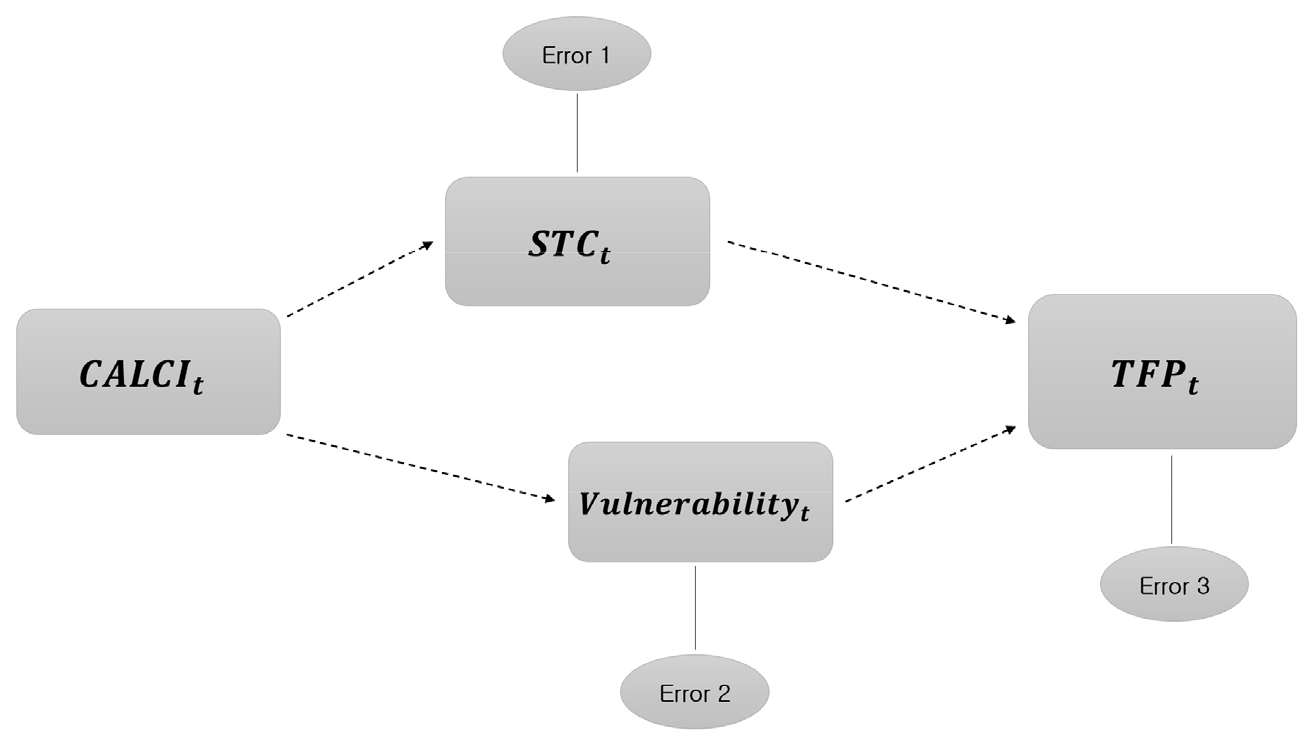
In the model structure, error term 1 accounts for the unexplained structural variance between CALCI and surface temperature change. Error term 2 reflects the unexplained structural error between CALCI and vulnerability. Error term 3 captures the residual variance in the relationship between climate-related variables and agricultural productivity not explained by the model. Since path analysis assumes that all unexplained variance in endogenous variables arises from structural errors rather than measurement errors, measurement error terms are not explicitly included in the model (Woo, 2012).
Results
Table 2 presents the descriptive statistics of the variables used in the analysis. Both the Total Factor Productivity (TFP) index and the Climate Altering Land Cover Index (CALCI) were normalized to a base year of 2015 (index = 100). Among the developed countries, the average TFP index values were relatively similar across France, Germany, and the United Kingdom. In contrast, among the developing countries, Indonesia showed the lowest average TFP, along with the highest variation, suggesting that agricultural productivity in Indonesia is relatively more unstable compared to the other countries.
Table 2
Summary statistics
The climate vulnerability index ranges from 0 to 1, where values closer to 1 indicate higher vulnerability to climate change. As illustrated in Fig. 1(c) and 1(d), France recorded the highest vulnerability among the developed countries, with an average vulnerability of 0.3069. However, the range between minimum and maximum values was relatively small, indicating overall stability in vulnerability levels. Developed countries generally exhibited vulnerability values closer to 0, implying that the negative impacts of climate change and the corresponding adaptive capacities are relatively well-managed and maintained.
Among the developing countries, the Philippines recorded the highest average vulnerability at 0.480 and also displayed the widest range between minimum and maximum values. This suggests that the Philippines is not only more exposed to climate change impacts but also less equipped in terms of adaptation capacity compared to its peers.
Surface temperature change showed substantial variation between its minimum and maximum values, indicating a high degree of fluctuation. These wide variations are often associated with increasing frequencies of extreme weather events, which in turn may negatively affect agricultural productivity.
The average CALCI value was notably higher in developing countries, with greater differences observed between minimum and maximum values. While urbanization in developed countries generally occurred gradually from the 19th to early 20th centuries, many developing countries have experienced rapid and recent urban transitions driven by large-scale population movements. This rapid land use change likely contributes to the greater volatility observed in the CALCI values of these countries.
The results of the path analysis reveal the direct and indirect effects of the Climate Altering Land Cover Index (CALCI), surface temperature change (STC), and climate vulnerability on agricultural productivity for both developed and developing countries (Table 3 and 4). CALCI was found to exert a direct influence on both surface temperature and climate vulnerability, and its overall effect on agricultural productivity was mediated through these two variables.
Table 3 presents the path analysis results for France, Germany, and the United Kingdom. In the case of France, an increase in CALCI was associated with higher surface temperatures, while climate vulnerability was mitigated (i.e., the vulnerability moved closer to 0). The rise in surface temperature due to land cover alterations led to a decrease in agricultural productivity. In addition, CALCI indirectly reduced productivity by influencing climate vulnerability, which also had a negative effect on agricultural performance.
Table 3
Results from path analysis_Developed countries
In Germany, higher CALCI values were associated with a decrease in surface temperature and a weakening of climate vulnerability (i.e., increasing vulnerability values). While changes in CALCI contributed to rising surface temperatures that positively influenced agricultural productivity, its impact on climate vulnerability had an adverse effect, leading to a net reduction in productivity.
For the United Kingdom, increasing CALCI values were linked to rising surface temperatures and deteriorating climate vulnerability. As a result, agricultural productivity was negatively affected both directly and indirectly.
The differences observed among France, Germany, and the United Kingdom in how climate change affects agriculture can be attributed to the varying agricultural structures and climate adaptation strategies of each country. France, known for its large-scale farms and diverse production systems, has emphasized climate resilience through the expansion of ecological and organic farming, the development of heat-tolerant crop varieties, and the promotion of low-carbon agricultural practices (OECD/IEA, 2016).
Germany, by contrast, employs a highly industrialized and intensive agricultural model with a strong focus on mechanization. Its climate adaptation strategies include the adoption of precision agriculture and smart farming technologies, as well as the utilization of biogas systems and participation in carbon credit markets to promote sustainability (Kim and Song, 2016).
The United Kingdom has focused on climate mitigation through carbon capture and storage (CCS) and regenerative agriculture. The country is also investing in climate-resilient farmland systems designed to manage flood risks and conducting research to reduce methane emissions in the livestock sector (Clean Air Task Force, 2023).
Table 4 presents the path analysis results for Indonesia, Malaysia, and the Philippines. In the case of Indonesia, increased land use and land cover changes were associated with a decrease in surface temperature and a weakening of climate vulnerability (i.e., an increase in the vulnerability score toward 1. The changes in land cover had a positive indirect effect on agricultural productivity through surface temperature variation. This positive relationship may be attributed to the recent expansion of farmland aimed at improving food self-sufficiency, which has contributed to higher agricultural output (KOTRA, 2024).
Table 4
Results from path analysis_Developing countries
For Malaysia and the Philippines, changes in land cover also contributed to decreases in surface temperature. However, unlike in Indonesia, these changes were associated with a deterioration in climate vulnerability (i.e., vulnerability values moved closer to 1), indicating an increased sensitivity to climate-related stressors. The combination of temperature decline and increased vulnerability had a negative overall effect on agricultural productivity in both countries.
Although Indonesia, Malaysia, and the Philippines all share similar tropical climates, the specific climatic threats they face differ considerably. Indonesia is significantly affected by flooding and rising sea levels, while Malaysia is more exposed to heat stress and deforestation. The Philippines, in contrast, is highly vulnerable to typhoons, which cause recurrent and severe crop damage each year.
Discussions
The increasing unpredictability of climate change presents critical challenges to agricultural systems across the nations. Although climate change affects all nations, its consequences tend to be more severe in countries that are geographically vulnerable and lack socioeconomic stability, particularly in developing regions. The results of this study clearly demonstrate that changes in land use and land cover, surface temperature fluctuations, and increased climate vulnerability have more pronounced negative effects on agricultural productivity in developing countries than in developed ones.
In developed countries such as France and the United Kingdom, land cover change has been found to increase surface temperature and climate vulnerability, which in turn reduces agricultural productivity. In Germany, however, the results suggest that increases in surface temperature are positively associated with productivity, which may be attributed to Germany’s advanced technological adaptation within the agricultural sector. In the case of Indonesia, land use expansion had a beneficial effect on productivity, likely due to ongoing efforts to increase food self-sufficiency by expanding arable land. In contrast, Malaysia and the Philippines experienced losses in agricultural productivity, which were closely linked to rising climate vulnerability and unstable surface temperature trends.
These findings highlight the need for differentiated strategies that reflect national capacities and climate risk profiles. Developed countries, with relatively stable institutions and technological capabilities, are in a position to emphasize sustainability, innovation, and the stability of global food trade. They are encouraged to invest in research and development for climate-resilient agricultural technologies such as precision farming, biotechnology, and heat-tolerant crop varieties. At the same time, it is important to expand the use of sustainable farming practices, including agroforestry, crop diversification, and organic agriculture. Policymakers in these countries should also consider offering financial incentives, such as subsidies or tax benefits, to support farmers adopting climate-smart approaches.
On the other hand, developing countries must focus on enhancing agricultural resilience through improved infrastructure and the transfer of climate adaptation knowledge. Strengthening agricultural extension services is essential to disseminate practical information about climate-resilient farming. Increasing access to drought-resistant seeds and improved irrigation technologies is equally important. These goals can be advanced through the strategic distribution of resilient agricultural inputs supported by public-private partnerships. Moreover, improving access to microfinance and credit facilities will help smallholder farmers invest in adaptive technologies.
Water resource management is another critical area requiring urgent attention. In response to climate change-induced droughts and altered rainfall patterns, developed countries are encouraged to promote investment in efficient irrigation systems, such as drip irrigation and rainwater harvesting, as well as in research on water recycling and desalination technologies. In developing countries, the priority lies in improving basic water infrastructure, including reservoirs and irrigation canals, to ensure a stable agricultural water supply. Community-based water management systems should also be established to promote equitable water use and prevent resource depletion. In addition, governments should provide financial and technical support programs to help farmers apply efficient water-use technologies.
Climate change also increases the frequency and intensity of crop pests and diseases, which pose serious threats to food security. National governments must strengthen pest and disease monitoring systems and invest in biological control and integrated pest management. In order to maintain environmental sustainability while safeguarding yields, pesticide use should be regulated. At the same time, eco-friendly pest control methods and low-cost solutions should be more widely promoted. Furthermore, regional cooperation is essential to prevent the cross-border spread of pests and diseases, and joint prevention systems should be established.
Considering the economic vulnerability of the agricultural sector to climate change, it is also essential to implement policies that protect farmers’ financial stability. In developed countries, expanding agricultural insurance programs can reduce climate-related financial risks. It is equally important to promote economic diversification in rural areas and strengthen social safety nets, such as income support schemes and emergency relief funds. In developing countries, increasing access to microfinance can support farmers in adopting climate-resilient practices. Moreover, the creation of alternative employment opportunities and the expansion of vocational training in rural areas will help reduce the economic fragility of communities that rely heavily on agriculture.
Finally, international cooperation must be strengthened to enhance the climate change response capacity of developing countries. The East Asia Climate Partnership (EACP), led by South Korea from 2008 to 2013, serves as a notable example of development cooperation in the field of climate adaptation. For international assistance to be effective, it must be grounded in a comprehensive assessment of the climatic and institutional conditions of the recipient country. Above all, local needs must be clearly identified, and project designs should be aligned with national priorities. In evaluating the potential contribution of a project to climate adaptation, it is necessary to consider whether the project will enhance the adaptive capacity of stakeholders, reduce climate-related risks or vulnerabilities in a tangible way, and remain effective in the face of future uncertainty.
Ultimately, building a resilient global food system in the context of climate change requires responses that are tailored to national realities but coordinated through international solidarity. Strengthening multi-level governance and knowledge-sharing across countries will be essential to ensure agricultural sustainability in an era of growing climatic instability.
Despite the contributions of this study, several limitations should be acknowledged. First, the use of national-level aggregated data may obscure regional heterogeneity in agricultural productivity and climate impacts, particularly in geographically diverse countries like Indonesia or the Philippines. Second, although the Climate Altering Land Cover Index (CALCI) and surface temperature change serve as meaningful proxies for climate-related variables, they do not capture the full range of biophysical stressors such as soil degradation, pest incidence, or extreme rainfall events. Third, while the Climate Vulnerability Index offers a comprehensive measure of exposure and adaptive capacity, it may not fully reflect sector-specific vulnerabilities within agriculture. Additionally, the study adopts a path analysis framework, which is based on assumed causal relationships; however, the directionality and magnitude of these effects may vary over time or under different policy conditions. Finally, this study does not incorporate socio-economic control variables—such as income, education, or institutional capacity—that could moderate the relationship between climate vulnerability and agricultural productivity. Future research may benefit from incorporating sub-national data, dynamic models, or interaction terms that reflect country-specific adaptation policies and practices.