


Introduction
Materials and Methods
Research Soil and Soil Amendments
Soil Amendment Treatment and Constant-temperature Cultivation Test
Soil Chemical Analysis
Statistical analysis
Results and Discussion
The Effect of Soil Amendments on Soil pH and Exchangeable Cation Content
Effects of Soil Amendments on Exchangeable Aluminum Content and Aluminum Saturation in Soil
The Effect of Soil Amendments on Exchangeable and Available S Content in Soil
Conclusion
Introduction
Phosphogypsum is a byproduct generated during the chemical production of phosphate fertilizers from phosphate rock. Currently, some of it is recycled in cement and gypsum board manufacturing. For agricultural use, it is classified as a lime-based fertilizer meeting fertilizer process standards by adding quicklime and is registered as byproduct gypsum (Kim et al., 2021a). However, the sheer volume of phosphogypsum generated during the phosphoric acid manufacturing process is so high that its recycling is not smooth, and consequently, the stockpiled amount continues to increase annually (Park et al., 2024). Meanwhile, phosphogypsum is known to contain fertilizer components, such as Ca, SiO2, S, Fe, and B, making it highly suitable for agricultural use as a soil amendment (Shainberg et al., 1989). Studies on the agricultural use of phosphogypsum in Korea have reported its effectiveness in desalination and improving acidic subsoil in reclaimed land (Ryu et al., 2010; Sohn et al., 2007), as well as its ability to enhance Ca and S content and growth in crops such as melons, garlic, and onions, thereby improving yield and quality (Chung, 2005; Kim et al., 2021a, 2021b). However, no systematic study has evaluated the effects of phosphogypsum application on crop growth and soil chemistry in Jeju Island’s volcanic ash soil. After citrus and radishes, garlic and onions are the primary field vegetable crops cultivated on Jeju Island (JSSGP, 2024). The S contained in phosphogypsum is expected to contribute to improving the quality of these crops.
The ameliorative effect of phosphogypsum (CaSO4) in acidic soils is the result of a combination of mechanisms. First, there is a self-liming effect where OH- ions are released through ligand exchange with SO42- ions, thereby raising soil pH. Second, there is an ion pairing effect where Al3+ reacts with CaSO4 to form ion pairs, such as AlSO4+, thereby reducing the concentration of toxic aluminum in solution. Third, a mechanism has been reported whereby CaSO4 applied to soil partially converts to Ca(OH)2, precipitating Al3+ as basic aluminum hydroxide (precipitation of basic aluminum sulfates) (Farina and Channon, 1988; Saigusa and Toma, 1997). Due to these characteristics, phosphogypsum has a higher solubility in water compared to limestone, supplying Ca and S even to acidic subsoils. Thus, it can be utilized as a soil amendment to improve soil chemical composition, promote root growth, and reduce Al toxicity (Farina and Channon, 1988; Shainberg et al., 1989; Sumner, 1993; Toma et al., 1999).
Andisols formed from volcanic deposits are characterized by allophane and Al-organic complexes. Volcanic ash soils dominated by Al-organic complexes contain high levels of toxic Al precursors, resulting in significantly greater root growth damage compared to allophane-dominated soils. While Al toxicity is rarely observed in allophane-rich soils, Al can dissolve from allophane when soil pH decreases in cultivated fields (Matsuyama et al., 2005). Exchangeable aluminum (1N KCl extraction) is commonly used as an indicator of aluminum toxicity, with toxicity levels harmful to plants induced at concentrations of 2 cmolc/kg or higher (Takahashi et al., 2006). In Chile’s acidic Andisols, gypsum treatment was found to slightly increase soil pH and reduce exchangeable Al. With S supply, Al3+ toxicity in rye was mitigated, and yields increased to levels similar to those achieved with limestone and gypsum application (Mora et al., 1999). In contrast, gypsum application did not significantly reduce exchangeable Al in Japan’s non-allophanic Andisols (Inoue et al., 2001). Furthermore, in some soils, the pH was reported to decrease slightly after gypsum treatment, with a reduction in exchangeable Al content (in soils with a content of 5 cmolc/kg or higher) of only 0.1-1.4 cmolc/kg (Takahashi et al., 2006). Taken together, the pH improvement and aluminum toxicity reduction effects of phosphogypsum application in volcanic ash soils show inconsistent trends depending on soil type, highlighting a need to reevaluate phosphogypsum applicability in volcanic ash soils by soil type.
Jeju Island’s soils developed from volcanic pyroclastic deposits originating from basalt, forming a wide variety of soils depending on soil-forming conditions, including climate and vegetation (Park and Koo, 2020). Soils are broadly classified into brown forest soils, black soils, very dark brown soils, and dark brown soils based on soil color, with dark brown soils corresponding to non-Andisols (Park and Kang, 2019; Song and Yoo, 1991). Farmland in coastal areas has a longer cultivation history than that in mid-mountain regions, resulting in relatively higher levels of pH, base saturation, available phosphorus, and exchangeable cations (K·Ca·Mg). However, it tends to have lower organic matter content and cation exchange capacity. Furthermore, it has been reported that as the duration of cultivation increases, pH rises and exchangeable aluminum content decreases, and that active aluminum reacts with phosphorus fertilizer to become insoluble (Yoo and Song, 1984a, 1984b). Song and Yoo (1991) reported that while soils with exchangeable Al content exceeding 2 cmolc/kg exist in the black soil A horizon dominated by Al-organic complexes, other soils exhibit very low levels. Furthermore, the proportion of citrus orchard soils in Jeju meeting the optimal pH requirement was only 28% for dark brown soil, 22% for very dark brown soil, and 24% for black soil. The lime requirement needed to raise the pH of each soil type to 6.5 was 1,106 kg/10a for dark brown soil, 2,218 kg/10a for very dark brown soil, and 2,457 kg/10a for black soil (Kang, 2020), indicating a general need for soil acidity improvement. These results suggest that tailored soil improvement measures should be developed, considering the chemical property differences between Jeju Island’s Andisols and non-Andisols.
Here, we evaluated the effects of applying phosphogypsum to representative Andisols and non-Andisols in Jeju Island, comparing it with shell meal and dolomitic limestone, focusing on soil pH improvement, increased exchangeable Ca content, reduced exchangeable Al, and S supply effects. Through this, we propose phosphogypsum as an effective soil amendment for Jeju volcanic ash soil, tailored to both soil types and improvement objectives, such as alleviating Al toxicity, supplying Ca, and providing crop-available S.
Materials and Methods
Research Soil and Soil Amendments
Soil samples used in the cultivation experiment included Andisols (WM (Wumitong), TP (Topyeongtong), HG (Hangyeongtong), and HW (Haengwontong)), as well as non-Andisols (JJ (Jejutong, a brown soil on granite) and GJ (Gangjeongtong, a dark brown soil)). All the samples were collected from uncultivated land. The chemical properties of the soils are shown in Table 1. Samples with varying soil pH and exchangeable cation content were selected. The organic matter content, cation exchange capacity (CEC), and Alo-Alp values of the black volcanic ash soil were 14.3-24.4%, 32.5-41.6 cmolc/kg, and 1.10-2.67%, respectively, higher than those of very dark brown soil and dark brown soil.
Table 1
Chemical properties of the soil prior to the experiment
| Soil series1) | pH |
O.M. (g/kg) |
Alo (%) |
Feo (%) |
Alp (%) |
Alo-Alp (%) | |
| H2O | KCl | ||||||
| WM | 5.0 | 4.3 | 215 | 3.36 | 2.26 | 2.26 | 1.10 |
| TP | 4.6 | 4.2 | 244 | 3.69 | 2.80 | 1.66 | 2.03 |
| HG | 5.5 | 4.5 | 216 | 4.01 | 3.51 | 1.34 | 2.67 |
| HW | 5.3 | 4.5 | 143 | 3.69 | 2.77 | 1.31 | 2.38 |
| JJ | 5.5 | 4.1 | 56.7 | 1.51 | 1.91 | 0.90 | 0.61 |
| GJ | 5.0 | 4.1 | 47.9 | 0.69 | 1.37 | 0.36 | 0.33 |
| Soil series |
CEC (cmolc/kg) | Exchangeable cation (cmolc/kg) | |||||
| K | Ca | Mg | Na | Al | |||
| WM | 40.3 | 0.16 | 0.37 | 0.21 | 0.28 | 1.52 | |
| TP | 41.6 | 0.28 | 0.57 | 0.29 | 0.41 | 2.10 | |
| HG | 34.9 | 0.33 | 3.09 | 0.93 | 0.33 | 0.50 | |
| HW | 32.5 | 0.18 | 1.77 | 0.76 | 0.23 | 0.86 | |
| JJ | 20.0 | 0.16 | 0.04 | 0.07 | 0.15 | 1.62 | |
| GJ | 20.8 | 0.17 | 8.79 | 1.93 | 0.22 | 0.33 | |
1)Black volcanic ash Andisols include Wimi (WM), Topyeong (TP), Hangyeong (HG), and Hangwon (HW), while non-Andisols include a very dark brown soil (Jeju (JJ)) and a dark brown soil (Gangjeong (GJ)). O.M., organic matter; Feo, Alo, acid-oxalate-extractable Alo and Feo; Alp, sodium pyrophosphate extractable Al; CEC, cation exchangeable capacity.
For soil amendments, shell meal, dolomitic limestone, and phosphogypsum were used in the cultivation experiments. To minimize variation in effectiveness due to particle size, the soil was air-dried then ground, and samples that passed through a 0.5-mm sieve were used. The available chemical components of soil amendments are shown in Table 2. The alkaline component was lowest in phosphogypsum at 33.6%, the CaO content was highest in shell meal at 52.1%, and the MgO content was highest in dolomitic limestone at 17.2%. The Al content was 0.04%, 0.24%, and 0.13% in shell meal, dolomitic limestone, and phosphogypsum, respectively, while the S content was highest in phosphate rock at 18.6%.
Table 2
Available chemical components of the soil amendments used in this experiment
Soil Amendment Treatment and Constant-temperature Cultivation Test
To compare the soil improvement effects of soil amendments on Jeju Island volcanic ash soil, a constant-temperature incubation experiment was conducted in triplicate. Soil amendments (shell meal, dolomitic limestone, phosphogypsum) were applied at a rate equivalent to 200 kg per 10 acres, based on the amount of alkali supplied. Specifically, for every 100 g of air-dried-dried soil passing through a 2-mm sieve, 0.16 g each of shell meal and dolomitic limestone powder (alkali content 52-53%) and 0.28 g of phosphogypsum (alkali content 33.6%) were mixed. The culture was maintained at 25°C for 30 days. Soil moisture was regulated at 70% of field capacity, and daily weight measurements were taken to consistently manage moisture content.
Soil Chemical Analysis
Soil samples were analyzed according to soil chemical analysis method (NIAST, 2010) by air-drying the samples and passing them through a 2-mm sieve. Soil pH (H2O) was measured using a soil-to-distilled water ratio of 1:5, and soil pH (KCl) was measured using a soil-to-1N KCl ratio of 1:2, after shaking, using a pH meter (Orion Star A211; Thermo). Organic matter content was determined using the Walkley & Black method. Exchangeable cations (K, Ca, Mg, and Na) and the CEC were measured using a 1N NH4OAc (pH 7.0). Al(Alp) forms complexes with organic compounds) was extracted for 16 hours using a 0.1M sodium pyrophosphate solution (pH 10). Al(Alo) and Fe (Feo) were extracted for 12 hours using 0.2M ammonium oxalate solution (pH 3) in the dark using an automatic extractor. The extraction solution was diluted with distilled water after centrifugation and measured by ICP-OES (5800ICP-OES; Agilent). Exchangeable Al was leached with 1N KCl solution, while organic complex Al was leached with 0.5M CuCl2 and 0.1M Na4P2O7 solutions, followed by analysis via ICP-OES. Al saturation was calculated by dividing exchangeable Al by the sum of exchangeable cations (K, Ca, Mg, and Na) and exchangeable Al. Exchangeable S was analyzed by ICP-OES after leaching with a 0.15% CaCl2 solution, while adsorbed and exchangeable S (available S) was analyzed after leaching with a 0.01M Ca(H2PO4)2ㆍH2O solution.
Statistical analysis
Statistical analysis was performed using SPSS 18.0 (SPSS Inc. Chicago, USA). Two-way ANOVA was conducted to compare differences between soil amendment treatments and soil types. Post-hoc tests were performed using Tukey’s HSD at a 5% significance level.
Results and Discussion
The Effect of Soil Amendments on Soil pH and Exchangeable Cation Content
Soil pH (H2O) ranged from 4.6 to 5.5 in untreated soil, while soil treated with shell meal, dolomitic limestone, and phosphogypsum ranged from 5.2 to 6.6, 5.3 to 6.4, and 4.9 to 5.8, respectively (Fig. 1). Previous reports have indicated that gypsum treatment corrects soil pH in greenhouse cultivation sites and Chilean acidic Andisols (Chung, 2005; Mora et al., 1999), with all soil amendments used in the experiment increasing the pH levels. Specifically, soils treated with shell meal and dolomitic limestone showed a significantly higher pH than those treated with phosphogypsum (p < 0.05). The effect of soil amendments was higher in GJ, a non-Andisol (p<0.05). Soil pH (KCl) ranged from 4.1 to 4.5 in untreated soil, while soil treated with shell meal, dolomitic limestone, and phosphogypsum ranged from 4.5 to 5.5, 4.5 to 5.5, and 4.4 to 5.2, respectively (Fig. 1). Soil pH (KCl) increased in treated soils compared to untreated soils (p < 0.05), similar to the change in soil pH (H2O). pH (H2O) reflects the immediate acidity change in the soil solution, while pH (KCl) reflects the potential acidity (exchangeable acidity), manifested by exchangeable H+ and Al3+. Therefore, the simultaneous increase in pH(H2O) and pH(KCl) following soil amendment treatment indicates that both the soil solution acidity and exchangeable acid components were mitigated. The proportion of soils with appropriate pH in Jeju citrus orchards is low: dark brown (28%), very dark brown (22%), and black (24%) (Kang, 2020). While the effect of phosphogypsum application is somewhat lower than that of shell meal and dolomitic limestone, it is believed to contribute to soil acidity.
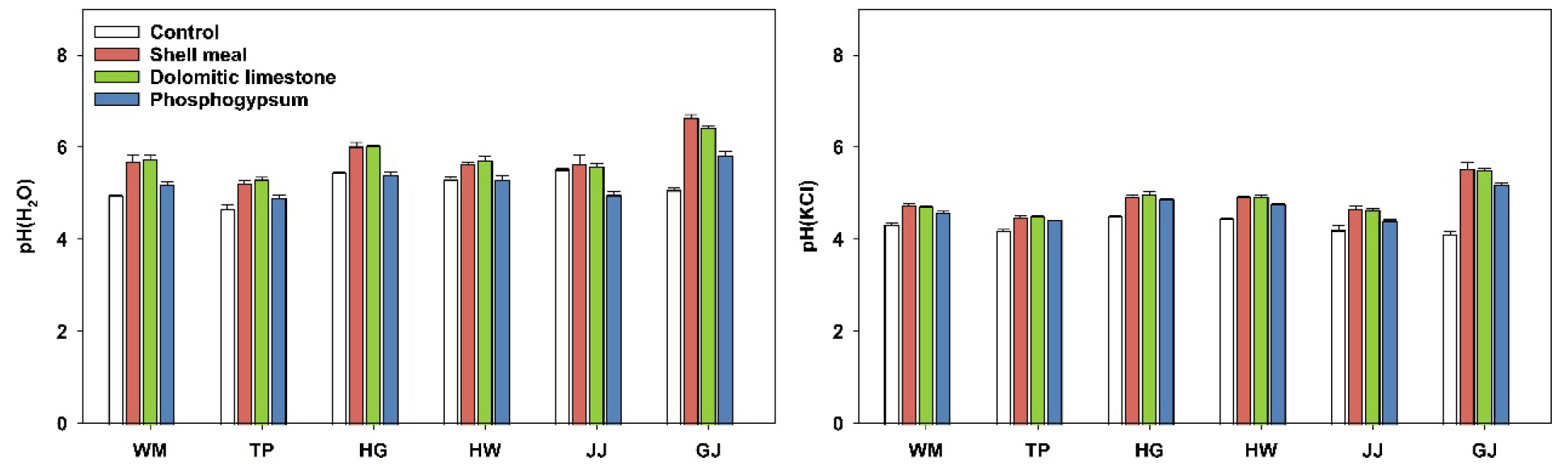
Fig. 1.
Soil pH (H2O and KCl) after soil amendment treatment. Error bars indicate the standard deviation. Two-way ANOVA indicated significant differences in both pH (H2O) and pH(KCl) among soil amendment treatments and among soil types (p < 0.01). Soil series are described in Table 1.
The exchangeable K and Na content in all soils ranged from 0.19 to 0.55 cmolc/kg and 0.36 to 0.57 cmolc/kg, respectively. Soil amendments (shell meal, dolomitic limestone, and phosphogypsum) resulted in low K and Na contents, with no difference between treated and untreated soils. The exchangeable Ca content ranged from 0.14 to 2.74 cmolc/kg in untreated soil. In soils treated with shell meal, dolomitic limestone, and phosphogypsum, the values were 1.50 to 4.67 cmolc/kg, 0.68 to 3.22 cmolc/kg, and 1.46 to 4.34 cmolc/kg, respectively (Fig. 2). These results showed a similar trend to reports in which gypsum application was found to increase the Ca content in both soil and plant tissues in reclaimed land and facility cultivation sites (Chung, 2005; Ryu et al., 2010; Sohn et al., 2007). Soil treated with phosphogypsum had a higher Ca content than soil treated with other soil amendments, with the highest levels in GJ at 2.74 to 4.34 cmolc/kg. The exchangeable Mg content showed no difference among untreated soil, soil treated with limestone, and soil treated with phosphogypsum. However, in soil treated with limestone (MgO 17.2%), the exchangeable Mg content increased significantly more than in soils treated with other soil amendments (Fig. 2). The total exchangeable cation content ranged from 1.05 to 4.87 cmolc/kg in untreated soil. In soils treated with shell meal, dolomitic limestone, and phosphogypsum, the values were 2.39 to 7.03 cmolc/kg, 2.14 to 6.24 cmolc/kg, and 2.27 to 6.32 cmolc/kg, respectively, all higher than the untreated soil (Fig. 3). The largest increases occurred in soils treated with shell meal in TP, in soils treated with dolomitic limestone in the HW, and in soils treated with phosphogypsum in the HG, JJ, and GJ.
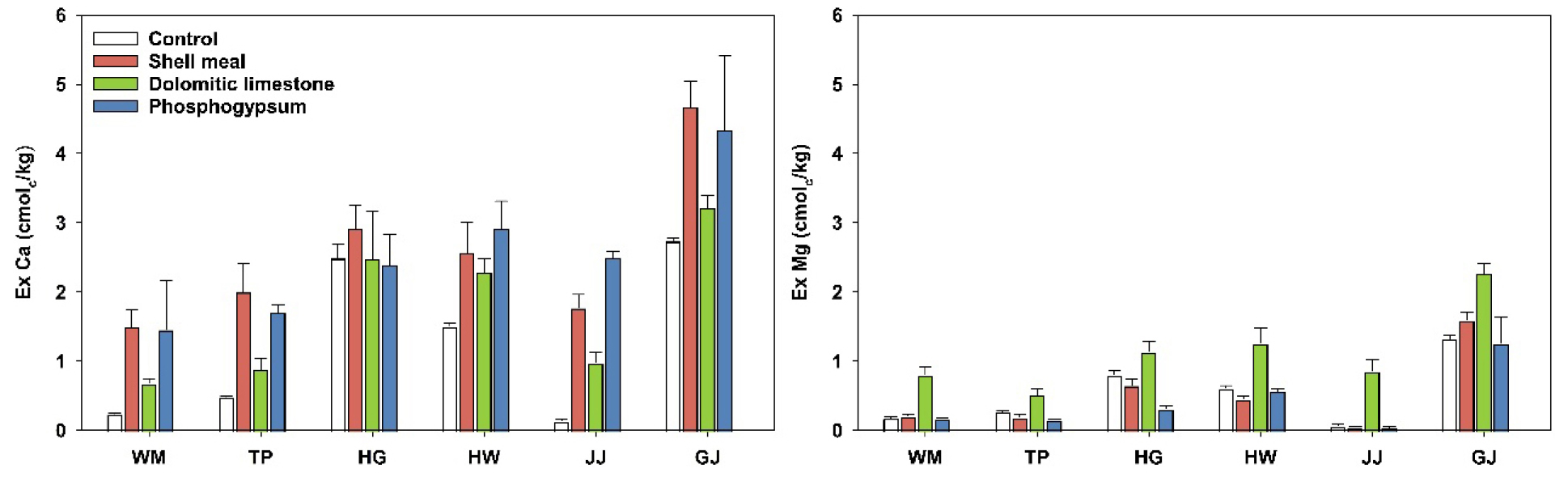
Fig. 2.
Exchangeable calcium (Ca) and magnesium (Mg) concentrations after soil amendment treatment. Error bars indicate the standard deviation. Two-way ANOVA indicated significant differences in exchangeable Ca and Mg among soil amendment treatments and among soil types (p < 0.01). Soil series are described in Table 1.
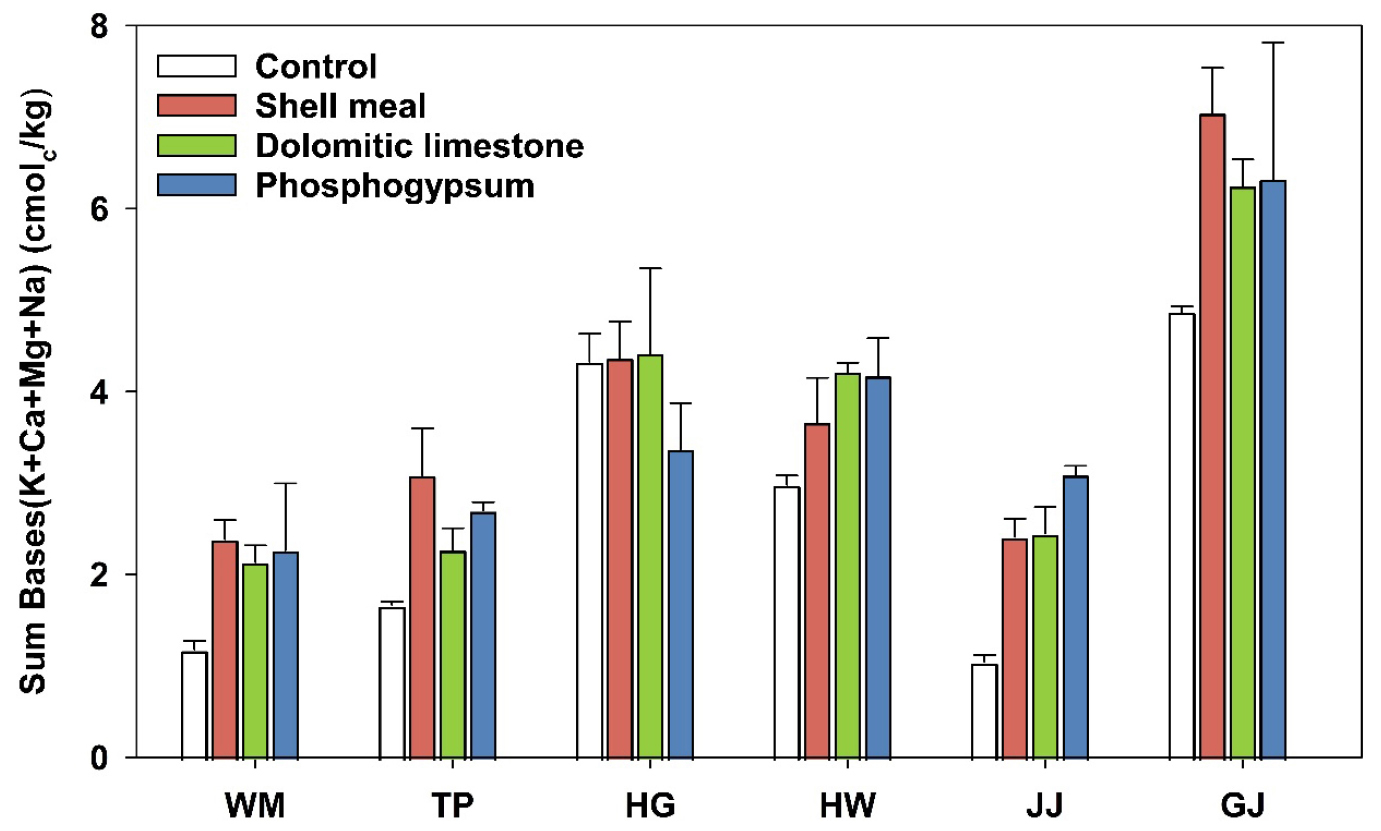
Fig. 3.
Sum of exchangeable cations after soil amendment treatment. Error bars indicate the standard deviation. Two-way ANOVA indicated significant differences in the sum of exchangeable cations among soil amendment treatments and among soil types (p < 0.01). Soil series are described in Table 1.
Effects of Soil Amendments on Exchangeable Aluminum Content and Aluminum Saturation in Soil
The exchangeable Al content decreased in all soils treated with soil amendments compared to untreated soils (p < 0.05). In particular, the exchangeable Al content in the untreated soil of TP exceeded 2 cmolc/kg, reaching levels toxic to plants (Saigusa et al., 1980). However, soil amendment treatment reduced this to 1.05-1.40 cmolc/kg (Fig. 4).
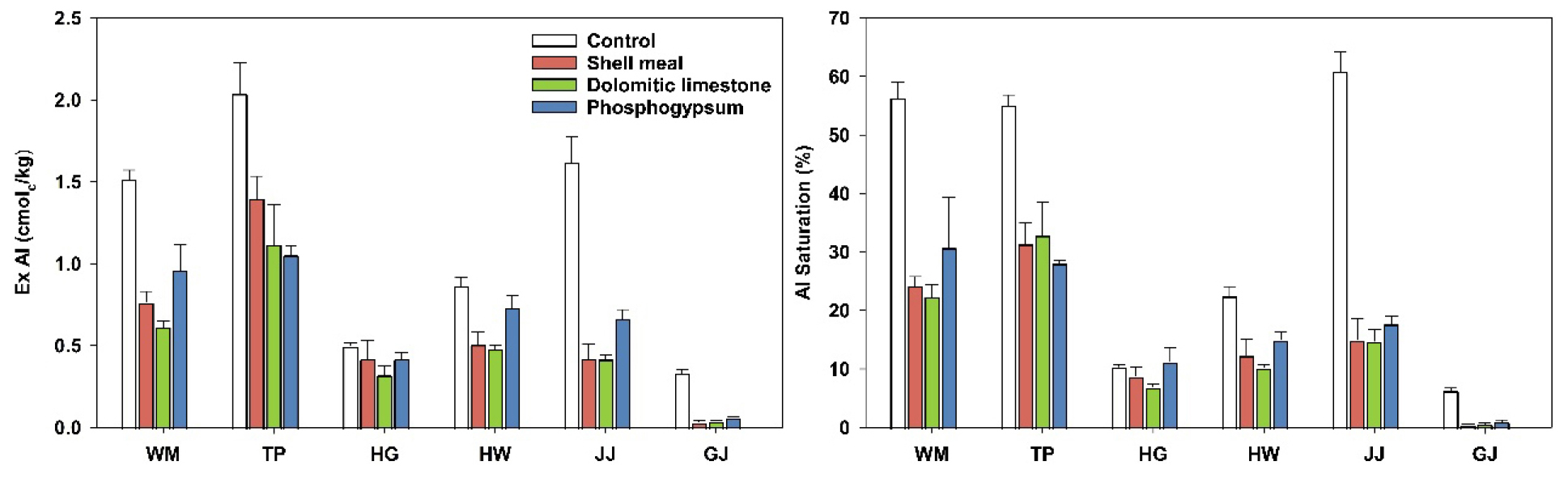
Fig. 4.
Concentrations of exchangeable aluminum (Al) and Al saturation after soil amendment treatment. Error bars indicate the standard deviation. Error bars indicate the standard deviation. Two-way ANOVA indicated significant differences in exchangeable Al and Al saturation among soil amendment treatments and among soil types (p < 0.01). Soil series are described in Table 1.
Gypsum is known to improve the toxicity of aluminum (Mora et al., 1999; Takakashi et al., 2006), and phosphogypsum treatment reduced aluminum saturation compared to shell meal and dolomitic limestone treatments, although differences were observed depending on the soil (p < 0.05). This is because the Ca content increased and the exchangeable Al decreased. The reduction in Al solubility in soil due to gypsum application is known to be caused by the formation of hydroxy Al polymers and Al-hydroxy-sulfate minerals (Takahashi et al., 2006).
The difference between CuCl leachable Al content and KCl exchangeable Al content (AlCu-K) represents Al that has formed organic complexes in soils with high organic matter content (Aitken, 1992; Conyers, 1990; Juo and Kamprath, 1979). No significant difference was observed with soil amendment treatment (Fig. 5, p > 0.05). The formation of hydroxy aluminum polymers reduces exchangeable Al and increases the AlCu-K value (Takahashi et al., 2006). However, GJ, which is a non-Andisol, showed a decrease in AlCu-K values compared to the untreated soil. In black volcanic ash soil, the AlCu-K value increased slightly (p<0.05), suggesting that hydroxy Al polymers formed to a small extent.
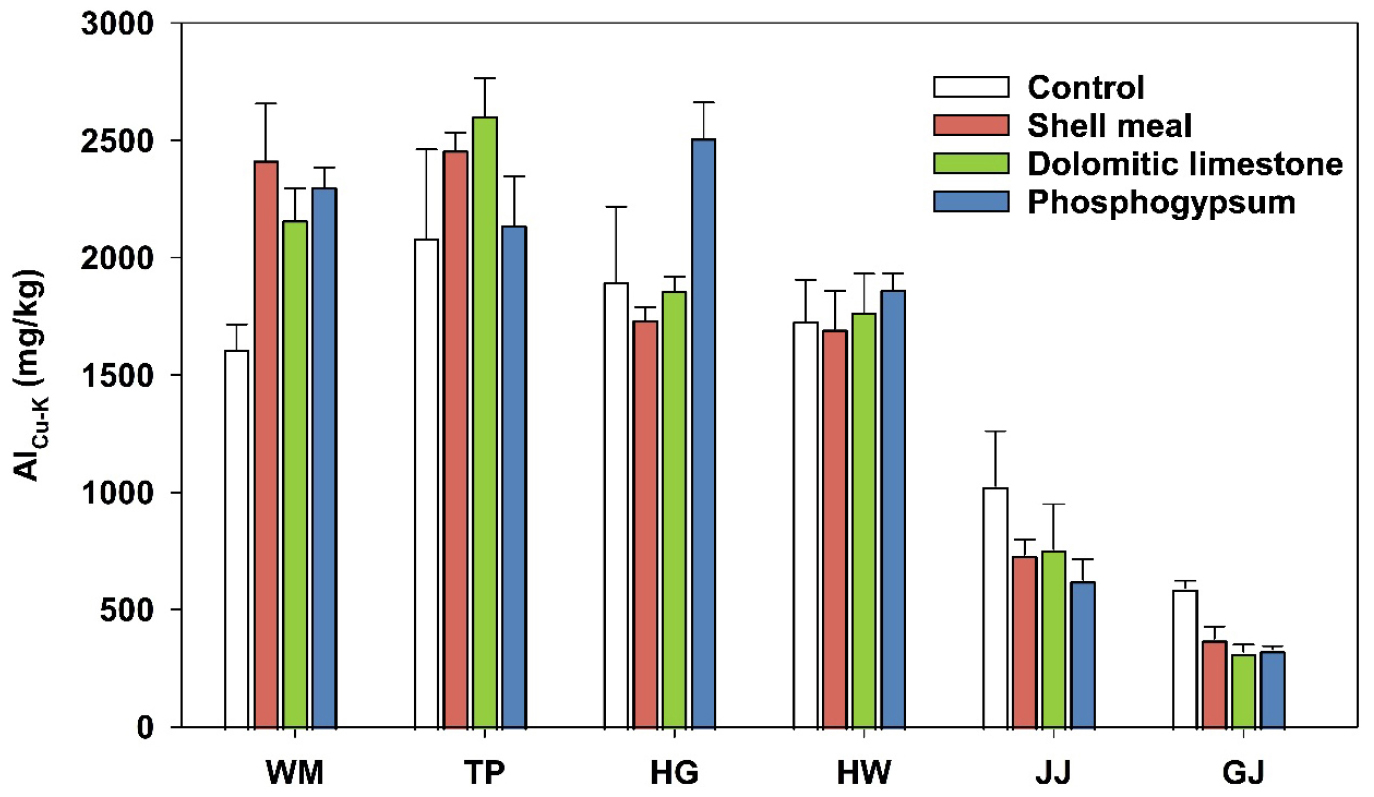
Fig. 5.
Concentration of exchangeable aluminum (AlCu-K) after soil amendment treatment. Error bars indicate the standard deviation. Two-way ANOVA indicated no significant differences among soil amendment treatments (p>0.01), but significant differences among soil types (p < 0.01). Soil series are described in Table 1.
The Effect of Soil Amendments on Exchangeable and Available S Content in Soil
The exchangeable S content of untreated soil ranged from 4.69 to 13.9 mg/kg (Fig. 6). Soils treated with shell meal (S 0.28%) and dolomitic limestone (S 1.06%) with a low S content showed little change in exchangeable S content, ranging from 3.92 to 25.9 mg/kg. In contrast, soils treated with phosphogypsum (S 18.6%) showed significantly higher exchangeable S levels (p < 0.05), ranging from 57.9 to 240 mg/kg, compared to soils treated with other soil amendments.
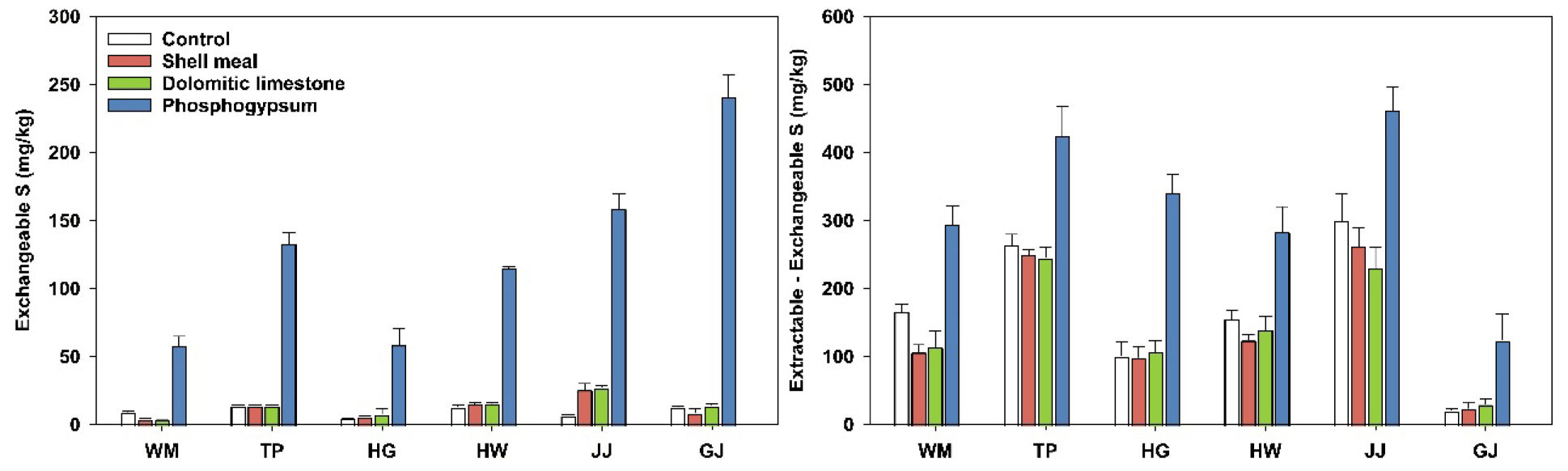
Fig. 6.
Exchangeable sulfur (S) and absorbed S (extractable S - exchangeable S) after soil amendment treatment. Error bars indicate the standard deviation. Two-way ANOVA indicated significant differences in exchangeable S and absorbed S among soil amendment treatments and among soil types (p < 0.01). Soil series are described in Table 1.
The difference between effective S leached with Ca(H2PO4)2 solution and exchangeable S leached with CaCl2 solution indicates the amount of SO4-S that is adsorbed onto the surfaces of Al and Fe hydroxides or precipitated as Al hydroxysulfate minerals, thus becoming fixed in a non-exchangeable form (Takahashi et al., 2006). In GJ, non-Andisols, the oxalate-extractable Al and Fe (Alo and Feo) content was lower compared to Andisols (Table 1). Due to the limited adsorption sites for sulfate ions (SO42-), the S mainly existed in an exchangeable form (240 mg/kg) after phosphogypsum treatment, while the effective S adsorbed onto soil particles was relatively low (p < 0.05) (Fig. 6). GJ is a soil type primarily distributed in the western region of Jeju Island, where garlic and onions are the main cultivated crops. Kim et al. (2021a) reported that the application of phosphogypsum increased the N, S, and Ca content in garlic, and elevated the levels of sulfur-containing amino acids cysteine and methionine, thereby improving garlic quality. Therefore, applying phosphogypsum to garlic and onion cultivation areas in western Jeju Island is expected to improve the quality of garlic and onions by increasing the exchangeable S content.
However, Jeju Island black calcareous soils, which have a high Al and Fe hydroxide content (Table 1), showed increased adsorbed S content following phosphogypsum application (Fig. 6). This resulted in a decrease in exchangeable aluminum due to the effect of AlSO4+ formation through the application of phosphogypsum and the precipitation effect that immobilizes Al3+ as gypsite (Al(OH)3) (Farina and Channon, 1988; Saigusa and Toma, 1997).
Conclusion
In this study, we compared the effects of applying shell meal, dolomitic limestone, and phosphogypsum on improvements in soil chemical properties under constant-temperature incubation conditions, targeting Andisols and non-Andisols in Jeju Island. All three types of soil amendments were found to increase the soil pH and exchangeable cation content compared to the untreated control. In particular, shell meal and dolomitic limestone significantly raised pH (H2O), demonstrating their characteristics as calcareous materials. On the other hand, phosphogypsum treatment showed the greatest increase in exchangeable Ca and S contents, and in most soils, exchangeable Al content and Al saturation decreased more significantly. In Andisols with high Al and Fe contents, phosphogypsum treatment was found to increase adsorbed S, thereby enhancing S retention capacity and long-term supply potential. In non-Andisols, such as GJ soils, phosphogypsum treatment showed that S primarily exists in an exchangeable form, functioning as a directly available S source for crops. These results suggest that phosphogypsum can be effectively utilized as a soil amendment to improve the chemical properties of volcanic ash soil in Jeju Island. In particular, the application of phosphogypsum in Jeju Island’s diverse Andisols and non-Andisols is expected to be utilized in various ways depending on the purpose of soil amendment application, such as reducing aluminum toxicity, supplying calcium, and providing crop-available sulfur. However, since this study was conducted under short-term constant-temperature cultivation conditions, additional long-term field studies will be needed to verify the effects of fertilizer application rates, timing, and repeated applications under real cultivation conditions.