Ⓒ Journal of Agricultural, Life and Environmental Sciences.
ABSTRACT
서 론
재료 및 방법
식물추출물
균주 및 배양조건
항균활성 검정
통계처리
결과 및 고찰
열대 식물추출물의 항균활성
최소 억제농도 결정
서 론
미생물에 의하여 변패된 식품의 섭취는 식중독, 패혈증, 담낭염 등의 질병을 유발시키며(Choi et al., 2007; Ro et al., 1978; Yang et al., 1999), 치료를 목적으로 다양한 항생물질의 사용량이 급증하고 있는 추세이다(Rheem, 2016). 그러나 인공적으로 합성된 항생물질은 암, 돌연변이, 세포 독성 유발 등 인체에 대한 부작용과 과다사용에 의한 내성 증가 등의 문제점이 제기되고 있다(Kim et al., 2015; Shin et al., 1998). 최근 합성 항생물질을 대체하기 위한 천연물 유래의 항생물질에 대한 연구가 지속적으로 증가하고 있으며(Kim et al., 2009), 식물의 자기방어 기전과 관련되어 생산하는 플라보노이드, 스테로이드, 페놀류 등 이차 대사산물들의 항생효과가 보고되고 있다(Agrios, 1988; Mitscher et al., 1980).
식품 유해균으로 알려진 Bacillus cereus는 식중독, 곡류 부패 및 변질을 일으키고(Kim et al., 2014), Listeria monocytogenes는 임산부에게 유산을 유발시키며, 성인에게는 폐렴, 결막염 등의 리스테리아증을 초래하는 것으로 보고되었다(Farber et al., 1991). 황금추출물(Cho et al., 2001), 소나무 에탄올 추출물(Cho and Kim, 2001) 등의 식물추출물은 L. monocytogenes 균주에 대하여 생육억제 효과를 나타내는 것으로 보고된 바 있다. 식품과 물에 의해 전염되는 Salmonella Typhimurium, Staphylococcus aureus 등은 전세계적으로 분포하는 유해미생물로(Sallami et al., 2006) 알려져 있으며 살모넬라증, 식중독 등의 질병을 유발한다(Han et al., 1969; Ryu et al., 2007). 인진호 추출물(Lee et al., 2003), 클로브 추출물(Park, 1998), 소목, 오미자, 지실, 초두구, 희렴 등 한약재 추출물들(Choi et al., 2006)은 S. aureus 생육 억제 활성에 대하여 보고되었다. Kim et al. (2010)은 삼백초 추출물을 이용하여 S. Typhimurium 균주에 대한 생육억제 효과와 대식 세포 내에서 균의 증식억제 기능을 규명하였으며, Kong et al. (2001)은 18종의 참나무과 식물의 추출물 중 신갈나무 잎의 추출물이 S. Typhimurium과 St. aureus 균주에 대한 생육억제 효과를 보유하고 있음을 보고하였다.
합성 보존제 사용에 대한 소비자의 인식이 부정적으로 변화하면서 천연물을 이용한 보존제의 개발 필요성이 증가하고 있으며(An, 1999), 산업계에서도 합성 보존제의 사용을 점차 제한하고 있다(Kwon et al., 2007). 따라서 천연물 유래의 항균물질들에 대한 연구는 지속적으로 증가할 것으로 예상되며, 천연물 유래의 항균물질을 활용한 식품의 품질 및 저장성 향상에 대한 연구가 함께 진행되고 있다(Han et al., 2014).
본 연구는 식물 추출물을 이용하여 식중독을 일으키는 B. cereus, St. aureus, L. monocytogenes, S. Typhimurium 등 4종의 미생물에 대한 생육억제 효과를 조사하고 천연 항균성 보존제로서의 이용 가능성을 검토하기 위하여 최소 억제농도를 측정하였다.
재료 및 방법
식물추출물
해외생물소재센터(International Biological Material Research Center, Daejeon, Korea)로부터 500종의 식물추출물을 분양 받아 사용하였다. 동결 건조된 식물 추출물 20 mg을 20% (w/v) 메탄올에 용해하여 항균 활성 실험에 사용하였다.
균주 및 배양조건
생육 억제활성 시험에 사용한 B. cereus KCTC3624, L. monocytogenes KCTC3569, St. aureus KCTC1916, S. Typhimurium KCTC2515 균주는 한국미생물자원센터(Korean Agricultural Culture Collection, KCTC, Daejeon, Korea)로부터 분양 받아 사용하였다. 각 균주는 TSA (MBcell, Los Angeles, CA, USA) 고체 배지에서 배양한 후, 생성된 단일집락을 TSB (MBcell) 배지에 접종하고 L. monocytogenes, St. aureus, S. Typhimurium 는 37°C, B. cereus는 30°C에서 배양하였다.
항균활성 검정
식물추출물의 유해균에 대한 증식 억제활성은 종이 디스크법(Lee, et al. 2012)을 사용하여 검정하였다. 각 유해균을 5 mL의 TSB 액체 배지에 접종하여 12시간 동안 진탕배양한 후, 원심분리(8,000×g, 5 분)하여 균체를 회수하였다. 회수한 균체는 TSB 배지에 초기 세포흡광도(OD600)가 0.1이 되도록 접종한 후, 최종 세포흡광도가 1.0 수준이 될 때까지 배양하였다. 배양액 100 µL를 회수하여 TSB 평판배지에 도말하고, 지름 7 mm의 멸균된 종이 디스크(3M, Paul, MN, USA)를 점적하였다. 적정 농도로 희석한 식물추출물 10 µL를 점적된 종이 디스크에 분주한 후 30°C 또는 37°C에서 배양하여 생육저해환의 크기를 측정하였다. 종이 디스크에 분주하여 미생물이 증식되지 않는 농도를 최소 저해농도(minimum inhibitory concentration, MIC) 로 정의하였다(Muraina et al., 2009). 양성대조구로 항생제인ampicillin (10 µg/mL, Sigma-Aldrich, St-Louis, MO, USA)을 사용하였으며, 음성대조구는 20% methanol (w/v)을 사용하였다.
통계처리
모든 실험은 3회 반복 수행하였으며 측정값은 SPSS (v 20.0, SPSS, New York, NY, USA)를 사용하여 통계처리 하였고, 유의성 검증은 일원배치 분산 분석법(Vallejo S et al., 1999)을 사용하였다.
결과 및 고찰
열대 식물추출물의 항균활성
열대 지방에서 수집한 식물의 추출물 500점을 이용하여 식중독을 일으키는 것으로 보고된 B. cereus와 St. aureus 균주에 대한 항균활성을 조사하였다. 500점의 식물추출물 중에서 B. cereus에 대해 항균활성을 나타내는 식물추출물은 101점, St. aureus 에 대한 항균활성을 나타낸 식물추출물은 14점으로 나타났다. B. cereus와 St. aureus 유해균에 대하여 동시에 항균활성을 나타내는 Lithocarpus tubulosus, Pogostemon auricularius, Magnolia officinalis, Embelia floribunda, Corylopsis sinensis 등 5종의 식물추출물을 선발하였다(Table 1).
Table 1. Plant extracts which showed inhibitory effects on foodborne pathogens1) 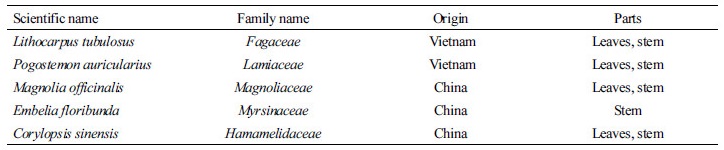 |
1)International Biological Material Research Center (Korea) kindly donated tropical plant extracts. |
해외생물소재센터의 자료에 의하면 베트남에서 자생하는 Lithocarpus tubulosus, Pogostemon auricularius과 중국 남부에 자생하는 Magnolia officinalis, Corylopsis sinensis는 잎과 줄기를 회수한 후 메탄올로 추출하였으며, Embelia floribunda추출물은 줄기를 회수하여 에탄올로 추출하여 제작한 것으로 나타났다.
선발된 식물추출물 5종의 유해 미생물 생육 억제활성을 비교하기 위하여 B. cereus, St. aureus, L. monocytogenes, S. Typhimurium 균주에 대한 생육억제 활성을 조사하였다(Fig. 1). Pogostemon auricularius 추출물은 L. monocytogenes와 S. Typhimurium 균주의 생육을 억제하지 못하였으며, Embelia floribunda 추출물은 B. cereus 균주의 생육만 억제하는 것으로 나타났다(Fig. 1).
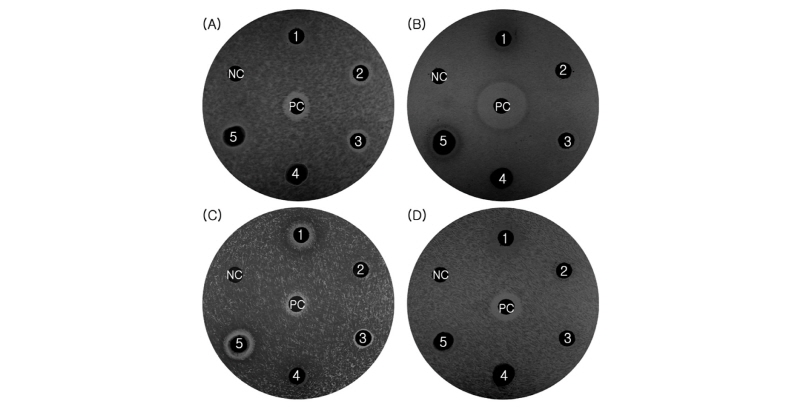
Fig. 1.
Antimicrobial activity of plant extracts against B. cereus (A), L. monocytogenes (B), S. aureus (C), and S. Typhimurium (D). 1; Lithocarpus tubulosus, 2; Pogostemon auricularius, 3; Magnolia officinalis, 4; Embelia floribunda, 5; Corylopsis sinensis, NC; negative control, PC; ampicillin (10 µg/mL).
Lithocarpus tubulosus 추출물과 Corylopsis sinensis 추출물은 4점의 유해균에 대해 모두 생육억제 활성을 나타냈으며, Corylopsis sinensis 추출물의 경우 St. aureus 균주에 대한 억제 활성이 양성대조구로 사용한 ampicillin 보다 약 20% 높은 생육 억제효과를 나타냈다(Table 2). Embelia floribunda추출물은 4점의 유해균에 대하여 육안으로 관찰이 가능한 수준의 생육억제 활성이 나타나지 않아 제외하였다.
Table 2. Antimicrobial activity of plant extracts on B. cereus, L. monocytogenes, S. aureus, and S. Typhimurium 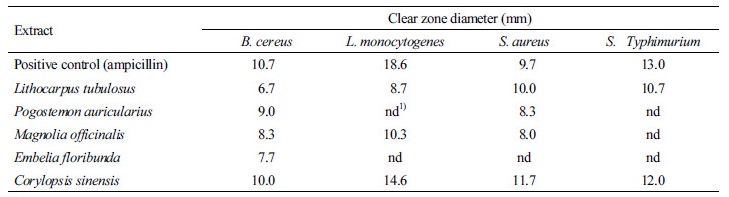 |
1)nd: not detected. |
최소 억제농도 결정
식물추출물의 최소 억제농도를 조사하기 위하여 적정농도로 희석한 식물추출물을 유해균이 도말된 배지에 점적하였다(Table 3). B. cereus 균주는 5 mg/mL의 Pogostemon auricularius와 Magnolia officinalis추출물에서 생육이 억제되었으며, 10 mg/mL의 Lithocarpus tubulosus 추출물과 20 mg/mL의 Corylopsis sinensis 추출물에서 생육억제가 나타났다. Pogostemon auricularius와 Magnolia officinalis추출물은 기존에 보고된 상산나무 잎(24.61 mg/mL) (Choe et al., 2014)과 황칠나무 잎(10 mg/mL) (Lee et al., 2015) 추출물보다 낮은 농도에서 B. cereus 균주의 생육을 억제하는 것으로 나타났다.
Table 3. Minimum inhibitory concentrations (MIC) of plant extracts against B. cereus, L. monocytogenes, S. aureus, and S. Typhimurium 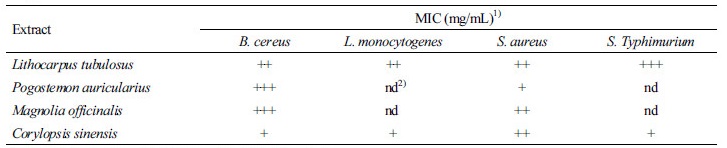 |
1)+: 20 mg/mL, ++: 10 mg/mL, +++: 5 mg/mL, ++++: 2.5 mg/mL. 2)nd: not detected. |
L. monocytogenes 균주는 10 mg/mL의 Lithocarpus tubulosus 추출물과 20 mg/mL의 Corylopsis sinensis 추출물에서 최소생육억제 효과가 나타났다. 40 mg/mL의 소나무 추출물(Lim et al., 2002)과 50 mg/mL의 백년초 추출물(Seo et al., 2012)에 의한 L. monocytogenes 균주의 생육억제가 보고되었으며, Lithocarpus tubulosus 추출물과 Corylopsis sinensis추출물은 소나무와 백년초 추출물과 비교하여 상대적으로 낮은 농도에서 균주의 생육을 억제하는 것으로 나타났다.
St. aureus 균주는 10 mg/mL의 Lithocarpus tubulosus, Magnolia officinalis, Corylopsis sinensis추출물과 20 mg/mL의 Pogostemon auricularius추출물에서 최소 생육억제가 확인되었다. 인진호 추출물(Lee and Seo, 2003)의 경우 20 mg/mL, 상산나무잎 추출물(Choe and Kang, 2014)의 경우 49.22 mg/mL의 농도에서 St. aureus 균주에 대한 생육 억제가 보고되었으며, Lithocarpus tubulosus, Magnolia officinalis, Corylopsis sinensis추출물은 인진호, 상산나무 추출물보다 낮은 농도에서 St. aureus 균주의 생육을 억제하는 것으로 나타났다.
S. Typhimurium 균주는 5 mg/mL의 Lithocarpus tubulosus추출물과 20 mg/mL의 Corylopsis sinensis추출물에서 최소생육저해가 나타났다. Lithocarpus tubulosus와 Corylopsis sinensis추출물은 인진호 추출물(80 mg/mL) (Lee and Seo, 2003)보다 낮은 농도에서 생육저해를 나타냈으나, 복분자 추출물(4 mg/mL), 참나무과 나뭇잎 추출물(0.25 mg/mL) 보다는 다소 높은 농도에서 최소 억제농도가 나타났다. 본 연구에서 사용한 4점의 유해균에 대하여 Lithocarpus tubulosus추출물이 상대적으로 낮은 농도에서 생육억제가 나타나는 것을 확인하였다.
Acknowledgements
This research was financially supported by the Ministry of Trade, Industry and Energy (MOTIE) and Korea Institute for Advancement of Technology (KIAT) through the Research and Development for Regional Industry (R0005969) and was funded by the Ministry of Science and ICT, Republic of Korea government (NRF-2016K1 A1A8A01939075).
References
Agrios, G. N. (1988). Plant pathology. (1st ed). pp. 325-450 Academic Press. Inc., New York, USA.
An, B. J. (1999) The material of natural anti-bacterial agents for the food preservative. Food Indust Nutr 4(2):5-16.
Cho, S. H., Kim, Y. R. (2001) Antimicrobial effects of Scutellariae radix extract against Listeria monocytogenes. J Korean Soc Food Sci Nutr 30(5):959-963.
Choe, S. B., Kang, S. T. (2014) Investigation of antimicrobial activity and stability of Orixa japonica Thunb. leaf extract. Korean J Food Sci Technol 46(1):39-43.
Choi, I., Cho, J. Y., Lim, S. C. (2006) Antimicrobial activity of medicinal herbs against Staphylococcus aureus. Korean J Plant Res 19(4):491-496.
Choi, Y. H., Bae, H. A., Eo, E. K., Jung, G. Y. (2007) Death due to sepsis in emphysematous cholecystitis. Korean J Surg Soc 72(3):250-253.
Farber, J. M., Peterkin, P. I. (1991) Listeria monocytogenes, a food-borne pathogen. Microbial. Review. 55:476-511.
Han, H. J., Kim, D. G., Han, D. W., Cho, S. Y. (2014) Effect of natural antimicrobial extracts on shelf-life extension and quality improvement of the flounder Sikhe. Korean J Food Sci Technol 46(6):689-693.
Han, Y. S., Lee, J. B., Kwon, J. Y., Kim, M. J. (1969) Clinical observation on Salmonella Typhimurium food poisoning. Korean J Medici 12(2):101-106.
Kim, D. H., Lee, J. J., Lim, J. J., Kim, D. G., LKim, G. S., Lee, H. J., Min, W. G., Rhee, M. H., Chang, H. H., Kim, S. H. (2010) Antibacterial and intracellular clearance effect of Saururus chinensis baill water extract aginst Salmonella typhimurium. J Agricul Life Sci 44(6):111-119.
Kim, K. M., Hwang, K. T., You, S. G., Lee, U. S., Jung, K. H., Moon, S. K., Choi, W. S. (2009) Antimicrobial effect of edible pullulan film containing natural antimicrobial material on cariogenic bacteria. J Korean Soc Food Sci Nutr 38(10):1466-1470.
Kim, S. H., Yoo, R. N., Lee, J. A. (2015) The impact of the antibiotic burden on the selection of its resistance among gram negative bacteria isolated from children. Pediatr Infect Vaccine 22(3):178-185.
Kim, T. S., Kim, M. J., Kang, Y. M., Oh, G., Choi, S. Y., Oh, M. S., Yang, Y. S., Seo, J. M., Ryu, M. G., Kim, E. S., Ha, D. R., Cho, B. S. (2014) Molecular characterization and toxin profile of Bacillus cereus strains isolated from ready-to-eat foods. Korean J Food Sci Technol 46(3):334-340.
Kong, Y. J., Hong, G. P., Kwon, H. J., Hong, J. K., Park, B. K., Oh, D. H. (2001) Antimicrobial activity of Quercus spp. leaf ethanol extract against foodborne disease microorganism. J Korean Soc Food Sci Nutr 30(3):415-420.
Kwon, Y. K., Choi, J. D., Kim, M. S., Lim, H. S., Chang, S. Y., Kim, M. S., Moon, G. I., Hong, K. H., Hong, J. H., Kim, M. C. (2007) Management on standards and specifications for food additives. Food Sci Indust 40(4):55-60.
Lee, C. K., Seo, J. J. (2003) Antimicrobial activity of the aerial part of Artemisia capillaris extracts on the food-borne pathogens. J Korean Soc Food Sci Nutr 32(8):1227-1232.
Lee, H. Y., Lee, J. S., Kim, D. H., Lee, S. G., Lee, Y. J., Kim, M. D. (2012) Extract on methods influence inhibitory effects of Agrimonia pilosa on the growths on meat-poisoning lactic acid bacteria. Food Eng Prog 16(1):180-184.
Lee, S. G., Lee, S. H., Park, E. J. (2015) Antimicrobial and antioxidant activities of ethanol leaf extract of Dendropanax morbiferus Lev. Korean J Food Cook Sci 31(5):515-523.
Lim, Y. S., Bae, M. J., Lee, S. H. (2002) Antimicrobial effects of Pinus densiflora Sieb. et Zucc. ethanol extract on Listeria monocytogenes. J Korean Soc Food Sci Nutr 31(2):333-337.
Mitscher, L. A., Park, Y. H., Clark, D. (1980) Antimicrobial agents from higher palnts, antimicrobial isoflavonoids and related substances from Glycyrrhiza glabra L. var Typica. J Nat Prod 43(2):259-269.
Muraina, I. A., Picard, J., Eloff, J. N. (2009) Development of a reproducible method to determine minimum inhibitory concentration (MIC) of plant extract against a slow-growing mycoplasmas organism. Phytomedicine. 16(2-3): 262-264.
Park, C. S. (1998) Antibacterial activity of edible plant against pathogenic bacteria. Korean J Postharvest Sci Technol 5(1):89-96.
Rheem, I. S. (2016) Building the data mart on antibiotic usage for infection control. Korean J Clin Lab Sci 48(4): 348-354.
Ro, S. J., Han, Y. W. (1978) Microbial food-borne diseases. Korean J Appl Microbiol Bioeng 6(3):135-140.
Ryu, S. H., Lee, Y. K. (2007) Antibiotic susceptibility and minimal inhibitory concentration of Staphylococcus aureus isolated from patients with food poisoning in seoul. Korean J Oral Maxillofac Pathol 31(3):165-174.
Sallami, L., Marcotte, M., Naim, F., Ouattara, B., Leblanc, C., Saucier, L. (2006) Heat inactivation of Listeria monocytogenes and Salmonella enterica serovar Typhi in a typical bologna matrix during an industrial cooking- cooling cycle. J Food Prot 69(12):3025-3030.
Seo, Y. H., Han, C. H., Lee, J. M., Choi, S. M., Moon, K. D. (2012) Effects of Opuntia ficus indica extracts on inactivation of Escherichia coli O157:H7 and Listeria monocytogenes on fresh-cut apples. J Korean Soc Food Sci Nutr 41(7):1009-1013.
Shin, Y. H., Yoo, J. S., Kim, K. S. (1998) In vitro antimicrobial susceptibility of Salmonella typhi, Salmonella typhimurium and Salmonella enteritidis isolated in Korea, 1997. J Korean Soc Chemother 16(3):205-214.
Vallejo, S G., Menendez de la, F. I., Fernandez, G P. (1999) Multiple comparison procedures for simple one-way ANOVA with dependent data. Span J Psychol 2(1):55-63.
Yang, H. C., Hong, S. S., Kim, K. H., Choi, S. H., Chung, H. J. (1999) Distribution of Vibrio vulnificus in chonnam coastal area. Korean J Appl Microbiol Biotechnol 27(1):70-74.