


Introduction
Materials and methods
Soils and characteristics of wildfire-damaged areas
Biochar and soil amendments
Germination and cultivation tests
Results and reflections
Soil properties in wildfire-damaged areas
Changes in biochar properties following modification with deep sea water
Effect of biochar application on the germination rate of vegetation
Effects of biochar application on cabbage growth and cultivation soil
Conclusion
Introduction
Globally, forest policies are being introduced to improve forest carbon absorption as a means of achieving carbon neutrality. In South Korea, the Korea Forest Service has announced the “2050 Carbon Neutral Forest Sector Promotion Strategy” to emphasize the importance of forest management and protection. However, the environmental health of forests is deteriorating owing to forest disasters, especially the damage caused by the steadily increasing number of wildfires (Djalante, 2019). Wildfires are human-caused social disasters that have become increasingly large and frequent since the 2000s owing to the climate crisis. Recent studies have reported that wildfires have increased globally, with an average annual loss of 423 million ha (approximately 42 times the size of South Korea) from 2002 to 2016. This phenomenon is attributed to anthropogenic global warming, and more forest fires are expected to occur in the future (Diffenbaugh et al., 2021; Sullivan et al., 2022; Zhuang et al., 2021).
South Korea is characterized by the formation of strong westerly winds in spring owing to the presence of low pressure in the south and north. In particular, the east coast of Korea is at high risk of large wildfires owing to intermittent strong winds caused by the Foehn phenomenon (Cha et al., 2022). Although the causes of wildfires in other countries are naturally occurring, such as lightning strikes and friction, more than 90% of wildfires in South Korea are caused by accidental fire resulting from human carelessness. According to wildfire statistics from the National Institute of Forest Science (NIFoS), 34.2, 16.0, and 14.0% of wildfires are caused by human accidental fire in forests, burning rice paddies and field margins, and burning garbage, respectively (NIFoS, 2022). Thus, burning adjacent to forests is a significant contributor to the aforementioned problem. Furthermore, Bae and Chae (2019) analyzed the types of wildfires in South Korea from 1990 to 2018 and reported that 15-30% of wildfires were caused by the burning of agricultural byproducts, including agricultural land (12.6%). Hence, essential measures must be taken to dispose agricultural byproducts near forests.
Wildfire is a critical forest disturbance that affects a wide range of ecosystem components, including biotic and abiotic factors in forest ecosystems. Numerous studies have been conducted on the relationship between ecosystems and soil characteristics in wildfire-damaged areas. Compared with pre-fire conditions, wildfire-damaged soils undergo a variety of physical, chemical, and biological changes, including decreased clay content and weakened stability, higher pH and nutrient levels, and fewer soil microorganisms (Agbeshie et al., 2022; Alcañiz et al., 2018; Certini, 2005; Liu et al., 2023; Thom and Seidl, 2015).
Various techniques have been developed and applied to restore forest ecosystems. Physically, mulching materials are introduced or trees with good rooting capacity are planted to prevent erosion caused by lost organic matter in the soil (Ahn et al., 2014; Garrido-Ruiz et al., 2022; Ortega et al., 2023). As chemical methods, soil amendments, such as fly ash, polyacrylamide (PAM), surfactants, xanthan gum, and biochar, have been applied to prevent soil erosion and improve soil (Akin et al., 2022; Ogunmokun et al., 2020). Additionally, biological methods are being developed to improve soil structure and quality by utilizing biocrust restoration using cyanobacteria, plant growth-promoting rhizosphere microorganisms, and dendritic mycorrhizal fungi (Reeve et al., 2023).
According to the Korea Rural Economic Institute (Issue Plus 2023, No. 4), agricultural byproducts include rice straws, soybean stalks, sesame stalks, and fruit-tree pruned branches, which amount to 9.34 million tons per year. Some of the low-moisture fruit-tree pruned branches are shredded and returned to the soil but most are incinerated or left unattended. Vegetable byproducts with high moisture, such as cucumbers, tomatoes, and peppers, are mostly dumped in agricultural fields or incinerated after drying. However, although green manure and composting can be utilized to convert agricultural byproducts into resources, green manure is limited in use owing to contamination by residual pathogens. Composting has fewer side effects than green manure but requires a long production time, and immature compost causes crop damage owing to gas generation. Recently, the use of biochar has increased to combat climate change. Biochar can be used as a long-term soil management method through the utilization of agricultural byproducts.
Biochar is a carbon-rich material produced by the pyrolysis of biomass under certain temperatures in the absence of oxygen and can be utilized for soil remediation and pollutant removal (El-Naggar et al., 2019; Feng et al., 2023; Lehmann and Joseph, 2009; Valizadeh et al., 2021; Wang and Wang, 2019). Biochar can be broadly categorized into plant and animal sources. Plant sources are favorable for the adsorption of non-polar substances owing to their low polarity, whereas animal sources have greater potential as adsorbents owing to the functional groups on the surface. However, considering the ease of securing raw materials and cost of energy consumed in the pyrolysis process, using plant-derived biochar is more economical than using animal-derived biochar. Thus, research topics and actual products in the market mostly represent biochar derived from plant materials. In the production of biochar, physicochemical properties are determined by the raw materials and pyrolysis conditions, such as residence time, temperature, and heating rate. Consequently, agricultural and forestry byproducts with favorable conditions for raw material acquisition and pyrolysis are mainly utilized (El-Naggar et al., 2019; Jang et al., 2023; Zhao et al., 2022).
Developers of plant-derived biochar are attempting to improve its performance through modification after the pyrolysis process to improve soil and increase the adsorption capacity (Feng et al., 2023; Jang et al., 2023; Lee and Shin, 2021; Panahi et al., 2020). Physical, such as ball milling and microwaves, and chemical methods, wherein acids or bases are treated, constitute the two main categories of biochar modification methods. Between them, the most commonly utilized are chemical modification methods (Jang et al., 2023; Lee and Shin, 2021). However, chemical methods have several issues regarding commercialization, such as secondary treatment of used chemical products and changes in acidity.
The purpose of this study was to evaluate the feasibility of using eco-friendly biochar modified by deep sea water as a means to restore wildfire-damaged soil and examine its efficiency in vegetation restoration.
Materials and methods
Soils and characteristics of wildfire-damaged areas
The topsoil (0-20 cm) was collected from a site damaged by a wildfire that occurred in March 2022 in Gangneung-si, Gangwon Special Self-Governing Province (N 37° 34' 38.15", E 129° 01' 36.13"), and from an undamaged site (N 37° 34' 31.03", E 129° 01' 20.09") adjacent to the damaged site for the comparison of characteristics. Field soil samples were collected as core samples for bulk density analysis and analytical samples. The samples for microbiological analysis were refrigerated (5°C) immediately after collection. Samples for physicochemical characterization were transported to the laboratory, where they were dried under darkness after removing gravel and other debris; the soil that passed through the 2.0-mm standard sieve was used for analysis. The prepared soils were analyzed for soil texture, acidity, electrical conductivity, organic matters, available phosphoric acid, and cation exchange capacity according to the National Institute of Agricultural Sciences’ Soil and Vegetation Analysis Method (2000). The microbial population was analyzed by inoculating the soil suspension mixed with distilled water into the culture medium (Petrifilm AC, 3M) and incubating it at 35°C for 2 days, according to a previous study by Mohammad et al. (2022).
Biochar and soil amendments
The biochar used in the test originated from rice husks, which is considered to have the best yield, hydrophilicity, and other properties for biochar conversion among the four types of raw materials used in a previous study (Jang et al., 2023). For biochar conversion, the rice husks were soaked in water for 6 h (to remove impurities), washed, dried (60°C, 24 h) in a multipurpose dryer (DY-420H, Lassele, Korea), and sieved to a homogeneous size (1.7-2.0 mm). The prepared rice husks were placed in a pyrolyzer, and rice husk biochar (RBC) was prepared by pyrolysis under conditions of maximum oxygen limitation (heating rate: 10°C/min, pyrolysis temperature: 500°C, and pyrolysis time: 1 h).
The biochar was crushed for size homogenization and filtered down to 1.0 mm or less. The biochar was modified using deep sea water collected from Jukwang-myeon, Goseong-gun, Gangwon-do, South Korea. Deep sea water is mostly used directly as raw water after collection, and the concentrated water generated in the process of food production is used for salt production or discharged back into the ocean. Thus, technology is required to utilize it as a means of recycling resources. The source of deep sea water used in the test had the following typical properties: alkalinity of pH 7.7, electrical conductivity (EC) of 55.2 dS/m, total dissolved solids (TDS) of 33.1 g/L, and salinity of 3.66%. Furthermore, it contained large amounts of inorganic elements, such as Na at 11,920 mg/L, Mg at 1,483 mg/L, Ca at 478 mg/L, K at 437 mg/L, B at 3.8 mg/L, and NO3 at 1.05 mg/L. Moreover, the concentrated water had a pH of 7.6, which is not considerably different from that of raw water; however, it had an EC of 90.0 dS/m, TDS of 54.0 g/L, and salinity of 6.38%, and was enriched with inorganic elements, namely, 18,670, 2,483, 749, 680, 5.4, and 5.53 mg/L of Na, Mg, Ca, K, B, and NO3, respectively, which was expected to have a positive effect on modification. The biochar was modified in a constant-temperature shaking incubator (DHWIS05210, Daihan, Korea) under constant conditions (25°C, 150 rpm, 24 h) with a solid-liquid ratio of 1:2 after sealing the mouth of the container. After the completion of the reaction, the solid and liquid phases were separated by a filter, washed with distilled water, dried at 70°C for 2 days, and named the following: modified RBC using raw deep sea water (RBCR) and modified RBC using concentrated deep sea water (RBCC). Considering the properties of biochar before and after modification, the surface morphology and elemental composition (FE-SEM/EDS S-4800, Hitachi, Japan), functional groups (FT-IR Spectrum 3, Perkin Elmer, USA), surface area (BET ASAP 2010, Micromeritics, USA), and minerals (ICP/MS 2030, Shimazu, Japan) were analyzed according to Jang et al. (2023). Scanning electron microscopy (SEM) measurements for the surface morphology of biochar were conducted on fabricated specimens at 100-um magnification, and the surface composition was analyzed with an energy dispersive spectroscopy (EDS) detector capable of detecting specific X-rays. Fourier transform infrared spectroscopy (FT-IR) measurements for the analysis of surface functional groups were obtained in the wavelength range of 650-4000 cm-1. The specific surface area was measured by applying the Brunauer-Emmett-Teller adsorption equation to determine the adsorption and desorption cycle data of N2 at -196°C. Additionally, inorganic matter was quantified using inductively coupled plasma mass spectrometry (ICP/MS) with internal standard mix 5183-4681 (Agilent) to minimize inter-elemental interference, and the concentrations of macro- and microelements contained in biochar were determined.
Biochar is known to be efficient in promoting plant growth, soil improvement, and carbon sequestration in soil. It has been applied to the agricultural field but mostly in powder form, which has disadvantages, such as increased labor and loss, and cannot be applied in the field. Therefore, attempts are being made to produce granular biochar using organic and inorganic auxiliary materials to secure fertilization convenience and loss safety. Bowden-Green and Briens (2016) and Vincevica-Gaile et al. (2019) used organic and sapropel binders to mold biochar using a wet-drum granulation method to produce molds with sizes of 1 to 4 (strength of 0.15 to 0.5 MPa) and 3 to 8 mm, respectively. Furthermore, Kim and Kang (2021) and Park and Kim (2017) used alginate gel to produce beads to be used as adsorbents. However, the methods reported in previous studies have the disadvantages of poor adsorption performance, increased manufacturing cost, and long production time. The biochar and modified biochar used in this study were shaped into pellets (within 5.0 mm in diameter and 20.0 mm in length) using a device (SP-200, Kumkang ENG) introduced by many public institutions and used for byproduct molding. Subsequently, these biochar pellets were examined in the germination and cultivation tests after being sieved with a 3.5 mesh.
Germination and cultivation tests
Plant germination tests were conducted to evaluate the ecological toxicity of soils in wildfire-damaged areas and their restoration potential by biochar application. The plants used for germination tests were Portulaca grandiflora and Ligularia fischeri. The germination tests were conducted in a plant growth chamber where seeds were soaked in distilled water for 12 h, and 100 g of soil was saturated with distilled water to maintain a moisture content of 70% to avoid drought stress during the test period (Cárdenas-Aguiar et al., 2017; Kang et al., 2022; Khan et al., 2019). Treatments included untreated (control; Cont), treated (not treated, NT), RBC, RBCR, and RBCC, which were applied at a level of 20 kg/10 a. After germination, the plants were grown for 8 days. Subsequently, their growth was observed, and germination rate, root length, and herbage length were measured. Based on the measurements, the germination test results were calculated using Equation 1. The germination index (GI) values were evaluated as very high, moderate, non-toxic, and growth stimulators for < 50, 50-80, > 80, and >100%, respectively.
where %GI: germination index, %G: germination rate, Le: average root length (mm) in treatment, and Lc: average root length (mm) in the control.
To verify the results of the germination test, a plant growth test was conducted using Chinese cabbage (Brassica rapa var. glabra). A pot (L × W × H: 80 × 20 × 20 cm) was filled with 10 kg of wildfire-damaged soil, and two types of biochar (RBC and RBCR) were used for treatment at a level of 20 kg/10 a. As no clear domestic or global standard exists for biochar treatment level, the level recommended for a domestic agricultural field was set as the treatment level, and the efficiency of the treatment level was not considered. After treatment with biochar, the seedlings were planted after a 2-week aging process, and the growth was observed by irrigating twice per week after planting. The growth of Chinese cabbage was monitored by measuring the leaf length, leaf width, leaf number, and stem thickness, and the soil properties were periodically analyzed.
Results and reflections
Soil properties in wildfire-damaged areas
In the last 10 years (2011-2022), 710 wildfires have occurred in Gangwon Special Self-Governing Province, covering an area of approximately 5,537 ha, with Goseong, Gangneung, and Samcheok accounting for 32, 30, and 20%, respectively (Gangwon Special Self-Governing Province Forest Fire Prevention Center). In March 2022, a wildfire caused by arson occurred in Okgye-myeon, Gangneung-si, and damaged approximately 4,190 ha of forest in 4 days. Although follow-up measures, such as forest restoration, were being implemented at the time of the field survey, traces of damage, such as wildfire remnants, remained. The properties of the collected fire-damaged soils are presented in Table 1, which are considerably similar to the changes reported in previous studies. The physical properties of the soils before and after the wildfire did not change in terms of the soil texture, but differences were observed in bulk density, moisture content, and particle size distribution, which are consistent with the results of previous studies (Agbeshie et al., 2022; Alcañiz et al., 2018). The bulk density and sand content increased by 24 and 7%, respectively, whereas the clay and silt contents decreased by 12 and 4%, respectively. The moisture contents of the soil also differed between the damaged and undamaged areas, namely, 10.8 and 18.0%, respectively. Changes in soil chemical properties were also observed after the wildfire. The acidity of the soil increased from 6.12 to 6.54, EC increased from 362 to 410 uS/cm, free phosphoric acid increased from 22.8 to 35.6 mg/kg, and exchangeable cations and nitrogen compounds (NO3-N and NH4-N) increased. Conversely, the organic matter content and cation exchange capacity decreased by 59 (64.2 → 26.3 g/kg) and 20% (11.4 → 9.2 cmolc/kg), respectively. These results were consistent with those of previous studies (Agbeshie et al., 2022; Certini, 2005; Liu et al., 2023; Thom and Seidl, 2015). These studies attributed the aforementioned decrease to the loss of organic matter owing to combustion, increase in acidity owing to the increase in ash after burning organic matter, and release of soluble ions from organic matter. The abundance of soil microbial flora, a biological trait, decreased from 6.67 × 10⁶ to 2.80 × 10⁶ CFU after the wildfire, consistent with the results of previous studies. Considering microbial outcomes in wildfire-damaged areas, Agbeshie et al. (2022) reported that at temperatures above 150°C, fungi die and the microbial biomass carbon (MBC) of soil decreases. The dominance in the soil microbial community shifts from fungi to bacteria. Alcañiz et al. (2018) reported temperature thresholds of 100 and 110°C for fungi and bacteria, respectively, at different wildfire temperatures, and reported that their populations decreased. Certini (2005) reported that wildfires were less damaging to invertebrates but relatively more damaging to microorganisms. He also reported that after a wildfire, surface microorganisms in the 0-5-cm layer of soil were nearly killed, whereas the populations of those in the lower 5-10 cm layer decreased by more than 50%, requiring up to 12 years to recover to pre-fire levels.
Table 1.
Physicochemical and biological properties of fire-damaged (FD) and undamaged (ND) soils
Changes in biochar properties following modification with deep sea water
When rice husks were converted into biochar through pyrolysis, the yield was 31.1%, with an increase in carbon content and a decrease in oxygen, hydrogen, and sulfur contents (Jang et al., 2023). This represents a change in the relative content of components volatilized during pyrolysis, which has been reported in previous studies (Kang et al., 2022; Panahi et al., 2020). The hydrogen to carbon (H/C; carbonization) and oxygen to carbon (O/C; hydrophilization) levels of RBC were 0.05 and 0.70, respectively. Jang et al. (2023) reported that RBC contained more hydrophilic functional groups than biochar prepared from pepper stalks, potato stalks, and soybean stalks, indicating relatively more hydrophilic properties and thus higher utilization as an adsorbent (Lee et al., 2018).
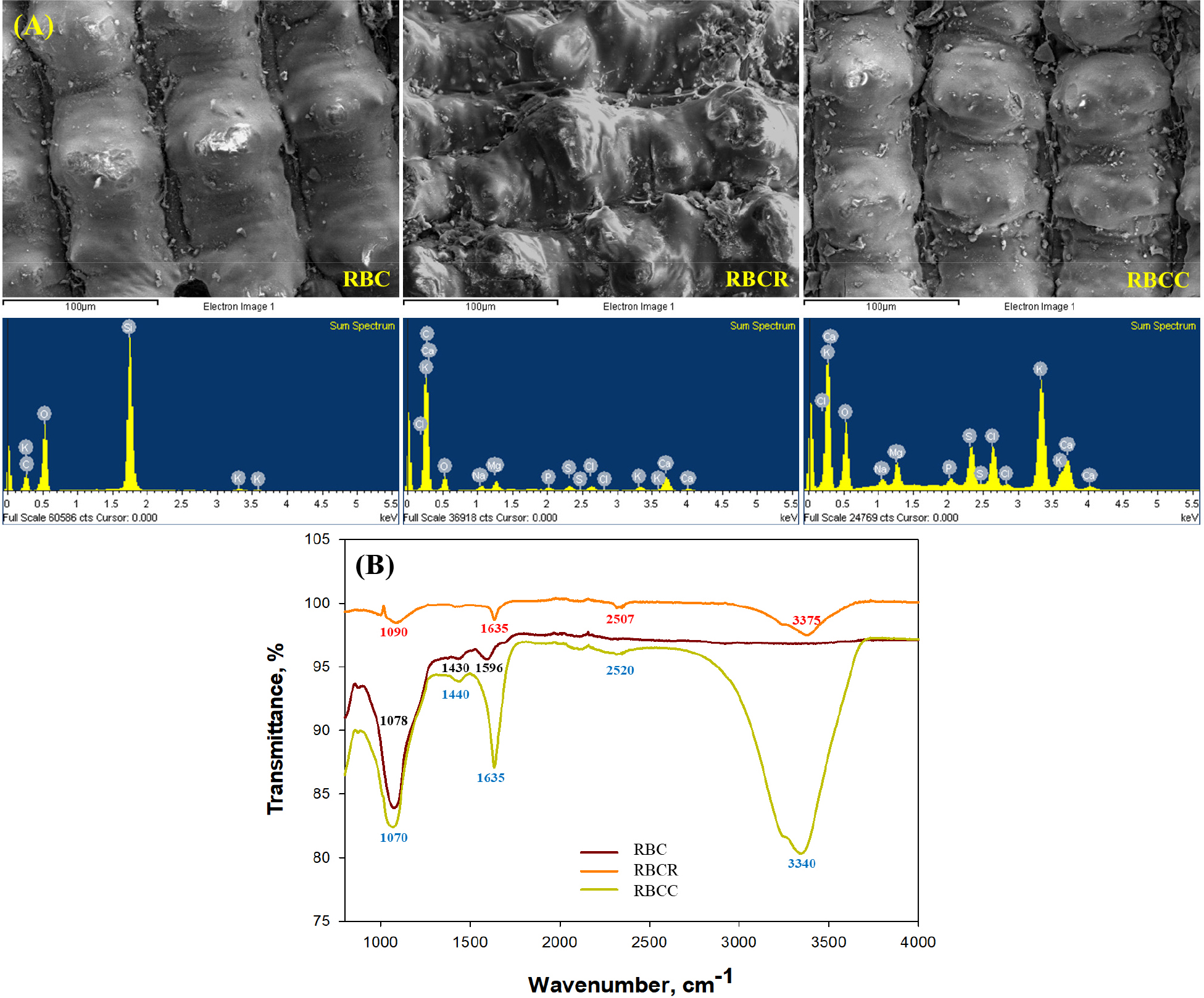
The surface of biochar modified by deep sea water exhibited certain changes, as shown in Fig. 1. The SEM/EDS analysis indicated that the surface cracking and roughness (adhesion formation) of RBC increased after modification compared with those before modification, and a greater change was observed owing to the higher concentration of minerals in RBCC than in RBCR. Furthermore, considering the increase in roughness, EDS analysis indicated that phytonutrient contents, such as Mg, S, Ca, and P present in deep sea water, increased on the surface after modification (Fig. 1-A). The specific surface area of biochar measured in this study increased from 61.2 m2/g before modification to 93.7 and 103.5 m2/g for RBCR and RBCC (after modification), respectively. These changes were likely influenced by the decrease in average pore size from 1.58 to 0.92 and 0.64 nm, respectively. Previous studies evaluating the modification properties of biochar have reported that the use of modifiers caused changes in the surface properties owing to pore blockage or surface breakage, such as the formation of surface attachments and surface corrosion (Lee and Shin, 2021; Li et al., 2018; Shin et al., 2015). Lee and Shin (2021) and Wang and Wang (2019) reported that the surface roughness decreased with the use of acidic modifiers and increased with the use of alkaline modifiers owing to the oxidation of the surface. The use of modifiers in deep sea water is known to exhibit similar properties to alkaline modifiers. The surface functional groups of biochar analyzed using FTIR and changes in properties are shown in Fig. 1-B. The surface of biochar before modification was characterized by Si-O-Si, C-C stretching, and C=O stretching at 1078, 1430, 1596 cm-1, respectively, consistent with the findings of Lee et al. (2018) and Lee and Shin (2021). Characteristic peaks, such as carbonyl, hydroxyl, and carboxyl groups, carbonyl stretching, O-D stretching, C-C stretching, and S-H stretching were identified at 1090, 1635, 2507, 1440, 2520, and 3300 cm-1, respectively, after modification with deep sea water (Choi et al., 2021; Jang et al., 2023; Kang et al., 2022; Lee and Shin, 2021; Lee et al., 2018). Jang et al. (2023) reported that the surface area of biochar modified by deep sea water increased by 35 and 41% from 61.2 m2/g before modification to 93.7 and 103.5 m2/g after modification, respectively, owing to changes in surface properties. They also reported that the pore volume and diameter of biochar before modification were 0.15 cm3/g and 1.58 nm but improved to 0.31-0.46 cm3/g and 0.92-0.64 nm after modification.
Soils in wildfire-damaged areas are characterized by organic matter loss and nutrient surplus immediately after the event, but nutrient dissolution and runoff are accelerated by the low organic matter content of soil. Therefore, a nutrient source that can preserve nutrients and improve soil is required for the restoration of forest vegetation. In this study, we aimed to utilize biochar to fix nutrients and moisture in the soil and use it as a source of nutrients for plant growth. As indicated in Jang et al. (2023), biochar modified by deep sea water showed an improvement in phosphate adsorption capacity and can be used to prevent the dissolution and leakage of nutrients in soil. To evaluate its utilization as a means of supplying nutrients, the mineral content of biochar before and after modification was analyzed, and the results are summarized in Table 2. Compared with those before the modification, the contents of macro- (Ca, K, Mg, etc.) and microelements (Mo, Mn, B, etc.) that can be utilized as plant nutrients increased with the utilization of deep sea water; this change was more pronounced when using concentrated water. These results are believed to be ascribed to nutrients (PO4, NO3, NH3, etc.) and minerals (Ca, Mg, K, etc.), which are abundant in deep sea water (Jang et al., 2023; Ju, 2016; Moon et al., 2004). Furthermore, the content of plant nutrients in biochar after modification satisfied the “plant use” standard among the four types of compound fertilizers in the fertilizer process standards issued by the Rural Development Administration. Thus, it can be utilized for soil management in wildfire-damaged areas.
Table 2.
Variation of inorganic nutrients in biochar modified by deep sea water
| Parameters | RBC | RBCR | RBCC |
| ----------------------------------------- % ----------------------------------------- | |||
| Ca | 0.215 ± 0.001 | 0.238 ± 0.001 | 0.266 ± 0.003 |
| K | 0.381 ± 0.001 | 0.641 ± 0.002 | 0.738 ± 0.006 |
| Mg | 0.034 ± 0.001 | 0.083 ± 0.002 | 0.096 ± 0.002 |
| Na | ND1) | 0.162 ± 0.001 | 0.190 ± 0.001 |
| P | 0.071 ± 0.001 | 0.090 ± 0.001 | 0.101 ± 0.002 |
| B | ND | 0.005 ± 0.001 | 0.005 ± 0.002 |
| Fe | 0.058 ± 0.002 | 0.084 ± 0.002 | 0.075 ± 0.001 |
| Mn | 0.021 ± 0.001 | 0.053 ± 0.002 | 0.058 ± 0.001 |
| Si | 0.001 ± 0.001 | 0.028 ± 0.002 | 0.027 ± 0.002 |
| Mo | ND | TR2) | TR |
| Cu | ND | 0.001 ± 0.001 | 0.001 ± 0.001 |
| Zn | 0.002 ± 0.001 | 0.009 ± 0.001 | 0.007 ± 0.001 |
Effect of biochar application on the germination rate of vegetation
The results of the germination test to evaluate the improvement in germination after applying biochar to wildfire-damaged soil environments are shown in Fig. 2 and presented in Table 3. We observed that the growth and germination rate of Portulaca grandiflora and Ligularia fischeri improved owing to soil improvement through biochar treatment. The growth parameters (plant length, root length, stem thickness, and dry weight) of Portulaca grandiflora and Ligularia fischeri were promoted above the not-damaged level in the three biochar-treated plots. The ranking of plant length for Portulaca grandiflora was Cont (74.1 mm) < RBC (81.9 mm) < RBCC (110.0 mm) < RBCR (94. 2 mm) with respect to NT (67.97 mm). Furthermore, the ranking of plant length for Ligularia fischeri was RBCC (33.1 mm) < NT (34.5 mm) < Cont (43.9 mm) < RBC (55.1 mm) < RBCR (60.2 mm). The ranking of germination rate was NT (51.1%) < RBC (64.4%) < RBCC (75.6%) < Cont (77.8%) < RBCR (93.3%) for Portulaca grandiflora, and RBCC (63.3%) < NT (66.7%) < RBC (83.3%) < Cont (86.7%) < RBCR (90.0%) for Ligularia fischeri. We concluded that biochar treatment positively influence vegetation restoration in wildfire-damaged areas. In particular, RBCR treatment had a good improvement effect on both plants. RBCC treatment had positive negative effects on germination and growth in Portulaca grandifloraLigularia fischeri, respectively. These effects are believed to be attributed to the effect of modification with concentrated water on high-mobility salts, whereas Portulaca grandiflora is a plant that is well adapted to hot and dry climates and was less damaged owing to its tolerance to high salt concentrations. Moreover, Ligularia fischeri is sensitive to environmental stress, and its growth was adversely affected under high salt concentrations. Considering the GI, most treatments were non-toxic for both plants. However, the GIs of RBCR and RBCC treatments were higher, at 115.7 and 101.1%, respectively, and those of RBC and RBCR were 124.8 and 141.3%, respectively. In general, RBCR could be utilized as a growth stimulator for both plants. Depending on the plant, RBC (Ligularia fischeri) and RBCC (Portulaca grandiflora) were also considered excellent growth stimulators. The biochar produced from the above results can be used to improve barren soil after the occurrence of wildfires (Kang et al., 2022; Zucconi, 1981).
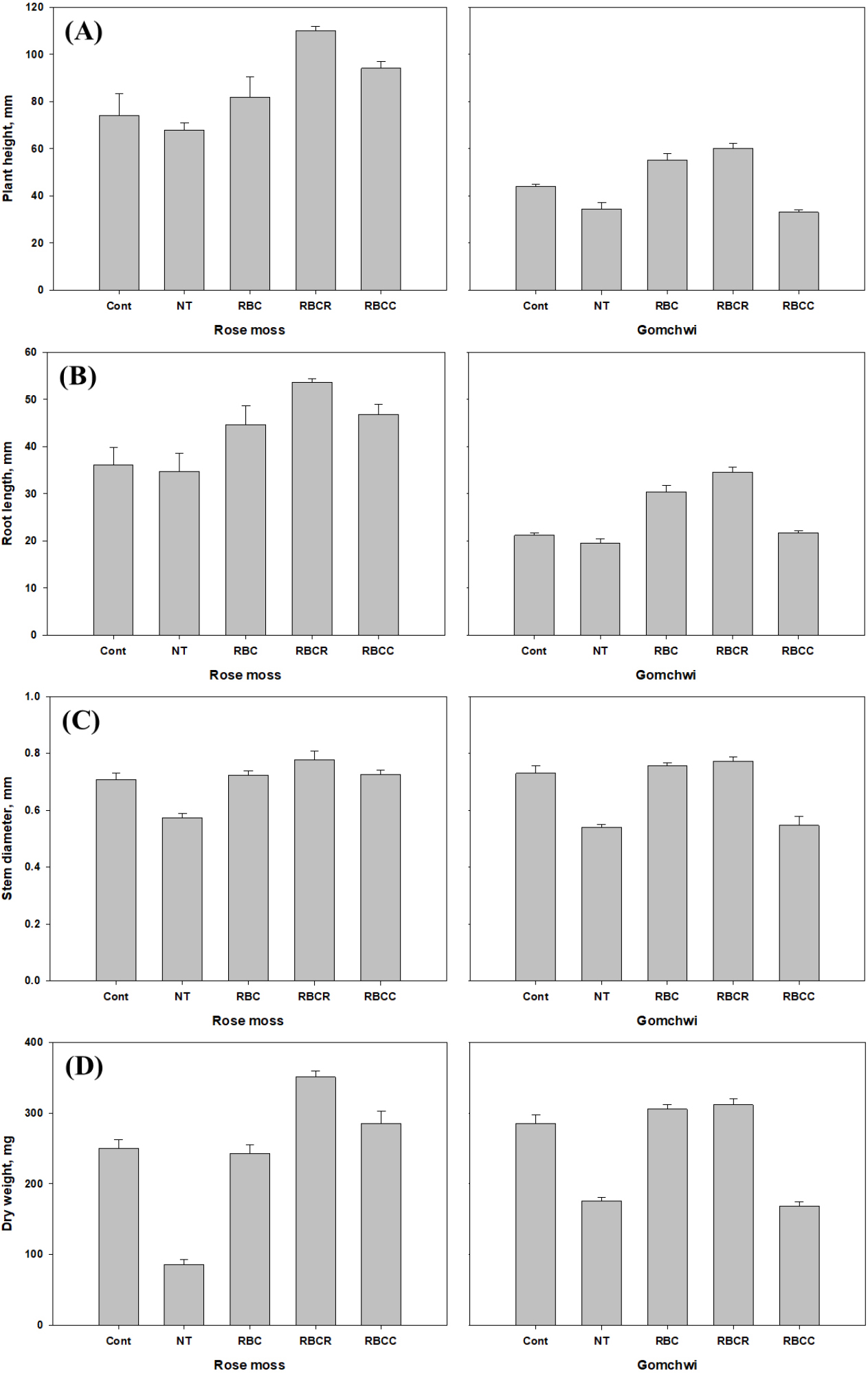
Table 3.
Germination test results of treated rice husk biochar in fire-damaged soils
Effects of biochar application on cabbage growth and cultivation soil
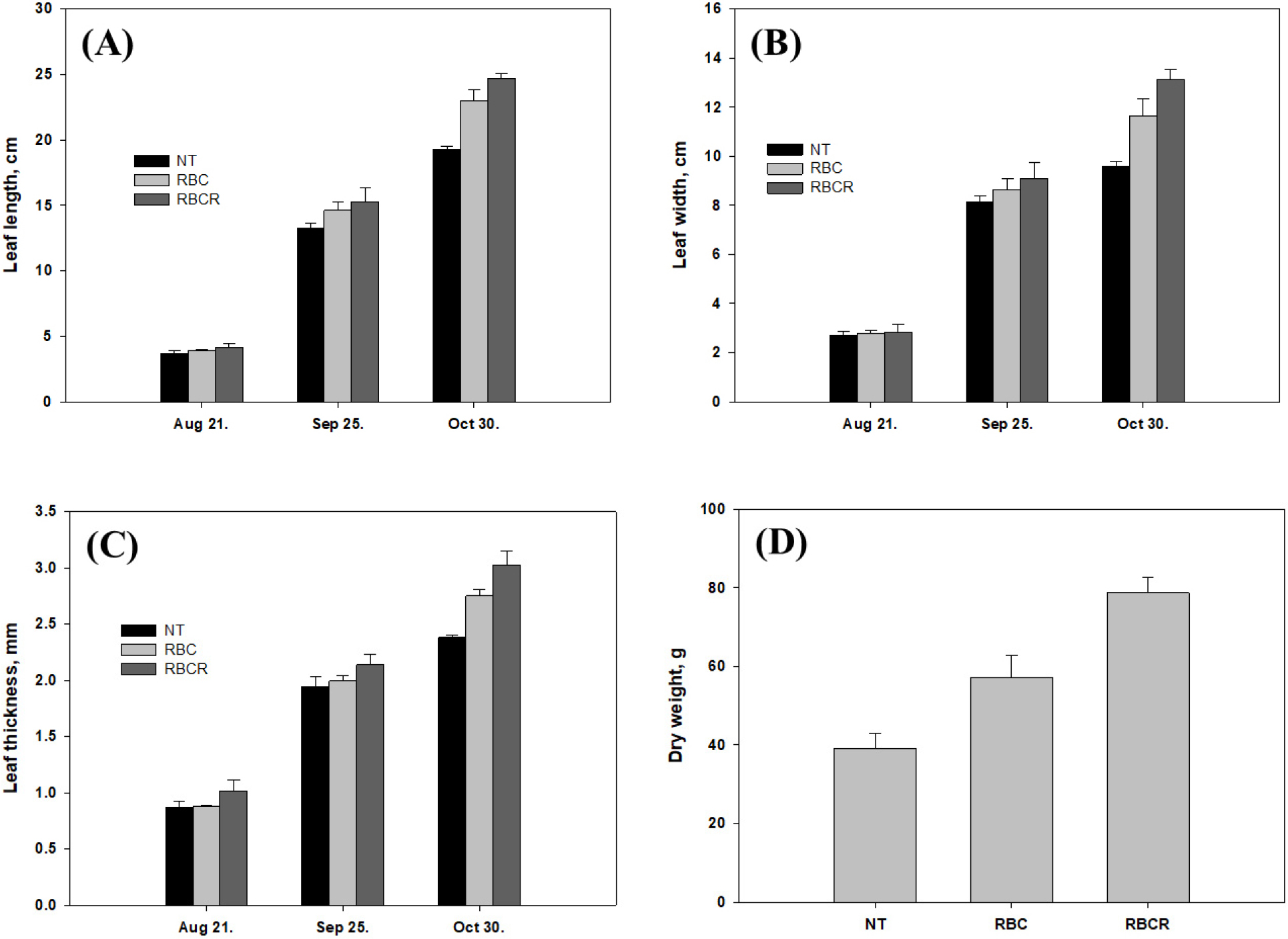
The effects of RBC and RBCR treatments on the growth of Chinese cabbage were examined in a pot test by growing it for approximately 70 days outdoors at the Goseong Deep Sea Water Industry Foundation; the growth of Chinese cabbage in the treatment plots is shown in Fig. 3. The overall growth was found to be higher in the RBC- and RBCR-injected treatments compared with that in NT, and the RBCR-injected treatment showed higher growth compared with RBC. At the time of final harvest, the growth indicators of cabbage, namely, the leaf length, leaf width, leaf thickness, and dry weight increased by approximately 16, 18, 13, and 32%, respectively, in the RBC treatment compared with those in NT, whereas RBCR treatment increased the above growth indicators by 22, 27, 21, and 50%, respectively. The growth enhancement in Chinese cabbage through biochar treatment is attributed to its high cation exchange capacity, the efficiency of supplying nutrients to the crop owing to surface functional groups, and improved utilization of nutrients in the soil (Kang et al., 2021; Yadav et al., 2023). Kang et al. (2022) and Werner et al. (2018) report that the application of biochar improved chemical properties by increasing the contents of phosphoric acid, potassium, and other compounds in the soil. Das et al. (2020) reported that the soil supply of volatile organic matter content generated from pyrolysis improved the growth owing to the increase in easily degradable organic matter. Moreover, the surface properties of biochar were improved and plant nutrients were supplied by modification with deep sea water (Jang et al., 2023; Ju, 2016).
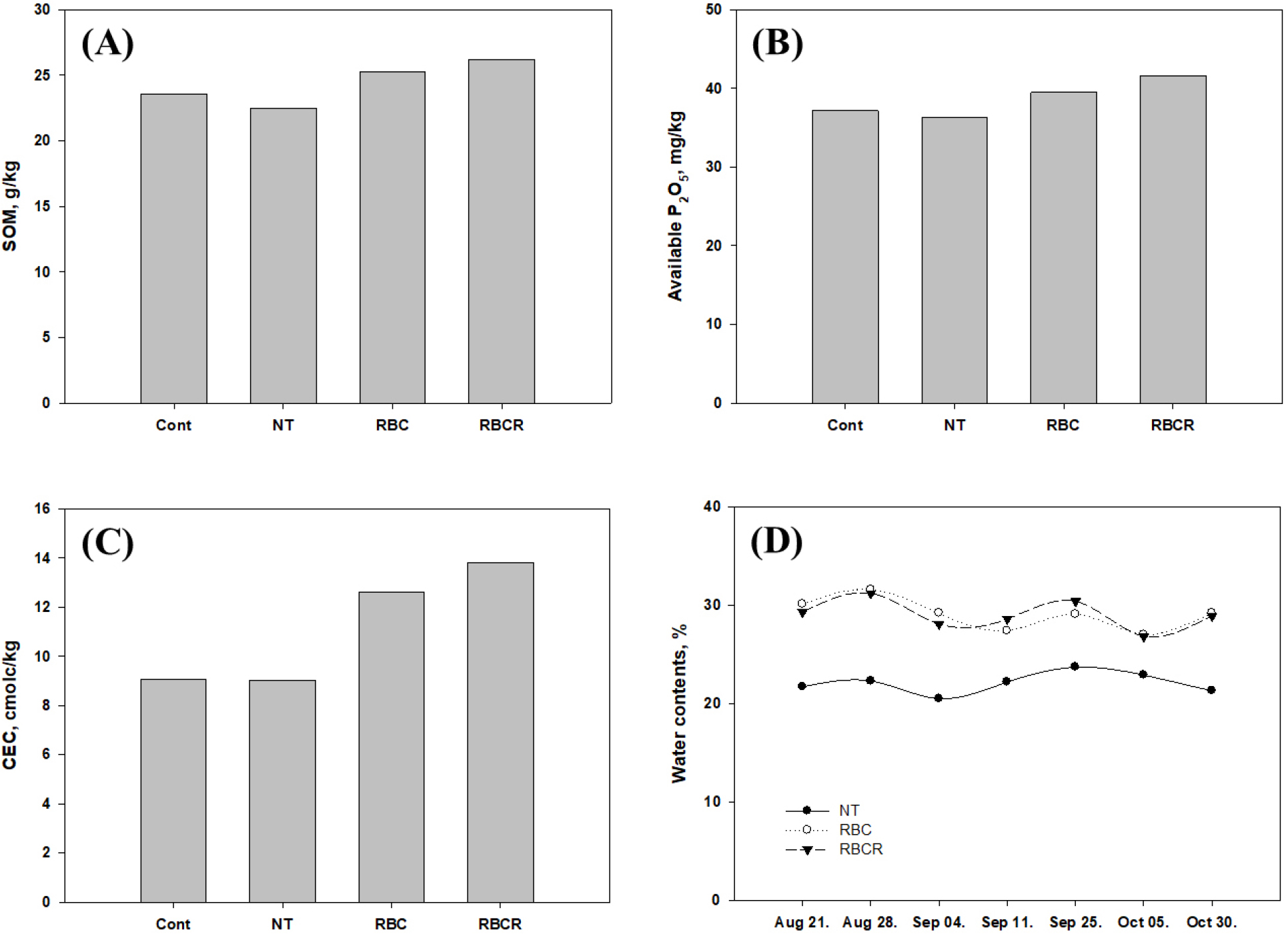
The physicochemical properties of the soil used for cabbage cultivation were investigated, as shown in Fig. 4. The results showed different characteristics depending on the type of biochar treatment. The soil pH and EC changed from 7.02 and 482 uS/cm before cultivation to 7.18, 7.16, and 7.06, and 359, 624, and 567 uS/cm in NT, RBC, and RBCR after harvest (data not shown), respectively. The soil organic matter content changed slightly, from 23.6 g/kg before cultivation to 22.5, 25.3, and 26.2 g/kg in NT, RBC, and RBCR, respectively (Fig. 4-A). Ghani et al. (2024) concluded that biochar treatment enriched microbial communities, such as Actinobacteriota and Acidobacteriota, in soil, as evidenced by the enzymatic activity and enrichment of microbial communities in the soil. This change is likely attributed to the increase in organic matter owing to the conversion of inorganic carbon by microbial proliferation. Similar to organic matter, the free phosphoric acid and cation exchange capacity of soil also increased with biochar treatment (Fig. 4-B, C). No significant change was observed in the values of free phosphoric acid for NT (36.3 mg/kg) compared with the pre-treatment level (37.2 mg/kg); however, those for RBC and RBCR increased by 8.1 and 12.7% to 39.5 and 41.6 mg/kg, respectively. Moreover, the cation exchange capacity values were not significantly different between the pre-treatment and untreated groups, at 9.05 and 9.02 cmolc/kg, respectively; however, those for RBC and RBCR improved by 28.4 and 34.6%, respectively. These results were attributed to the increase in nutrient supply and nutrient utilization in soil following the application of biochar, as reported in previous studies (Kang et al., 2021, 2022; Werner et al., 2018; Yadav et al., 2023). Fig. 4-D shows the changes in soil moisture content. The average moisture content was 22% in NT during the growing period, whereas that in the RBC and RBCR treatments was 29%. Kang et al. (2022) also reported that the application of biochar pellets to soil improved water retention and holding capacities depending on the treatment level. This is consistent with the findings of Abu-Hamdeh et al. (2019), Karhu et al. (2011), and Wong et al. (2017), who reported that the porous nature of biochar is effective in maintaining the water content in soil.
Conclusion
In this study, we examined the utilization of biochar as a material for vegetation restoration in wildfire-damaged soils. We found that the soil environment of the wildfire-damaged area deteriorated owing to the increase in bulk density, sand content, and pH, and decrease in organic matter content, microbial flora, and cation exchange capacity. Biochar was selected to improve the soil environment, and the raw material for biochar was rice husk, which is the largest agricultural byproduct. After manufacturing biochar, deep sea water was used for its modification. After modification, the biochar showed changed properties, such as increased surface roughness, surface area, formation of organoleptic groups, and inorganic phytonutrient content. The biochar was prepared into molds using a pellet molding machine, and the germination and cabbage cultivation tests were subsequently conducted. Differences were observed depending on the application of biochar, such as improved germination rate and growth of plants in wildfire-damaged soil. For all plants used in the germination test, the application of biochar modified by deep sea water underscored the high potential for its utilization to promote plant growth. Based on the results of the germination test, crop cultivation tests were conducted. The application of biochar improved plant growth indicators, such as plant height, leaf width, and yield. Biochar also contributed to increasing the soil nutrient and moisture contents, demonstrating its benefits for improving the soil environment. Based on our results, biochar has sufficient utilization value for improving the soil environment in wildfire-damaged areas. In particular, we found that the performance of biochar can be improved when modified by deep sea water, resulting in superior effects than when using biochar alone. Therefore, biochar modification with deep sea water was identified as the most promising technology for the commercialization of biochar.