


Introduction
Materials and Methods
Materials
Preparation of AVP Morning Rolls
Measurement of moisture content, pH and acidity
Measurement of weight and volume
Color measurement
Texture measurement
Total Polyphenol Content
Measurement of the Electron Donating Ability Using the DPPH Radical Assay
Statistical Analysis
Results and Discussion
Moisture content of morning rolls with added AVP powder
pH and acidity of morning rolls with added AVP powder
Weight and volume of morning rolls with added AVP powder
Color measurement of morning rolls with added AVP powder
Texture of morning rolls with added AVP powder
Total Polyphenol contents
Measurement of the DPPH Radical Scavenging Activity
Conclusion
Introduction
With rising income levels and an aging society, consumers have become more health-conscious and increasingly interested in functional foods with superior bioactivity (Yoo and Lee, 2020). The growth of single-person households, nuclear families, dual-income households, and elderly households has expanded the market for convenience foods and HMR (home meal replacement), and consumption of convenient-to-purchase and easy-to-eat foods such as bakery products continues to increase (Kim et al., 2020). There is strong interest in developing bakery and confectionery products that are convenient to eat and contain health-promoting functional ingredients (Hong and Kim, 2021). Morning rolls (small round bread) are made from similar ingredients as regular loaves but are smaller and rounder; they are convenient for eating plain or with jam or spreads as a quick breakfast and are also used in various sandwiches. As the incidence of metabolic syndrome, cardiovascular disease, and cancer related to lifestyle increases, active research is being conducted to utilize high-value food materials with functional properties (such as anti-inflammatory and antioxidant effects) for value-added food applications (Lee et al., 2024). Driven by consumers’ growing health-oriented demands, the demand for health-functional foods containing bioactive ingredients has increased, and the baking industry has pursued research to improve bread quality and develop healthier breads by incorporating functional materials (Yoon et al., 2014). Studies on morning rolls have explored various functional ingredients with bioactivity, including seagrass (Yang et al., 2020), Portulaca (Lee et al., 2015), sea buckthorn fruit and powder (Lee et al., 2020; Park et al., 2021), dried laver (Kim et al., 2020), edible green algae (Kim et al., 2019), aronia (Park and Joo, 2020), and various cereals (Kim et al., 2014), aiming to improve quality and produce healthier morning rolls.
Allium victorialis Prokh. (mountain garlic) is a perennial herb that primarily grows in cool regions such as high-altitude areas above 800 m in Odaesan, Seoraksan, Jirisan, and on Ulleungdo (Kim et al., 2023). Mountain garlic has a distinctive flavor and aroma; the entire plant emits a strong garlic odor, its taste is pungent and slightly warming, and it is non-toxic. Although mountain garlic belongs to the same Allium genus and is pharmacologically similar to garlic, it has a completely different morphology from garlic (Chang et al., 2011). The leaves of mountain garlic are known to be rich in flavonoids such as kaempferol, quercetin, and astragalin, as well as phenolic compounds like ferulic acid (Woo et al., 2012). It is also rich in minerals and vitamins and contains bioactive compounds that exhibit antithrombotic activity and promote absorption of B-group vitamins in the human body (Chung et al., 2015), Mountain garlic has been reported to have tonic effects, alleviate physiological dysfunctions, and possess detoxifying properties, attracting attention as a natural health-functional material and potential pharmaceutical raw material (Kim et al., 2018). Research applying mountain garlic as a food ingredient is limited. Studies include quality characteristics of mountain-garlic kimchi (Park and Kim, 2008), and applications as a health-functional ingredient such as mountain-garlic powder added to rice noodles (Park and Kim, 2010), mountain-garlic - supplemented beef patties (Kim et al., 2018), and mountain-garlic - enriched mackerel fish cakes (Byeun, 2023). Overall, research on mountain garlic as a food material remains sparse.
This study aimed to utilize Allium victorialis (Myeonginamul) (Allium species native to Hongcheon County), which has a garlic-like aroma familiar to Koreans and is rich in antioxidant compounds with reported functions such as prevention of hyperlipidemia and obesity, hepatoprotection, and antibacterial activity. By incorporating Allium victorialis powder (AVP) into morning rolls, we analyzed baking properties, physicochemical characteristics, mechanical properties, and antioxidant capacity. The study was to establish foundational data for applying AVP in the baked sector and to support its use as a health-functional food ingredient across various food industry applications.
Materials and Methods
Materials
AVP used in the experiment was purchased from Banong Co., Ltd. (Hongcheon, Korea), where it was cultivated. After washing and drying, the material was ground using a grinder (MF Co., basis Ika-Werke, Germany) and sieved through 40-mesh and 100-mesh screens to obtain a fine powder, which was used for morning roll production. The product was prepared using wheat flour (Daehan Flour Mills, Seoul, Korea), yeast (Ottogi, Seoul, Korea), sugar (CJ Cheiljedang Co., Seoul, Korea), salt (Sempio Co., Seoul, Korea), butter (Lotte Foods, Seoul, Korea). 2,2Diphenyl1picrylhydrazyl (DPPH), Folin-Ciocalteu’s phenol reagent, sodium carbonate, and gallic acid were purchased from SigmaAldrich Co. (St. Louis, MO, USA) and used as received.
Preparation of AVP Morning Rolls
The formulations of the doughs used to prepare morning rolls with different AVP addition levels (0, 3, 6, and 9%) are shown in Table 1. Doughs were prepared by the straight dough method using a mixer (YSM50, Daeyoung Co., Seoul, Korea). All ingredients except butter were mixed at low speed for 3 min, and butter was added at the final stage followed by mixing at medium speed for 15 min. Primary fermentation was carried out in a proofer (EP-40, Daeyoung Co., Seoul, Korea) at 27-30°C and 75-80% relative humidity for 50 min. After the first fermentation, the dough was divided into 30 g portions, rounded, and subjected to an intermediate rest for 15 min. The portions were then shaped into rounds and placed 15 per pan. Secondary fermentation was performed at 30°C and 75-85% relative humidity for 30 min. After the second fermentation, the rolls were baked in an oven (FDO-7102, Daeyoung Co., Seoul, Korea) with top heat at 200°C and bottom heat at 180°C for 10 min. Baked rolls were cooled for 1 hour, packaged in polyethylene film, and used as samples.
Table 1.
Formulation of morning rolls containing different levels of AVP
| Ingredients (g) | Allium victorialis powder | |||
| AVP1) 0% | AVP 3% | AVP 6% | AVP 9% | |
| Allium victorialis powder | 0 | 14.4 | 28.8 | 43.2 |
| Wheat flour | 480 | 465.6 | 451.2 | 436.8 |
| Water | 210 | 210 | 210 | 210 |
| Egg | 96 | 96 | 96 | 96 |
| Butter | 96 | 96 | 96 | 96 |
| Sugar | 28 | 28 | 28 | 28 |
| Powdered milk | 14 | 14 | 14 | 14 |
| Baking improvers | 0.5 | 0.5 | 0.5 | 0.5 |
| Salt | 6 | 6 | 6 | 6 |
| Dry yeast | 6 | 6 | 6 | 6 |
Measurement of moisture content, pH and acidity
Moisture content was determined using 1 g of morning roll measured with a moisture analyzer (MB45, Ohaus, Bradford, MA, USA). For pH and acidity analyses, 5 g of sample was homogenized in a stomacher (BagMixer 400W, Interscience, France) with ten times the sample weight of distilled water. The homogenate was centrifuged at 1,000 x g for 20 min, and the supernatant was collected. pH was measured at 25°C using a calibrated pH meter (TOA HM7E, TOA Electronics Ltd., Japan), and the mean value was reported. Acidity was determined by taking 10 mL of the supernatant and titrating with 0.1 N NaOH to pH 8.3 the volume of NaOH consumed was converted to lactic acid (%) and reported as total acidity.
M = Lactic acid amount (coefficient) corresponding to 1 mL of sodium hydroxide solution in the sample with the highest content: 0.009
V = Volume of 0.1 N NaOH consumed
F = Conversion factor for 0.1 N NaOH
Measurement of weight and volume
The weight of the morning roll was measured in triplicate after baking 40 g portions of dough on a flat sheet and cooling at room temperature for 1 hour. The volume was measured three times by the seed displacement method (AACC, 2000), and the mean value was reported.
Color measurement
Color was measured using a colorimeter (CHROMA METER CR-200b, Minolta Co., Tokyo, Japan). The L (lightness), a (redness), and b (yellowness) values were measured three times and the mean values were used. The standard white plate used for calibration had been corrected to L = 98.34, a = 0.28, and b = 2.67.
Texture measurement
Texture measurements of the morning rolls were performed in quintuplicate using a texture analyzer (Sun Compac-100, Sun Scientific Co., Tokyo, Japan). Samples (30 mm × 30 mm × 30 mm) were prepared, and TPA (texture profile analysis) parameters (hardness, springiness, cohesiveness, and chewiness) were determined from the force-time curve. Measurement conditions were pretest speed 1.0 mm/sec, test speed 1.0 mm/sec, strain 50%, and trigger force 5 gf.
Total Polyphenol Content
The total polyphenol content was measured based on the reduction of the Folin-Ciocalteu reagent to a molybdenum blue complex by the phenolic compounds present in the sample (Folin and Denis, 1912). To each sample (1 mL) was added 10% Folin-Ciocalteu reagent (1 mL) and a 2% aqueous Na2CO3 solution (1 mL). The resulting solution was mixed and allowed to stand at room temperature for 1 h prior to measuring the absorbance of the supernatant at 750 nm using a microplate reader (Molecular Devices, Sunnyvale, CA, USA). Gallic acid was used as a standard, and the total polyphenol content was calculated from the standard calibration curve (y = 15.695x - 0.0312, R2 = 0.9984).
Measurement of the Electron Donating Ability Using the DPPH Radical Assay
The electron donating abilities (EDA) of the extracts were evaluated by measuring their reducing power using the DPPH (α, α-diphenyl-picrylhydrazyl) radical scavenging assay. To a test tube containing ethanol (1 mL), were added the sample (10 µL), 100 mM sodium acetate buffer (pH 5.5, 990 µL), and 0.5 mM DPPH solution (absolute EtOH solution, 0.5 mL). The resulting mixture was stirred and allowed to react in the dark for 5 min, after which time the DPPH radical concentration was measured using an ultraviolet (UV) spectrophotometer at 517 nm (Blois, 1958). The EDA (%) was expressed as [(1 - As/Ac) × 100], calculated by substituting the absorbance values of the experimental group and the control group into As and Ac, respectively.
Statistical Analysis
The results obtained from repeated measurements (at least in triplicate) were analyzed using one-way ANOVA with SPSS (Statistical Package for the Social Sciences, Version 26.0, IBM-SPSS Inc., Chicago, IL, USA). The significance between each measured mean was verified at the p < 0.05 level using Duncan’s multiple range test.
Results and Discussion
Moisture content of morning rolls with added AVP powder
The results of moisture content measurements for morning rolls containing AVP powder are presented in Table 2. The moisture content of the AVP powder-added groups ranged from 31.86% to 32.45%, and there were no significant differences among treatments. Bread staling has been reported to be initiated by moisture loss (Kim et al., 1991). In a study that added dried laver (Baek et al., 2018), the control without dried laver showed the highest moisture content, and no significant differences were observed among the added groups, which differs from the present findings. It was also reported that dried laver powder, which has a lower moisture content than flour, may have influenced the final product. The moisture content of the AVP powder used in this study was 8.18%, and it is considered that the dietary fiber in AVP increased water-holding capacity, resulting in the morning rolls having a slightly higher moisture content than the control, although the difference was small.
Table 2.
Moisture content of morning roll containing different amount of AVP
| Ingredients (g) | Allium victorialis powder | ||||
| AVP1) 0% | AVP 3% | AVP 6% | AVP 9% | F-value | |
| Moisture Contents (%) | 32.37 ± 0.037ns2,3) | 31.86 ± 0.257 | 32.03 ± 0.392 | 32.45 ± 0.159 | 3.796** |
pH and acidity of morning rolls with added AVP powder
The pH and acidity of morning rolls containing AVP powder are presented in Table 3. As the amount of AVP powder increased, pH showed a significant decreasing trend from 5.82 to 5.42. Titratable acidity increased with increasing AVP powder (0.08-0.22), which is consistent with the pH results, and significant differences were observed among the samples (p < 0.05). The pH of added ingredients can affect product quality (Min and Lee, 2008); generally, yeast activity is maximal at about pH 4.7, and the pH that provides the best gas retention is reported to be 5.0-5.5 (Dunlap and Yamamoto, 1995). It has been reported that adding persimmon leaf powder acidifies the dough and promotes fermentation as the addition level increases (Bae et al., 2001). These findings are similar to other studies reporting a decrease in pH with increasing amounts of added ingredients (Jung et al., 2020; Kim et al., 2020; Lee et al., 2020).
Table 3.
pH and acidity of morning rolls containing different amount of AVP
| Allium victorialis powder | |||||
| AVP1) 0% | AVP 3% | AVP 6% | AVP 9% | F-value | |
| pH | 5.82 ± 0.072)ns3) | 5.80 ± 0.17 | 5.63 ± 0.12 | 5.42 ± 0.22 | 4.285** |
| Acidity (%) | 0.08 ± 0.01d4) | 0.13 ± 0.02c | 0.17 ± 0.01b | 0.22 ± 0.01a | 60.571** |
Weight and volume of morning rolls with added AVP powder
The results of weight and volume measurements for morning rolls containing AVP powder are presented in Table 4. Weight decreased after baking due to moisture evaporation compared with the pre-baked samples, but there were no significant differences among the samples (p < 0.05). The volume of the morning rolls was 131.00 mL in the control, and decreased from 117.32 mL to 102.73 mL as the addition level of AVP powder increased; significant differences were observed among the samples (p < 0.05). These findings are similar to studies on breads made with added Aster glehni powder (Park, 2022) and Peucedanum japoincum Thunberg powder (Yang et al., 2020). It is considered that dietary fiber in the added ingredients reduced the gas-holding capacity and decreased the dough’s ability to expand, resulting in the observed reduction in volume.
Table 4.
Weight and volume of morning rolls containing different amount of AVP
| Allium victorialis powder | |||||
| AVP1) 0% | AVP 3% | AVP 6% | AVP 9% | F-value | |
| Weight (g) | 35.68 ± 0.432)ns3) | 35.77 ± 0.59ns | 35.58 ± 0.34ns | 35.44 ± 0.39ns | 1.36** |
| Volume (mL) | 131.00 ± 4.36a4) | 117.32 ± 4.19b | 111.54 ± 1.99c | 102.73 ± 2.21d | 60.57** |
Color measurement of morning rolls with added AVP powder
The results of color measurements for morning rolls containing AVP powder are shown in Table 5. The control rolls exhibited a light and yellow color, and as the amount of AVP powder increased, the rolls became a darker brown. The lightness (L) value for the control was 79.52, and it markedly decreased to 71.59-46.29 as the addition level increased, although no significant differences were observed. The redness (a) values for all samples were negative, indicating a greenish hue, and tended to decrease with increasing AVP powder. The yellowness (b) value was 18.62 for the control and increased to 23.51-33.88 for the 3-9% AVP additions. Lightness and redness decreased while yellowness increased with AVP addition, and all color parameters showed significant differences among samples (p < 0.05). Similar trends were reported in bread made with Cudrania tricuspidata leaf powder (Kim and Ju, 2016), where increasing levels of added ingredients decreased L and a values and increased b values. Sample color is influenced by the original color of the ingredient, contained sugars and proteins, Maillard reactions, dough pH, and baking oven temperature (Hosry et al., 2025). Studies on baked goods with added Houttuynia cordata Thunb. powder (Park, 2015), Sargassum sagamianum extract (Kim et al., 2011) similarly reported decreases in L and a value and increases in b values.
Table 5.
Hunter color value of morning rolls containing different amount of lium victorialis powder
| Allium victorialis powder | ||||
| L-value | a-value | b-value | △E4) | |
| AVP1) 0% | 75.92 ± 1.892)a3) | -4.08 ± 0.11a | 18.62 ± 0.51d | - |
| AVP 3% | 71.59 ± 1.31b | -4.94 ± 0.24b | 23.51 ± 0.74c | 6.59 ± 0.13 |
| AVP 6% | 58.63 ± 1.94c | -6.01 ± 0.30c | 30.29 ± 1.27b | 20.95 ± 0.48 |
| AVP 9% | 46.29 ± 2.61d | -9.12 ± 0.37d | 33.88 ± 0.94a | 33.71 ± 0.29 |
| F-value | 153.21** | 196.10** | 169.33** | - |
Texture of morning rolls with added AVP powder
The changes in texture of morning rolls made with varying amounts of AVP powder are presented in Table 6. Hardness, which represents the force required to deform a food’s structure, was 71.32 in the control and increased to 79.95, 98.32, and 115.56 with AVP powder addition; significant differences were observed among samples (p < 0.05). These results are similar to findings for breads supplemented with grape peel powder (Lee et al., 2026), where hardness increased as powder addition increased. It has also been reported that adding highdietaryfiber ingredients such as oat flour reduces bread volume and tends to increase hardness (Xu et al., 2021). In general, bread texture is affected by moisture, fat, and protein contents, and the structural characteristics and proportions of starch; for example, addition of persimmon leaf powder (Bae et al., 2001) was reported to increase hardness while decreasing softness. The higher hardness observed with AVP powder addition compared with the control is considered to result from the powder’s effect on gluten formation, which makes the crumb structure firmer (Kim et al., 2013). Springiness decreased with increasing AVP powder: the control was 80.32, and the addition groups were 79.20, 79.97, and 75.20, showing a decreasing trend and significant differences among samples (p < 0.05). The significant differences between samples are thought to arise because increasing amounts of AVP powder affect gluten formation, weakening the binding of water and hydrophobic components (Wang et al., 2025). Cohesiveness was 74.25 in the control and 75.36, 73.42, 72.94 in the addition groups, showing a decreasing trend with increased addition and significant differences among samples (p < 0.05). Chewiness was 52.36 in the control and 65.32, 73.45, 84.12 in the addition groups, increasing with higher addition levels and showing significant differences among samples (p < 0.05). The observed increase in chewiness with greater AVP powder addition is considered to result from the powder making the bread structure firmer. Therefore, increasing the amount of extract added tended to increase the overall texture values of the morning rolls, which is consistent with similar findings reported by Kim et al. (2011).
Table 6.
Texture profile of morning rolls containing different amount of Allium victorialis powder
| Properties | Allium victorialis powder | ||||
| AVP1) 0% | AVP 3% | AVP 6% | AVP % | F-value | |
| Hardness (g/cm2) | 71.32 ± 2.392)d3) | 79.95 ± 2.10c | 98.32 ± 3.54b | 115.56 ± 4.21a | 115.62** |
| Springiness (%) | 78.31 ± 2.91NS | 79.20 ± 1.68 | 79.97 ± 1.59 | 80.32 ± 5.27 | 10.39** |
| Cohesiveness (%) | 75.20 ± 0.32d | 71.29 ± 1.01c | 67.23 ± 1.18b | 65.21 ± 0.18a | 92.72** |
| Chewiness (g) | 90.23 ± 3.68d | 95.36 ± 2.74c | 132.32 ± 1.67b | 161.29 ± 2.39d | 453.15** |
Total Polyphenol contents
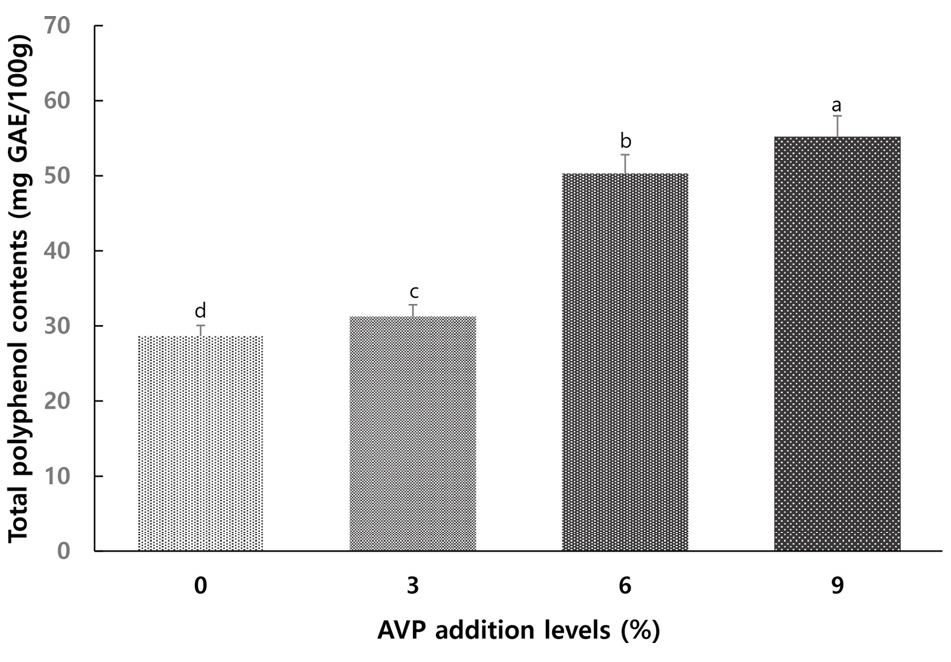
The total phenolic content of morning rolls containing AVP powder is shown in Fig. 1. The control exhibited 28.64 mg GAE/100 g, and the samples with AVP powder showed 31.25, 50.29, and 55.21 mg GAE/100 g, respectively, demonstrating a significant increasing trend with powder addition (p < 0.05). These results indicate that the amount of AVP powder added influenced the increase in total polyphenol content of the morning rolls. Phenolic compounds are a class of secondary metabolites that exhibit antioxidant activity due to the reactivity of their phenolic hydroxyl groups with proteins and other substances, and they scavenge free radicals by possessing one or more hydroxylated aromatic rings. The AVP powder used in this study contains flavonoids such as kaempferol, quercetin, and astragalin, as well as phenolic acids like ferulic acid, which are considered to have contributed to the increased total polyphenol content of the morning rolls.
Measurement of the DPPH Radical Scavenging Activity
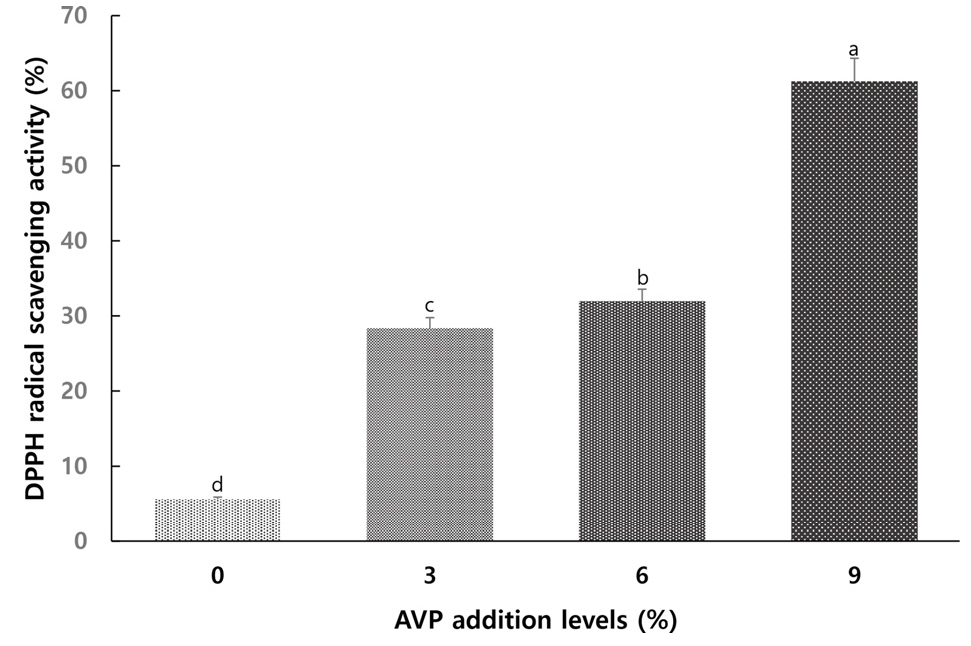
The DPPH radical scavenging activity of morning rolls containing AVP powder is shown in Fig. 2. At a concentration of 100 mg/mL, the control exhibited 5.61% scavenging activity, whereas the addition groups showed 28.36%, 31.97%, and 61.25%, respectively. Total phenolic content and DPPH radical scavenging activity increased significantly with increasing amounts of AVP powder, which is consistent with previous reports on the antioxidant and bioactive effects of added ingredient powders (Lee, 2000, 2022; Park and Joo, 2020). AVP powder has potential as a natural antioxidant, and it is expected to provide high antioxidant efficacy in various food products to which AVP powder is added.
Conclusion
This study evaluated morning rolls fortified with 0%, 3%, 6%, and 9% Allium victorialis (Myeonginamul) powder (AVP) and found that moisture content showed little change across treatments, while pH decreased (from about 5.82 to 5.42) and titratable acidity increased (approximately 0.08-0.22) as powder level rose; color changed markedly with lightness (L) falling from 79.52 to a range of 71.59-46.29, redness (a) remaining negative and tending to decrease (greener hue), and yellowness (b) increasing from 18.62 to 23.51-33.88, producing progressively darker, browner rolls; texture measurements indicated increased hardness (control 71.32 → 79.95, 98.32, 115.56) and chewiness (52.36 → 65.32, 73.45, 84.12) with higher powder addition, while springiness (80.32 → 79.20, 79.97, 75.20) and cohesiveness (74.25 → 75.36, 73.42, 72.94) tended to decrease, suggesting firmer, less elastic crumb likely due to effects on gluten formation; weight decreased after baking because of moisture loss but showed no significant differences among samples, whereas loaf volume declined significantly from 131.00 mL in the control to 117.32-102.73 mL with increasing powder - an effect attributed to dietary fiber reducing gas-holding capacity and dough extensibility; functional properties improved substantially, with total phenolic content rising from 28.64 mg GAE/100 g in the control to 31.25, 50.29, and 55.21 mg GAE/100 g and DPPH radical scavenging activity at 100 mg/mL increasing from 5.61% (control) to 28.36%, 31.97%, and 61.25% in the fortified samples. In antioxidant studies, AVP powder increased total polyphenol content and DPPH radical scavenging activity, suggesting that its use in bread production could enable the development of functional breads likely to appeal to consumer preferences.