


Introduction
Materials and Methods
Test Materials
Preliminary Test for Making Makgeolli Using SC101 Starter
Production of Makgeolli with DSW and CP
Analysis of the Properties of Makgeolli
Statistical Analysis
Results and Discussion
Makgeolli Fermentation Efficiency of SC101 Starter
Fermentation Efficiency According to Fermentation Temperature and Type of Saccharifying Agent
Fermentation Efficiency Following the Addition of Lactic Acid Bacteria
Fermentation Efficiency and Makgeolli Quality According to Water Hardness
Conclusion
Introduction
The size of South Korea’s alcoholic liquor market grew from approximately KRW 8.1448 trillion in 2011 to KRW 9.97 trillion in 2022. This trend reflects the expansion of the “healthy pleasure” movement, particularly among younger generations, who are embracing a new drinking culture centered on a healthy approach to alcohol consumption. This shift is driving growth in the market for traditional fermented liquors such as makgeolli. Recent survey results indicate that South Korea’s liquor market is breaking away from consumer trends of the past, showing a decrease in consumption of other alcoholic beverages and an increase in the proportion of traditional liquor consumption. Premium makgeolli and distilled soju are leading this trend, with makgeolli in particular standing out due to its utilization of various agricultural products, including chestnuts, yuzu, and bananas, as secondary ingredients (Oh and Lee, 2024).
Makgeolli, a traditional Korean fermented liquor, is produced by fermenting starch-based materials. It undergoes parallel complex fermentation, where sugars broken down during the saccharification process by hydrolytic enzymes secreted by fermented malt are converted by yeast into alcohol and flavor compounds (Kim et al., 2019; Lim et al., 2025; Oh and Lee, 2024; Wang et al., 2025). Makgeolli is rich in dietary fiber, B vitamins, and protein due to the action of microorganisms involved in the fermentation process. It also contains a variety of amino acids, largely due to the proteolytic enzymes in the fermented malt, which is a fermentation starter. Furthermore, due to new compounds generated during fermentation, it contains bioactive substances involved in metabolic processes within the body, giving it nutritional characteristics distinct from conventional alcoholic beverages (Kim et al., 2022; Lee and Jang, 2025; Peng et al., 2025). According to previous studies, the quality and functional characteristics of makgeolli vary depending on the type of grain used as the main ingredient, rice variety, and type of secondary ingredients (Sung et al., 2021; Yoon et al., 2024). The primary starch-containing grains used in makgeolli production include rice (glutinous rice, non-glutinous rice, brown rice, puffed rice flour), wheat flour, and barley (Baek et al., 2013; Lee and Jang, 2025; Sung et al., 2021; Yoon et al. 2024). By incorporating regional specialties, such as strawberries, melons, yuzu juice, and sowthistle-leaved hawksbeard, as secondary ingredients, the concept of regional specialty liquor is being introduced to expand the market through product premiumization and enhanced functionality (Bae et al., 2016; Kim et al., 2015; Oh and Lee, 2024; Yang and Eun, 2011).
According to the recently released 2025 Global Health and Well-being Survey, consumers are increasingly focusing on nutrition, weight loss, health, and well-being. With the advent of an aging society, there is a growing preference for functional foods to prevent diseases such as hypertension and cardiovascular diseases (Kim et al., 2020; Park et al., 2017). Therefore, antioxidant functional foods are gaining attention. Notably, cacao, the raw material for chocolate products, is known to possess various physiological effects, including rich polyphenols, antioxidant activity, and anti-cancer and antibacterial properties. Phenolic compounds act as antioxidants, eliminating and inhibiting free radicals that cause oxidative damage, DNA destruction, biomolecular oxidation, and age-related cellular performance decline (Martínez et al., 2012; Miller et al., 2006; Okiyama et al., 2018). Deep seawater (DSW) circulates at depths exceeding 200 m, where sunlight cannot reach, resulting in minimal organic matter and pathogens. With rich minerals such as magnesium and calcium, as well as nutrient salts such nitrate and phosphate, DSW is a marine resource that can be obtained only in limited volumes in countries including South Korea, Japan, the United States, and Taiwan. In particular, DSW from the eastern coastal regions of Korea is known as DSW of the East Sea. Compared to resources utilized in the US, Taiwan, and elsewhere, it is recognized for its superior quality due to its abundant dissolved oxygen, low water temperature, and low salinity. Water from the East Sea comprises 1,690 trillion tons, representing 95% of total seawater volume along the East Coast and is a sustainable and abundant resource, with 4 trillion tons generated annually (Jang et al., 2023; Yang et al., 2019). Goseong County in Gangwon Province has developed several industries utilizing DSW, including within the health-functional drinking water, salt, and food sectors. Specialized industries leveraging the high mineral content of DSW continues to grow, and its applicability as a diverse food ingredient continues to be established.
This study explored conditions for makgeolli production using the SC101 starter, a food-grade strain with gas and alcohol production capabilities suitable for fermented liquor production, based on confidential data and evaluated the effects of adding DSW and cacao powder (CP) on fermentation efficiency during makgeolli production utilizing this starter.
Materials and Methods
Test Materials
The rice used for making makgeolli was Haedeulmi (Geumgangsan-su Haeandulmi, Goseong County Agricultural Cooperative Rice Association Joint Venture Corporation) grown in Goseong County, Gangwon Province, purchased from Hanaro Mart. The saccharifying agents used were Chungmu Enzyme (Chungmu Refined Enzyme, Chungmu Fermentation Co., Ltd.; titer 15,000 SP) and malt extract (Our Family Healthy Table Malt Extract, Durewon; titer 150 SP). The water used for makgeolli production was primary distilled water produced using a Genie U12 ultrapure water generator (Rephile, Korea). The CP was provided by Bonatera, the only chocolate manufacturer in Korea located in Goseong-gun, Gangwon Province. They supplied a product made from beans imported from Malaysia, which they dried and processed themselves. This powder was sieved using a 200-mesh sieve before use. DSW was collected from a depth of 605 m in the Oho-ri waters off Jukwang-myeon, Goseong-gun, Gangwon Province. This raw DSW was processed into powder using a spray dryer (Mini Spray Dryer S-300; Buchi, Switzerland), and the dried DSW was employed as a hardness control agent for distilled water. The yeast used was Saccharomyces cerevisiae (SC101), a food-grade strain with excellent alcohol-producing ability (data not shown), isolated from liquor brewed with wild pears harvested in Goseong County. The Goseong Deep Sea Water Industry Foundation and Microbial Institute for Fermentation Industry jointly developed this strain. Following the method proposed by Kim et al. (2025a), the starter (1 × 10⁹ CFU/g) was prepared as a freeze-dried powder formulation by adding a combination of glucose, yeast extract, ammonium sulfate, magnesium sulfate, potassium phosphate monobasic, sodium phosphate, and the preservatives trehalose and maltodextrin to the culture medium. This starter was stored in an ultra-low temperature freezer (UniFreez U400; Daihan, Korea) at -75°C before use.
Preliminary Test for Making Makgeolli Using SC101 Starter
SC101 starter was used to produce makgeolli by steaming glutinous rice (Haedeulmi, Goseong, Gangwon Province, Korea) as the starch-rich raw material after steaming, soaking for 3 h, then steaming at 120°C for 1 h. The rehydrated rice was cooled to below 25°C before use, and 100 g of rice was placed in a 500-mL fermentation container. 25% malt extract (w/w) relative to the rice weight, 0.6% SC101 starter (w/w), and 200% distilled water (w/w) were added to the fermentation vessel and mixed. The mixture was then fermented in a large-scale batch fermenter (LSI-6002M; LabTech, Korea) at 22°C for 7 d to evaluate the applicability of the SC101 starter. Subsequently, the fermentation efficiency was evaluated by changing the fermentation temperatures (22.0, 23.5, 25.0, 26.5, and 28.0°C), saccharifying agent type, and processing volume (malt extract 25, 50, 75% [w/w] and purified enzyme 0.05, 0.1, 0.2, 0.3% [w/w]).
Production of Makgeolli with DSW and CP
The treatment efficiency of DSW and CP was evaluated through preliminary tests for the treatment group, with the SC101 starter demonstrating high application efficiency. CP was applied at 2% (w/w) to the total rice quantity in all treatment groups and compared for efficiency against the untreated control. It was added and mixed at the processing of the main and secondary ingredients before fermenting the makgeolli. The raw DSW used in the test was slightly alkaline with a pH of 7.8 ± 0.16 and salinity of 35 psu, similar to standard seawater. The main elements were Mg (1,357.7 ± 2.6 mg/L), Ca (483.1 ± 0.8 mg/L), K (367.6 ± 0.6), and Na (10,907.1 ± 32.9 mg/L), as well as trace elements such as B, Fe, and Si. The results were similar to those reported by Jang et al. (2023). The raw DSW was dried using a spray dryer with an inlet gas flow rate of 31-32 m3/h, inlet temperature of 150°C, atomizing gas flow of 900 L/h, and pump flow rate of 10 mL/min. One liter of raw DSW was processed for 100 min, yielding 37.6 ± 0.52 g of DSW powder, representing a recovery rate of approximately 3.8%. The hardness of primary distilled water was adjusted to 0, 300, 500, and 1,000 mg/L as CaCO3 using DSW powder, and its effect on fermentation efficiency was evaluated when used as water for makgeolli production.
Analysis of the Properties of Makgeolli
Makgeolli produced using SC101 starter was tested in triplicate per treatment group. Samples collected at each fermentation stage were analyzed daily for pH, soluble solids, alcohol content, and other characteristics, according to the National Tax Service’s liquor analysis regulations. Live bacteria (lactic acid bacteria and yeast) in makgeolli were measured during the fermentation period, and the mineral content of the produced makgeolli was determined. pH was measured using a pH meter (HI 5521; Hanna, Korea), and the soluble solids content was measured using a digital saccharimeter (ATAGO; PAL-3, Japan). The alcohol content was determined by taking 100 mL of the sample and distilling it using a rotary evaporator (Rotavapor® R-300; Buchi) until the distillate volume reached 70 mL. After marking the 100-mL graduated cylinder, the alcohol content was measured using a 0-35% thermo-alcoholometer (AL.0530; TP000, Alla®, France) and converted using an alcohol content conversion table. During the fermentation period, the viable microbial count of makgeolli was analyzed using a suspension sample, employing 3M’s Petrifilm (Yeast RYM, Lactic Acid Bacteria LAB). After inoculating 0.5 mL of the suspension into each medium and distributing it evenly, the yeast and lactic acid bacteria were cultured for 2 d at 25 and 35°C, respectively, using an incubator (LEF-105P-1; LabTech, Korea), and the viable cell counts were measured. The mineral content of makgeolli produced using DSW was analyzed for Ca, Mg, and K using ICP/MS (ICPMS-2030; Shimadzu, Japan) on wet-digested samples.
Statistical Analysis
The experiments in this study were conducted in triplicate, and the data were analyzed using SPSS (Windows version 23, IBM Co., USA). The average fermentation efficiency of makgeolli was compared using Duncan’s multiple range test at a 95% confidence level after conducting an analysis of variance.
Results and Discussion
Makgeolli Fermentation Efficiency of SC101 Starter
The preliminary fermentation test for the SC101 starter used malt extract as the saccharifying agent and employed 25.0% of the rice quantity used in makgeolli production. The pH of makgeolli is a key factor for estimating fermentation and alcohol production levels. Changes in the pH of SC101 starter makgeolli during the fermentation period are summarized in Table 1. The pH on day 1 decreased sharply from 4.95, reaching 3.76 on day 2, and remained largely unchanged at around 3.62 until the end of fermentation on day 7. This is because of the production of organic acids and other compounds through microbial action during fermentation (Kim et al., 2019, 2025b; Noh et al., 2022). The soluble solids content decreased as the fermentation period increased, showing a trend similar to pH changes. It decreased from 25.6 °Brix on day 1 of fermentation to 20.8 °Brix on day 3, then remained stable until day 7. However, compared to previous studies, it was found to be at a slightly higher level (Table 1). Kim et al. (2025b) reported that the sweetness of makgeolli can vary significantly depending on the ingredients used and manufacturing method, and Noh et al. (2022) reported that it may be affected by factors such as the amylase activity of saccharifying agents. Alcohol content tended to increase as fermentation time increased, and at the final fermentation stage, an alcohol content of 4.3% was measured, which is lower than that of commercially available makgeolli (Lim et al., 2025). Although not described in this study, the S. cerevisiae used in the SC101 starter employed in this experiment demonstrated a considerable level of gas production capacity, alcohol production capacity, and antioxidant activity in the functional evaluation of candidate strains for alcoholic beverage applications. However, sufficient fermentation factors were not applied to achieve the target alcohol content level.
Table 1
Variations in pH, soluble solids, and alcohol content in SC101 starter makgeolli with malt by fermentation period (fermentation temperature at 22.0°C)
Fermentation Efficiency According to Fermentation Temperature and Type of Saccharifying Agent
Preliminary test results indicated that the alcohol content of the SC101 starter makgeolli was evaluated as being at a significantly low level. To address this, tests were conducted based on prior research to identify factors that could influence fermentation efficiency improvement, specifically focusing on fermentation temperature, saccharifying agent type, and processing volume (Kang et al., 2016; Kim et al., 2019; Lee, 2020). The fermentation efficiency of SC101 starter was evaluated under various conditions, specifically assessing its efficiency at different fermentation temperatures. The results obtained at fermentation temperatures of 22.0, 23.5, 25.0, 26.5, and 28.0°C are presented in Table 2. The pH of makgeolli showed a similar trend to the preliminary test, decreasing sharply from the first day of fermentation (4.52-4.68) and stabilizing thereafter. Similar to the preliminary test results, no significant differences in fermentation temperature were observed. The soluble solids content of makgeolli showed a decreasing trend with increasing fermentation time at all fermentation temperatures. However, at temperatures below 25.0°C, a clear decrease was observed starting from the second day of fermentation. At 26.5 and 28.0°C, a decrease was observed starting from the 6th d of fermentation. According to prior research, makgeolli undergoes parallel complex fermentation where amylase enzymes break down rice starch into fermentable sugars, which yeast then converts into alcohol. Residual sugars remain in this process because, as demonstrated by results indicating increased starch breakdown during high-temperature fermentation, the amount of starch broken down exceeds the amount converted to alcohol, leading to higher residual sugar levels (Kim et al., 2019, 2022; Lee and Jang, 2025). Kim et al. (2025b) observed that the soluble solids content increased when fermentation was initiated at an initial temperature of 25°C and fermentation temperature was subsequently raised to 35.0 and 45.0°C after 3 d. This was caused by enhanced starch degradation due to increased enzyme activity as the temperature rose. The alcohol content of all treatment groups increased as fermentation time progressed, showing differences ranging from 3.77 to 4.64 °Brix at the final fermentation point on day 6. These results showed a similar trend to the soluble solids content of makgeolli. At fermentation temperatures below 25.0°C, relatively high alcohol contents of 4.28-4.64 °Brix were observed, whereas temperatures exceeding 25.0°C yielded contents of 3.77-3.98 °Brix, representing a maximum reduction of 19%. Baek et al. (2013), Kang et al. (2016), and Shin et al. (2017) reported that when the soluble solids content stabilized, alcohol production also remained constant. This is consistent with the finding that the saccharification power of the fermentation agent results in higher fermentation temperatures at medium temperatures compared to that of low or high temperatures. In this experiment, even when fermentation properties were evaluated by adjusting the fermentation temperature, the alcohol content of the makgeolli did not meet the target set by the research team. However, based on the pH stabilization level and alcohol content of the makgeolli, the optimal fermentation temperature for the SC101 starter was determined to be 25.0°C.
Table 2
Variations in pH, soluble solids, and alcohol content in SC101 starter makgeolli with malt by variety fermentation temperature
Various methods of applying saccharifying agents were considered to enhance the saccharification capacity of starch, increasing the alcohol content of makgeolli. The treatment groups used in the experiment were conducted by increasing the amount of malt extract used compared to previous tests and by applying purified enzymes as a new saccharifying agent at various levels (Table 3). The pH of makgeolli showed a consistent decreasing trend over time compared to that of the initial stage as the fermentation time increased, stabilizing at a level of 3.35-4.02. An increase in the malt processing volume was observed to rise proportionally to the processing level. When using purified enzymes as saccharifying agents, a decrease with increasing fermentation time and differences based on processing volume were also observed. Compared to malt extract, the yield was up to 1.3 times higher and showed a tendency to decrease continuously rather than stabilize as time increased. The soluble solids content of makgeolli also showed a decreasing trend with increasing fermentation time, similar to the previous experiment. However, it decreased sharply in all treatment groups except for the group using 250 g of malt extract, which showed a gradual decrease, reaching 8.09-6.78 °Brix. These results are attributed to the breakdown of starch into sugars, specifically the difference in saccharification enzyme activity, which is itself the result of sufficient enzymatic action. Therefore, the alcohol content was expected to increase in a similar trend due to sugar consumption by yeast (Kim et al., 2019, 2025b). As predicted, the alcohol content of the makgeolli reached the target level of 11.8-12.3% at the final fermentation stage in all treatment groups except the one with 250 g of malt extract. For each saccharifying agent, treatments with 500 and 750 g of malt produced higher initial alcohol yields. However, after 4 d of fermentation, the refined enzyme-treated group showed a sharp increase, producing 10.2-11.1% alcohol, significantly more than that of the malt treatments at 3.68-9.53%. According to Kwon et al. (2023), the minimum enzyme dosage required to produce 9.17% alcohol when manufacturing makgeolli from 1 kg of rice was proposed as 200 mg/L. All treatment groups in this study, excluding the 250 g malt treatment group, satisfied the minimum saccharification capacity criteria proposed in the prior study. According to the results derived from this experiment, to produce alcohol exceeding 10% using the SC101 starter, the optimal levels for malt extract and purified enzyme were 500 and 5 g, respectively. However, from the perspective of economic viability in terms of makgeolli production volume and raw material usage, the use of purified enzymes is superior to malt extract.
Table 3
Variations in pH, soluble solids, and alcohol content in SC101 starter makgeolli by saccharifying agent type and addition ratio (fermentation temperature at 25.0°C)
|
Fermented period | Treatment | pH |
Soluble solid (°Brix) |
Alcohol content (%) |
| 1 day | M1)250 | 4.45 ± 0.16 a | 21.4 ± 0.35 b | 0.56 ± 0.08 a |
| M500 | 4.59 ± 0.21 ab | 20.9 ± 0.21 b | 3.27 ± 0.16 c | |
| M750 | 4.71 ± 0.14 ab | 21.2 ± 0.41 b | 3.51 ± 0.21 c | |
| PE2)5 | 5.06 ± 0.08 b | 16.8 ± 0.19 a | 2.12 ± 0.05 b | |
| PE10 | 5.79 ± 0.06 c | 16.3 ± 0.15 a | 2.24 ± 0.11 b | |
| PE20 | 6.11 ± 0.11 cd | 17.1 ± 0.23 a | 2.11 ± 0.06 b | |
| PE30 | 6.34 ± 0.15 d | 16.8 ± 0.17 a | 2.28 ± 0.07 b | |
| 2 days | M250 | 3.62 ± 0.07 a | 20.2 ± 0.15 b | 1.79 ± 0.21 a |
| M500 | 3.70 ± 0.11 a | 15.8 ± 0.09 a | 6.51 ± 0.09 c | |
| M750 | 3.81 ± 0.09 a | 16.6 ± 0.21 ab | 6.79 ± 0.15 c | |
| PE5 | 4.91 ± 0.21 ab | 15.5 ± 0.06 a | 3.21 ± 0.06 b | |
| PE10 | 5.34 ± 0.02 b | 15.4 ± 0.07 a | 3.93 ± 0.14 bc | |
| PE20 | 5.69 ± 0.24 cd | 16.1 ± 0.11 ab | 3.84 ± 0.11 bc | |
| PE30 | 5.91 ± 0.16 d | 15.9 ± 0.29 ab | 4.12 ± 0.09 bc | |
| 4 days | M250 | 3.84 ± 0.16 a | 19.1 ± 0.26 c | 3.68 ± 0.16 a |
| M500 | 3.75 ± 0.21 a | 13.0 ± 0.16 b | 8.31 ± 0.23 b | |
| M750 | 3.91 ± 0.14 a | 12.6 ± 0.11 b | 9.53 ± 0.27 c | |
| PE5 | 4.05 ± 0.08 a | 9.41 ± 0.03 ab | 10.2 ± 0.05 c | |
| PE10 | 4.32 ± 0.03 ab | 9.62 ± 0.08 ab | 11.0 ± 0.09 d | |
| PE20 | 5.33 ± 0.16 b | 9.91 ± 0.14 ab | 11.0 ± 0.14 d | |
| PE30 | 5.59 ± 0.04 b | 8.63 ± 0.13 a | 11.1 ± 0.06 d | |
| 6 days | M250 | 3.35 ± 0.16 a | 18.8 ± 0.36 c | 4.51 ± 0.26 a |
| M500 | 3.77 ± 0.02 ab | 7.61 ± 0.15 ab | 11.9 ± 0.19 b | |
| M750 | 4.02 ± 0.21 b | 8.09 ± 0.26 b | 11.8 ± 0.14 b | |
| PE5 | 3.68 ± 0.08 ab | 7.43 ± 0.14 ab | 12.3 ± 0.23 b | |
| PE10 | 4.36 ± 0.11 b | 6.78 ± 0.09 a | 12.1 ± 0.31 b | |
| PE20 | 5.06 ± 0.24 c | 7.11 ± 0.11 a | 12.0 ± 0.16 b | |
| PE30 | 5.11 ± 0.13 c | 6.93 ± 0.16 a | 12.3 ± 0.21 b |
Fermentation Efficiency Following the Addition of Lactic Acid Bacteria
Cacao is known as a food ingredient rich in antioxidants, such as polyphenols, whose various bioactive compounds inhibit free radical formation and positively influence human metabolic development. Its global production has increased, reaching 5.6 million tons from 11.5 million hectares as of 2021 (Campoverde et al., 2025; Dewi et al., 2025). We evaluated the effect of processing cacao, a functional material provided by a company located in Goseong County, on makgeolli fermentation efficiency using the SC101 optimal fermentation conditions derived from previous experiments (Table 4). During makgeolli production, CP was added at 2% (w/w) of the rice weight during the ingredient mixing process to evaluate its effect on fermentation efficiency. The pH of makgeolli decreased over time, ranging from 4.59-4.63 for malt extract and 5.11-5.23 for purified enzyme at the start of fermentation to 3.77-3.85 by the final fermentation date, consistent with previous results. The difference due to CP treatment was not significant. The soluble solids also showed a decreasing trend similar to the results of the previous experiment. Although statistical significance was not confirmed, a slight decrease was observed depending on the CP treatment, suggesting that alcohol production was likely promoted. The alcohol content of makgeolli tended to increase with longer fermentation times and lower soluble solids content. Based on the final fermentation date, the utilization of refined yeast (11.3-12.4%) was somewhat higher than that of malt powder (9.61-9.89%). Regardless of the type of saccharifying agent used in makgeolli production, the addition of CP resulted in a slight increase compared to that of the untreated control. A significant increase was observed in makgeolli produced using purified enzyme as the saccharifying agent compared to that of malt extract. Bae et al. (2016) and Kim and Yi (2010) reported that adding puffed millet and strawberries during makgeolli production enhances alcohol production, a finding consistent with our results.
Table 4
Variations in pH, soluble solids, and alcohol content in SC101 starter makgeolli with cacao powder addition (fermentation temperature at 25.0°C)
|
Fermented period | Treatment | pH |
Soluble solid (°Brix) |
Alcohol content (%) |
| 1 day | M1)500 | 4.63 ± 0.25 a | 20.4 ± 0.41 b | 3.18 ± 0.16 b |
| M500C2) | 4.59 ± 0.17 a | 21.1 ± 0.19 b | 3.35 ± 0.06 b | |
| PE3)5 | 5.11 ± 0.06 b | 16.3 ± 0.26 a | 2.32 ± 0.09 a | |
| PE5C | 5.23 ± 0.09 b | 16.6 ± 0.11 a | 2.42 ± 0.02 a | |
| 2 days | M500 | 3.70 ± 0.13 a | 15.8 ± 0.32 a | 6.23 ± 0.23 b |
| M500C | 3.73 ± 0.08 a | 15.3 ± 0.16 a | 7.11 ± 0.11 c | |
| PE5 | 4.92 ± 0.24 b | 15.7 ± 0.14 a | 3.33 ± 0.11 a | |
| PE5C | 4.80 ± 0.11 b | 15.2 ± 0.23 a | 3.68 ± 0.31 a | |
| 4 days | M500 | 3.61 ± 0.16 a | 14.6 ± 0.51 d | 8.03 ± 0.05 a |
| M500C | 3.65 ± 0.11 a | 12.9 ± 0.26 c | 9.07 ± 0.16 b | |
| PE5 | 3.60 ± 0.21 a | 10.7 ± 0.13 a | 9.13 ± 0.13 b | |
| PE5C | 4.00±0.17 b | 10.1 ± 0.08 a | 9.61 ± 0.08 c | |
| 6 days | M500 | 3.77 ± 0.13 a | 13.0 ± 0.23 b | 9.61 ± 0.18 a |
| M500C | 3.80 ± 0.25 a | 12.5 ± 0.41 b | 9.89 ± 0.23 a | |
| PE5 | 3.77 ± 0.16 a | 7.60 ± 0.29 a | 11.3 ± 0.05 b | |
| PE5C | 3.85 ± 0.09 a | 7.10 ± 0.16 a | 12.4 ± 0.15 c |
Fermentation Efficiency and Makgeolli Quality According to Water Hardness
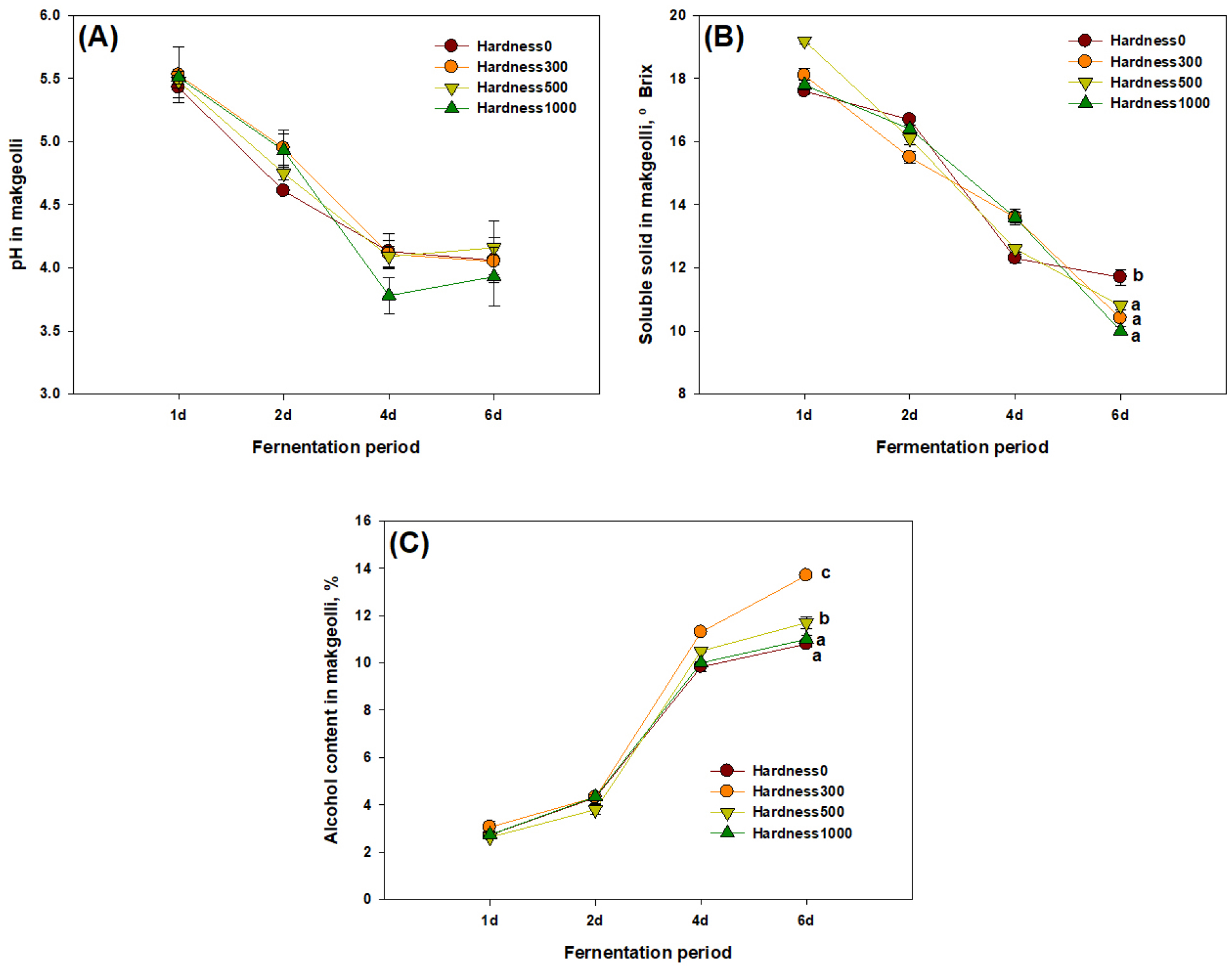
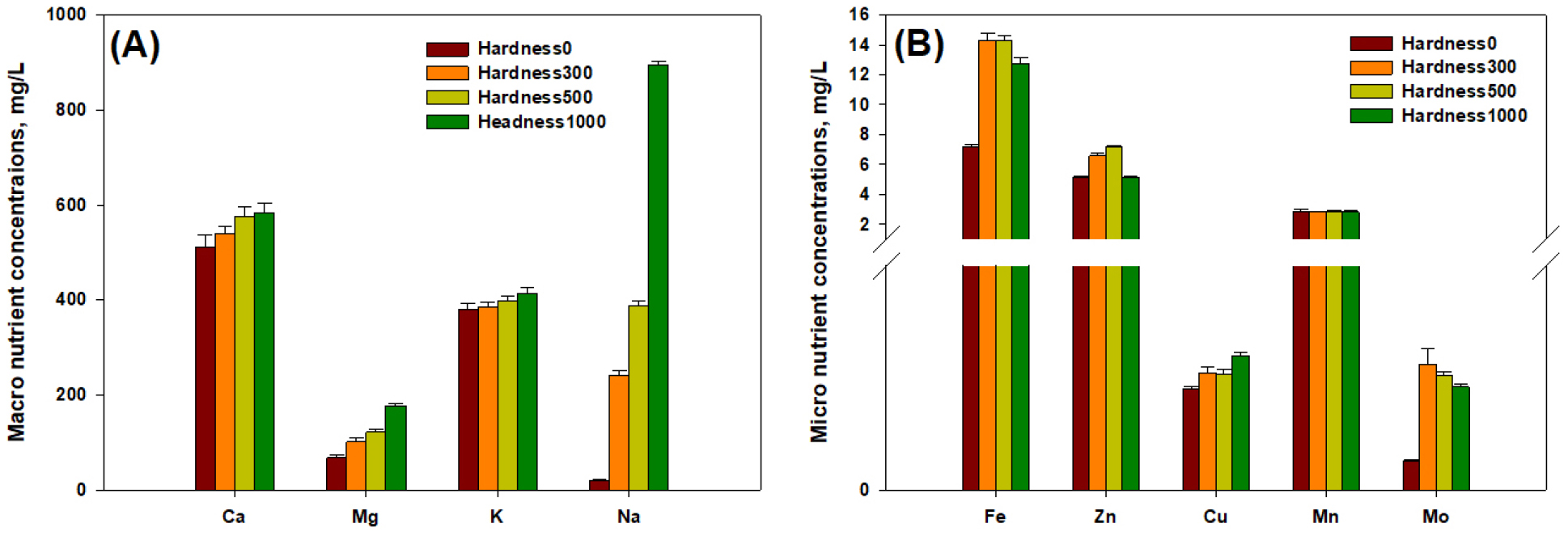
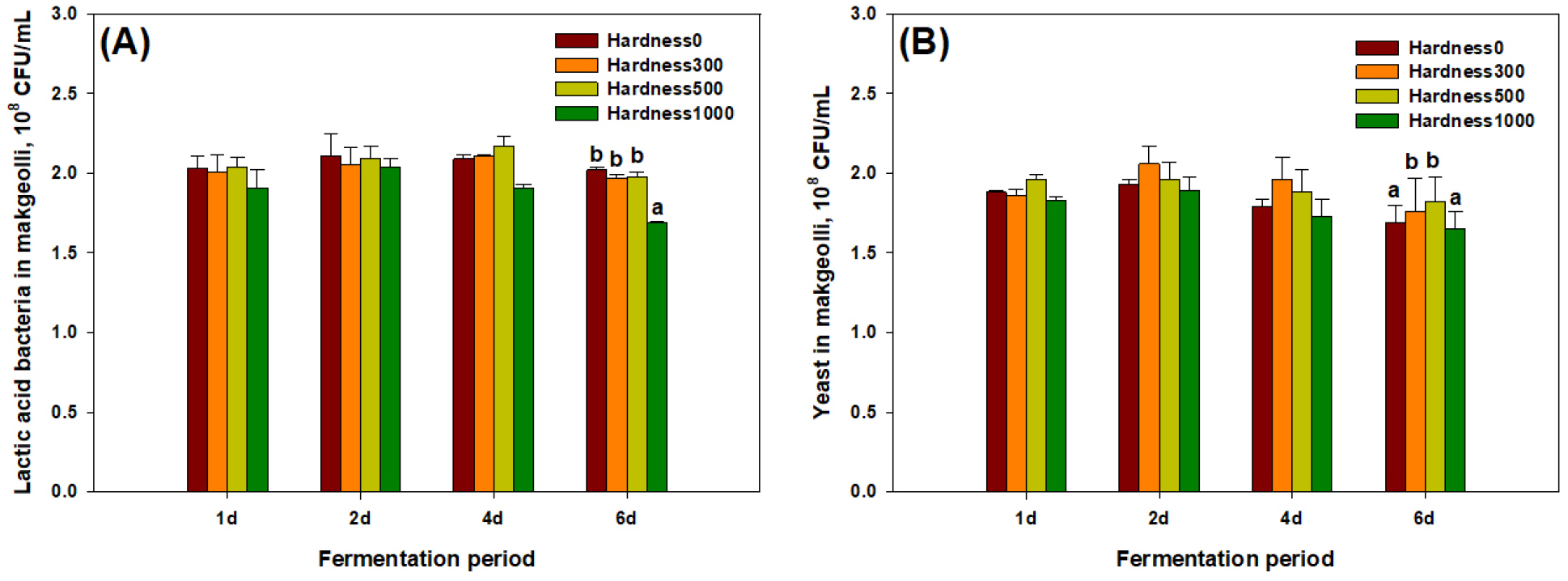
DSW is located beneath the thermocline, exhibiting characteristics that make it difficult to mix with surface water. However, these same properties enable the stable utilization of inorganic minerals, such as calcium, magnesium, and potassium, contained within the seawater (Jang et al., 2023; Yang et al., 2019). As shown in Fig. 1(A) and (B), the pH and soluble solids content of makgeolli during fermentation decreased as the fermentation time increased from the initial to the later stages, following a similar trend to the previous experiment. The soluble solids content of makgeolli was found to increase as hardness increased, suggesting that yeast activity increased, leading to higher alcohol production. As shown in Fig. 1(C), the alcohol content of makgeolli also increased with longer fermentation times and, consistent with the results of the previous experiment, showed a sharp increase on the 4th d of fermentation. Differences in fermentation efficiency were observed depending on the adjustment of water hardness for makgeolli production using DSW powder, and a significant increase was observed according to the hardness level. When using water with a hardness of 300 mg/L, the alcohol content was 13.7%, representing a 21.2% increase compared to that of the control group’s 10.8%. With water at 500 mg/L hardness, the alcohol content was 11.7%, showing a 7.7% increase. However, in water with a hardness of 1,000 mg/L, no significant difference was observed compared with that of the control group at 11.0%. In previous studies, water hardness was identified as a factor influencing microbial proliferation rates and final population size during fermentation. While soft water (hardness 0 mg/L) may delay microbial growth due to mineral deficiency, hard water (hardness 300-500 mg/L) may promote fermentation enzymes and cellular metabolism due to the supply of minerals (Ca2+, Mg2+, and K+). Conversely, extremely hard water (hardness ≥ 1,000 mg/L) may inhibit yeast growth and reduce fermentation rates due to excessive Ca2+ accumulation (Bokulich and Bamforth, 2013). Costa et al. (2018) reported that at Ca2+ levels of 1,200 mg/L, both the yeast cell survival rate and fermentation efficiency decreased. Additionally, Walker et al. (1996) and Lee et al. (2025) reported that fermentation performance can be enhanced utilizing the interaction between Mg and Ca ions in the fermentation medium, with, yeast survival rates increasing under conditions of a high Mg:Ca ratio, potentially increasing fermentation speed. The mineral content of fermented makgeolli was found to increase proportionally with the hardness level, which itself increased with the amount of DSW powder treatment (Fig. 2). The major element concentrations in the untreated sample, where distilled water hardness was not adjusted, were Ca 511.0 mg/L, Mg 67.6 mg/L, K 381.0 mg/L, and Na 20.2 mg/L. This is due to the influence of input materials, such as auxiliary materials added during the seed culture preparation process, in addition to the distilled water used as the process water. When adjusting water hardness using DSW powder treatment, the macronutrients in makgeolli increased by 5.5-14.1% for Ca, 49.4-161.8% for Mg, 1.3-8.4% for K, and 1,093.1-4,335.6% for Na. This clearly reflects the characteristic high magnesium content of deep sea water. Although the results were not presented in the main text, the initial salt content of the makgeolli was 0.44, 0.85, 1.02, and 1.76 psu at water hardness levels of 0, 300, 500, and 1,000 mg/L, respectively. At the final fermentation stage, it increased to 0.79, 1.03, 1.25, and 2.14 psu, respectively. The Mg:Ca ratio of makgeolli increased from 0.13 in makgeolli made with distilled water to 0.19, 0.21, and 0.30 when treated with DSW powder, increasing hardness from 300 to 1,000. This increase is considered to have positively influenced the yeast’s fermentation efficiency. However, yeast proliferation was inhibited as the Na content increased sharply when adjusted to a hardness of 1,000. Regarding these effects, Lee et al. (2018), Shirvanyan and Trchounian (2024), and Wei et al. (1982) reported that adding NaCl above a certain concentration during fermentation negatively affects yeast growth and reduces fermentation efficiency. A decrease in fermentation efficiency is predicted due to the rapid increase in Na, a salt-induced substance in DSW. The trace element content in makgeolli also showed an increase following treatment with DSW powder, but the concentration did not increase proportionally with the processing volume. To determine the effect of DSW treatment during fermentation on makgeolli fermentation, changes in lactic acid bacteria and yeast populations were observed (Kim et al., 2025a). Lactic acid bacteria increased from 1.91-2.04 ×10⁸ CFU/mL on day 1 of fermentation to a peak of 2.05-2.11 ×10⁸ CFU/mL on day 2, then decreased from day 6 onward (Fig. 3). Yeast also showed the highest population density of 1.89-2.06 × 10⁸ CFU/mL on the 2nd d of fermentation, after which it gradually decreased. The highest population levels of lactic acid bacteria and yeast were observed at 300-500 mg/L, depending on the water hardness, and this was determined to be consistent with the alcohol content. These results occurred because yeast produced carbon dioxide through sugar consumption under aerobic conditions, followed by alcohol production under anaerobic conditions. Furthermore, at a salinity of 1,000 mg/L, the populations of lactic acid bacteria and yeast were lower than in the control group, indicating that microbial growth was inhibited by osmotic or ionic stress (Birch et al., 2002).
Conclusion
This study evaluated the fermentation properties of makgeolli produced using an SC101 starter culture derived from S. cerevisiae isolated from home-made liquor, along with DSW and CP. In preliminary tests to evaluate the applicability of SC101, makgeolli produced using a mixture of 100 g of rice, 25 g of malt extract, 0.06 g of starter, and 200 g of distilled water was assessed to have pH and soluble solids content at typical levels. However, its alcohol content was found to be only 40% of the target level of 10%. An evaluation was conducted on the effects of fermentation temperature and fermentation agent type to enhance the alcohol content of makgeolli. Similar to the preliminary test results, the pH and soluble solids content of the makgeolli were comparable to typical makgeolli properties in tests by fermentation temperature. However, the alcohol content ranged from 3.77 to 4.64%, failing to meet the target value. The results showed that the highest alcohol content was achieved at 25°C. To enhance the saccharification power of rice, the amount of malt extract, an existing raw material, was increased, and the characteristics when utilizing refining enzymes were evaluated. The pH and soluble solids content of makgeolli showed similar trends to those of previous experiments based on fermentation time. However, the alcohol content varied significantly depending on the type of saccharifying agent. By day 6 of fermentation, the alcohol content remained largely unchanged at 4.51% for the mixture using 25% malt extract. However, increasing the malt extract usage to 50% and 75% resulted in an increase in alcohol content to 11.8-11.9%. Furthermore, when using purified enzymes, it produced 12.1-12.3% alcohol. Accordingly, a mixture of 50% malt extract and 0.05% purified enzyme was determined to be the most efficient. However, considering economic factors, the use of purified enzyme was found to be superior. Through previous experiments, the formulation ratio and fermentation conditions for SC101 were determined, and the effects of adding DSW and CP on fermentation properties were evaluated. When 2% CP was added to the derived conditions, the fermentation efficiency increased. Consequently, the alcohol yield improved by 3% in the malt extract treatment and 9% in the refined enzyme treatment, indicating that the use of refined enzymes and cacao is suitable. Therefore, the optimal fermentation conditions were explored by adjusting the hardness of the water used for making makgeolli to 0, 300, 500, and 1,000 mg/L using DSW powder. Differences in fermentation efficiency were observed depending on water hardness. At hardness levels of 300 and 500 mg/L, the rates of alcohol production increased by 21% and 8%, respectively, due to enhanced microbial activity resulting from mineral supplementation. In support of this, the yeast population count in makgeolli was also highest at hardness levels of 300 and 500 mg/L. Taken together, utilizing DSW and CP during makgeolli fermentation enhances fermentation efficiency. Thus, these findings provide foundational insights for the future production of regionally specialized makgeolli.