


Introduction
Materials and Methods
Study Area
C/N Ratio
Trophic State Index (TSI)
Classification Criteria by Pollution Type
Results and Discussion
Classification of Pollution Types in Sediments
Management Measures by Sediment Pollution Type
Assessment of the Effects on Water Quality Based on Sediment Leaching Characteristics
Conclusion
Introduction
Reservoirs exhibit diverse characteristics in hydrology, chemistry, and biology (Thronton et al., 1990). Small-scale agricultural reservoirs have diverse functions, including enhancing agricultural productivity, preventing droughts and floods, protecting ecosystems, revitalizing the economies of local communities, and improving living environments. In situations where water scarcity intensifies, they can serve as core infrastructure for agriculture and local communities. Most reservoirs in South Korea are artificial, small in scale, and have been in use for a long time, containing significant amounts of pollutants, such as organic matter, in their sediment layers. Furthermore, except for certain valley-type reservoirs, nearly all reservoirs tend to become eutrophic during the summer, suffering damage from algal blooms. This adversely affects not only the aesthetic aspects, such as algae-related taste and odor, but also water regulation and ecological functions (Kim et al., 2007).
Most agricultural reservoirs have shallow depths of 10 m or less and small effective storage capacities (Lee et al., 2003). Nutrients, such as nitrogen (N) and phosphorus (P), introduced through domestic sewage flowing from the upstream region, livestock wastewater, and stormwater runoff from neighboring cities or farmland, are the primary causes that deteriorate reservoir water quality. Among these pollutants, organic matter and nutrients decompose in the water layer at greater depths. However, in shallow water bodies, such as agricultural reservoirs, undecomposed pollutants bind to colloids in the water layer, subsequently settle, and enter the sediment layer (Kim et al., 2017). These introduced pollutants are released back into the water layer through physical and chemical processes, such as diffusion, resuspension, and bioturbation, adversely affecting the water quality (Canfield et al., 2005).
During microbial respiration, organic carbon is converted to inorganic carbon through the decomposition of organic matter, and the reproduced nutrients significantly influence primary algal production in the water layer (Along, 1995; Lee et al., 2014). The growth and death of algae from this process become a potential source of organic matter in the sediment layer. Excessive organic matter supply induces anaerobic conditions in the upper few millimeters or centimeters of the sediment layer, creating anaerobic environments and ultimately, a vicious cycle that causes persistent internal loading. The microbiological reductive dissolution of iron(III) and manganese oxides occurs in anaerobic environments. Sulfide produced by sulfate reduction bacteria forms black-colored sediments, which subsequently undergo methane gas (CH4) production by methanogenic microorganisms.
Classifying various factors that deteriorate reservoir water quality—such as high algal productivity owing to contaminated sediments or pollutant inflow from outside the reservoir—by pollution type, and applying selective management measures will significantly improve reservoir water quality. Among the various factors to consider for optimal reservoir management, organic matter in sediments is utilized as a key indicator for assessing the aquatic environmental health, as it can contain numerous pollutants owing to its large surface area. The carbon-to-nitrogen (C/N) ratio is widely used to determine the origin of organic matter by utilizing the values of total organic carbon (TOC) and total nitrogen (TN) in sediments. The trophic state index (TSI) proposed by Aizaki et al. (1981) and Carlson (1977) can be used as an indicator to assess the degree of eutrophication when analyzing reservoir water quality. Therefore, if the characteristics of these indicators are comprehensively evaluated to realize classifications per pollution type, they could serve as effective criteria for reservoir management.
In this study, we aim to classify agricultural reservoirs in the Yeongsan River and Seomjin River basins according to sediment pollution types, and propose management strategies for each type. Additionally, we summarized the appropriate methods to assess the impacts on water quality based on sediment leaching characteristics. The fundamental data required for analysis were obtained from the measured data of the Korea Rural Community Corporation (2020) (Table 1).
Table 1
C/N ratio at each reservoir (Korea Rural Community Corporation, 2019, 2020)
Materials and Methods
Among approximately 17,000 agricultural lakes and marshes in South Korea, the proportions exceeding water quality management standards (Lake and Marsh Water Quality Standard Grade IV) at the 3,319 sites managed by the Korea Rural Community Corporation were 17.3, 13.7, and 18.1% in 2016, 2017, and 2018, respectively. The average TOC concentrations were 4.2, 4.1, and 4.4 mg/L in 2016, 2017, and 2018, respectively, showing no particular trend of increasing pollution over time (Korea Rural Community Corporation, 2020). This is judged to be the result of water quality improvement projects, such as installing constructed wetlands, sedimentation basins, and water circulation systems, to prevent pollution, along with continuous pollution source management, including comprehensive surveys of agricultural reservoir water quality. However, owing to the recent frequent occurrence of abnormal weather events, such as droughts and floods, the possibility of other pollution patterns emerging at any time must be considered, necessitating continuous management. Agricultural reservoirs in South Korea, characterized by shallow depths and small effective water volumes compared with natural lakes abroad, possess high productivity, making them prone to eutrophication. Therefore, the reservoir-specific water-quality conservation management per pollution type is essential to ensure sustained compliance with water quality standards.
The criteria requiring consideration for classifying reservoir sediments per pollution type are as follows: first, there are reservoirs where the effects of external pollution are insignificant, but where severe water quality degradation necessitates prompt water quality improvement projects. These reservoirs, rich in organic matter and nutrients, foster high biomass development. Massive algal growth and subsequent die-off create anaerobic conditions, making them highly susceptible to internal loading. Second, there are reservoirs that receive large volumes of pollutants from the outside environment, making basin management urgent. Point and non-point sources of pollution located upstream of the reservoir directly impact its water quality, necessitating the definition of pollution sources, investigation of their scope, and improvement of water quality of the inflowing water. Third, there are reservoirs that are relatively unaffected by external pollution but are vulnerable to eutrophication owing to their hydrological and hydraulic characteristics, necessitating ongoing management. This type of reservoir is prone to eutrophication owing to factors, such as water temperature, light intensity, and nutrient concentrations, necessitating structural improvements in the long term. Finally, there is a type of reservoir capable of self-purification within the reservoir from both internal and external loadings, eliminating the need for active water quality improvement projects but requiring continuous monitoring (Korea Rural Community Corporation, 2015; Lee et al., 2003).
As described above, standard elements were established for each pollution type to ensure appropriate reservoir water quality management. To apply these elements, the C/N ratio, namely, a characteristic of organic matter in sediments, and TSI were utilized as indicators.
Study Area
The Yeongsan River and Seomjin River basins are regions with the distribution of numerous agricultural reservoirs, with water exceeding 100,000 tons. They possess a structural characteristic where the water quality and sediment conditions of upstream reservoirs directly impact the water quality of downstream rivers. In particular, reservoirs in the Yeongsan River basin exhibit relatively high average chemical oxygen demand (COD) concentrations, highlighting the need for upstream reservoir management.
Accordingly, the agricultural reservoirs within the Yeongsan River and Seomjin River basins were selected as the study sites. The target reservoir was selected by comprehensively considering the characteristics of pollution sources, upstream basin conditions, general status of the reservoir, and water quality and sediment characteristics. The location, effective storage, year of completion, distance from the upstream basin, and key water quality parameters (e.g., COD, TOC, total phosphorus (TP), and TN) of the reservoir were set as the evaluation items. Priorities were derived by applying weights to each item. Additionally, reservoirs exceeding Grade 3 (average) in key water quality items were prioritized, and considering the spatial distribution balance across medium influence areas, a total of 39 reservoirs were ultimately selected for investigation.
C/N Ratio
When organic matter is abundant in the lower layers of reservoirs or sediments, microbial activity accelerates oxygen consumption, rapidly forming a hypoxic layer that can severely impact benthic organisms or cause nutrient leaching issues. Accordingly, the need to manage organic matter in bottom waters and sediments and identify its sources of input has intensified (Woo et al., 2014). As organic matter typically involves biogeochemical processes, methods utilizing the C/N and stable isotope composition ratios are widely used to determine the source of organic matter input. In this study, we identified inflow sources using the C/N ratio, utilizing the TOC and TN values from sediments in the target reservoir. In general, organic matter readily available to phytoplankton in water bodies exhibits a C/N ratio of less than 10 (oligohumic), whereas that of terrestrial origin with high carbon volumes that cannot be utilized as nutrients has a high C/N ratio (polyhumic) (Carlson, 1977; Hakanson, 1984). Pocklington and Leonard (1979) reported that factors regulating the organic matter concentration include the increased surface area owing to production, supply rate, retention rate, and fine-grained particle size distribution within the water body.
Trophic State Index (TSI)
Eutrophication in reservoirs occurs when nutrients, such as carbon, nitrogen, and phosphorus, which act as growth factors for algae, accumulate within the reservoir alongside rising water temperatures. Determining whether eutrophication occurs, and assessing the trophic state is essential in reservoir water quality management (Suh et al., 2014). The TSI for assessing eutrophication is evaluated using transparency, chlorophyll-a (Chl-a), and TP concentrations, as proposed by Aizaki et al. (1981) and Carlson (1977). The TSI proposed by Carlson (1977) is expressed in Eq. (1), (2), (3), and the modified TSI proposed by Aizaki et al. (1981) is expressed in Eq. (4), (5), (6).
The TSIs calculated according to Eq. (1), (2), (3), (4), (5), (6) are used to determine the trophic state of lake and marsh water quality based on the criteria proposed by Kratzer and Brezonik (1981), as presented in Table 2.
Table 2
Eutrophication assessment criteria for reservoirs based on the trophic state index (TSI) (Kratzer and Brezonik, 1981)
| TSI | Trophic state |
| < 20 | Ultra-oligotrophic |
| 30-40 | Oligotrophic |
| 45-50 | Mesotrophic |
| 53-60 | Eutrophic |
| > 70 | Hypereutrophic |
However, the TSI proposed by Aizaki et al. (1981) and Carlson (1977) is based on equations derived from natural lakes in the United States. Accordingly, in South Korea, the influx of large amounts of inorganic suspended matter from upstream regions during the summer flood season hinders the use of transparency as TSI. Accordingly, the Ministry of Environment developed the Korean-type TSI (TSIko), reflecting the characteristics of domestic lakes and marshes. In this study, this Korean-type eutrophication index was used to assess the eutrophication status of agricultural reservoirs in the Yeongsan River and Seomjin River basins. In TSIko, COD, Chl-a, and TP were set as the assessment items, and the index calculation equation per item is expressed in Eq. (7), (8), (9), (10).
The evaluation criteria for the eutrophication level when assessing reservoir water quality, calculated according to Eq. Eq. (7), (8), (9), (10), are presented in Table 3.
Table 3
Eutrophication assessment criteria for reservoirs based on the trophic state index (TSI) (Ministry of Environment, 2006)
| Integrated TSIko | Trophic state |
| < 30 | Oligotrophic |
| 30-49 | Mesotrophic |
| 50-69 | Eutrophic |
| > 70 | Hypereytrophic |
Classification Criteria by Pollution Type
Pollutants flowing in from the upstream region of the reservoir and those generated internally owing to eutrophication eventually migrate into the sediment. Sediments contain records of reservoir pollution and provide information on the patterns of aquatic environmental change. Furthermore, oxidation-reduction changes and other processes lead to the re-release of pollutants contained within sediments, adversely affecting water quality and the benthic ecosystem. Therefore, appropriate sediment management must be in line with the specific characteristics of pollution.
Accordingly, pollution types were classified to apply sediment management techniques tailored to reservoir pollution characteristics. The indicators used were the C/N ratios and TSIko, and the classification criteria for each are expressed as follows.
C/N ratio = 10 → if C/N ratio ≧ 10, external load is highly likely; if C/N ratio < 10, internal load is highly likely.
TSIko = 70 → TSIko > 70 indicates a hypereutrophic state,
whereas TSIko ≤ 70 indicates eutrophic or oligotrophic states.
The basis for calculating the constants used in this study is as follows. The C/N ratio serves as an indicator for distinguishing the origin of organic matter within sediments, enabling the relative contributions of endogenously produced and externally introduced organic matter to be determined based on the magnitude of the value. Organic matter generated within water bodies typically exhibits a low C/N ratio, whereas that introduced from terrestrial sources tends to have a relatively high C/N ratio (Hakanson, 1984; Kang et al., 2012). Based on these characteristics, the baseline C/N value was set to 10, enabling the determination of the dominance of either externally introduced or internally produced organic matter.
Meanwhile, TSIko helps comprehensively assesses the trophic status of a lake or marsh according to the Ministry of Environment’s official evaluation criteria, with index values of 70 or higher classified as hypereutrophic (Ministry of Environment, 2006). Considering the high variability in water quality of agricultural reservoirs depending on rainfall and inflow conditions, we applied a TSIko value of 70 or higher as the determination criterion, representing the most conservative standard from a management perspective.
Results and Discussion
Classification of Pollution Types in Sediments
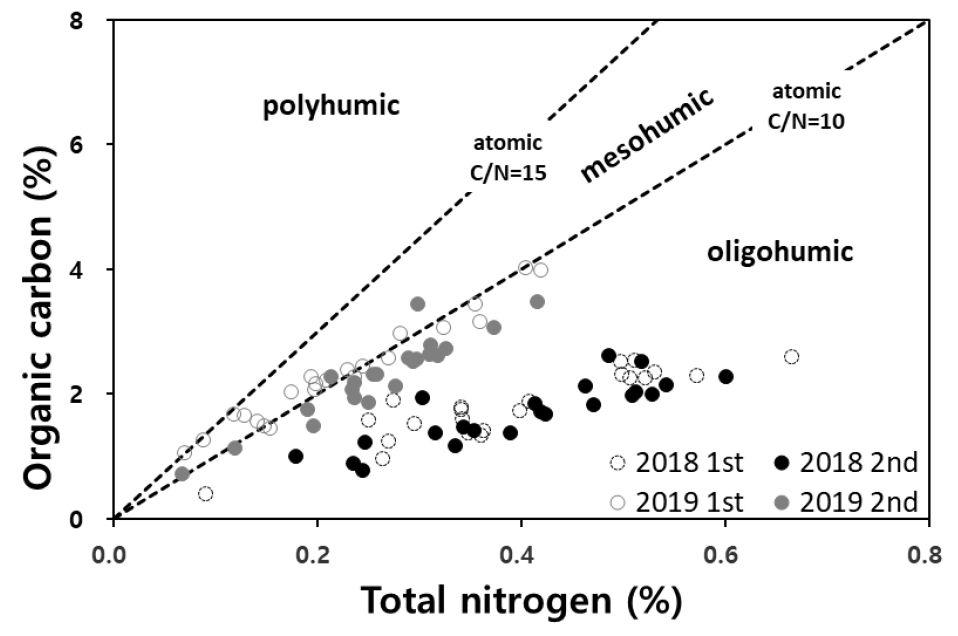
Analysis of the C/N ratio data used in this study showed minimum, maximum, and average values of 3.06, 6.83, and 4.40 in 2018, respectively. In 2019, the minimum, maximum, and average C/N ratio values were 7.33, 14.60, and 9.76, respectively, indicating that the C/N ratio ranged from an average of 4 to 10 (Table 1). Therefore, we estimated that the production within water bodies, namely, the influence of autochthonous organic matter produced by phytoplankton, was significant, and the potential for eutrophication in these reservoirs was evaluated to be relatively high.
According to a survey in 2019, although the patterns varied by season, certain sites, such as Doan, Ilro 2, Pungam, Jijeong, Seongam, Dongbang, Hansoo, Suyang, Bongsan, Hakpa 2, Magok, and Noijuk reservoirs, showed C/N ratios above 10, suggesting that terrestrial organic matter was the primary source of input. In particular, for the Suyang, Magok, and Noijuk reservoirs, two surveys conducted in 2019 showed C/N ratios exceeding 10. This indicates that the organic load within these reservoirs is largely influenced by inflow from external sources. The C/N ratio for each surveyed point is shown in Fig. 1.
Based on TSIko, the eutrophication indices and evaluation results for each water quality survey item in agricultural reservoirs within the Yeongsan River and Seomjin River basins for 2018 and 2019 are presented in Table 4. The evaluation results show that in the first survey of 2018, the Bangok, Ogang, Wolho, Seongsan, Songrim, Okdang, Dongsan, Ilro 2, and Hwangsan reservoirs were classified as hypereutrophic. In the second survey of 2019, the Noan 1, Dosan, Ilro 2, Seongsan, and Sinpo reservoirs were classified as hypereutrophic.
Table 4
Eutrophication assessment results by site based on the Korean-type trophic state index (TSIko)
By applying the C/N ratio and TSIko classification criteria, each reservoir is classified into four types, as follows (Fig. 2). The reservoirs included in each type are as presented in Table 5.
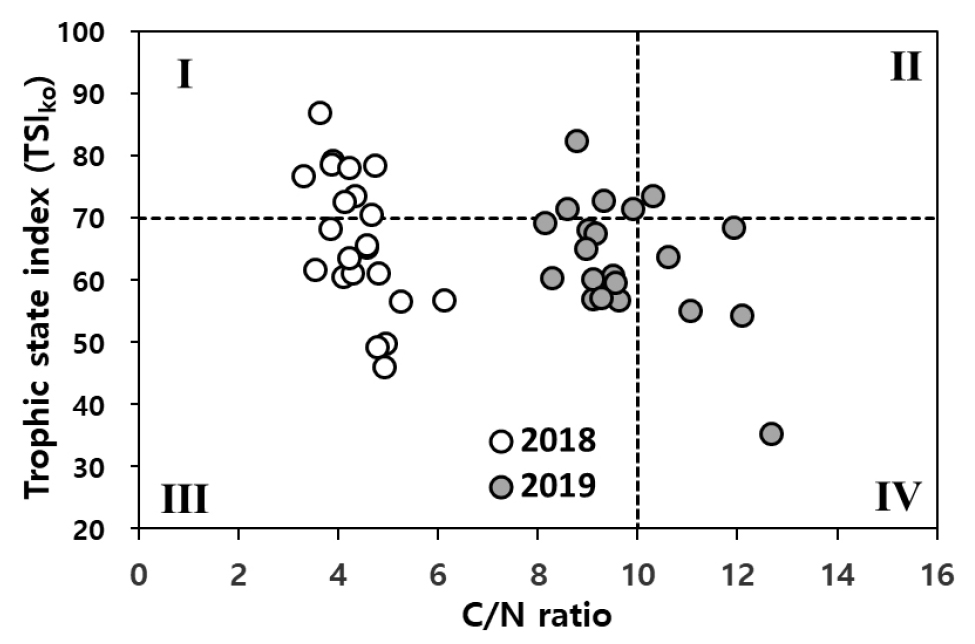
Table 5
Classification of the studied reservoirs according to pollution types
| Classification | Reservoir names | Type |
| I | Bangok, Ogang1), Wolho, Seongsan1), Songrim, Okdang, Dongsan, Ilro2, Hwangsan, Noan1, Sinpo | Internal production |
| II | Dosan | External inflow |
| III | Daeya, Geumjeon, Suyang, Yongam, Geumhyeon, Gaya, Bongsan, Imgok, Jeongseok, Hakpa1, Seoseong, Jukcheong, Ungang, Gusan, Hwajeong, Hwaji, Wolryang, Songhyeon, Seongam, Dongbang, Hansoo, Daeheung, Hakpa2 | Potential eutrophication |
| IV | Pungam, Jijeong, Magok, Noijuk | Continuous management |
Type I: Endogenous production-type sediment pollution → a type influenced more by endogenous production than by external inflow, exhibiting severe eutrophication that requires prompt water quality improvement projects.
Type II: External inflow-type sediment pollution → a type where the volume of pollutants entering from the outside environment is high, necessitating the prioritization of upstream basin management.
Type III: Sediment pollution with potential eutrophication → a type prone to eutrophication under certain internal conditions (e.g., water temperature, light intensity, and nutrient levels), requiring continuous sediment management and structural improvements to the reservoir.
Type IV: Continuous management-type sediment pollution → a type where the external inflow and endogenous production of pollutants are relatively low, and where self-purification within the reservoir is possible; continuous monitoring is required to observe its behavior in response to environmental changes.
Management Measures by Sediment Pollution Type
Sediments serve as the final destination for pollutants entering water bodies, acting as a sink where colloids and pollutants in water combine and are stored within sediment layers. They also play a crucial role in the decomposition of organic matter and nutrient cycling. In particular, nutrients reproduced through the respiration of diverse microorganisms present in sediments are supplied to the water layer, exerting a decisive influence on primary production within the water body (Jahnke and Craven, 1995; Lee et al., 2014). Thus, considerable efforts have been made to treat contaminated sediments, but applying uniform standards remains difficult. The reasons for these challenges include sampling and analytical errors during the process of sample collection to assess contaminated sediments; the influence of matrix materials on pollutant concentrations; variations in pollution effects owing to spatiotemporal changes; and the fact that sediments exist on the seabed, making them difficult to access and thus receiving less attention compared with other media. Furthermore, applying appropriate sediment management technologies suited to site characteristics requires careful consideration of the presence and toxicity of specific pollutants, water usage issues, hydraulic and hydrological characteristics of the site, and treatment duration and costs. By identifying these issues and applying appropriate control technologies, effective sediment management can be achieved (Korea Rural Community Corporation, 2015).
Type I - Endogenous Production Type
Dredging
Dredging is the most direct method to clean up contaminated sediments. In general, the deposition of pollutants reduces the effective storage, leading to a decrease in water depth and water quality deterioration. Additionally, the generation of gases, such as hydrogen sulfide (H2S) and CH4, during the decomposition of organic matter can lead to complaints from residents. To address this issue, dredging is the most powerful remediation method; it can also improve water quality and flood control measures. However, it also entails secondary issues, such as odors and leachate from the dredged sediment, as well as problems in the water purification process during water-intake owing to the high turbidity generated during dredging. Moreover, the short-term disruption of the benthic ecosystem is an unavoidable issue. A representative domestic dredging case is the Ulsan Taehwa River Channel Maintenance and Polluted River Cleanup Project (2002-2007). This project achieved an outstanding improvement in water quality, reducing the biological oxygen demand (BOD) by a maximum of 90%. Furthermore, the formation of new sandbars and installation of ecological corridors after dredging significantly improved the habitat environment for fish (Ministry of Environment, 2013).
Dredged sediment generated from dredging operations is either recycled or disposed of as waste. The treatment methods are considerably challenging, depending on the form and characteristics of the dredged sediment, and owing to the high amount of foreign matter and moisture content, intermediate treatment processes are also required.
Moreover, a novel dredging technology has recently been developed that can selectively remove only the surface sediments (maximum depth of 20 cm), where akinetes and amorphous organic matter are primarily distributed. Through this dredging method, demonstration studies are being conducted to prevent the transfer of pollutants in the surface sediments to the water later.
Capping
In general, within the first few millimeters beneath the organic-rich sediment surface layer, oxygen is rapidly consumed, causing nutrients, such as ammonium and phosphate, to leach into the overlying water column (Canfield et al., 2005). At this point, the diffusive boundary layer impedes material cycling. The diffusion boundary layer is a thin water layer immediately above the sediment surface that acts as a barrier limiting the vertical transport of substances owing to molecular diffusion (Kim et al., 2017). Capping is a method to limit material transport between sediment and water layers. It involves covering contaminated sediments with capping materials, such as soil, sand, or gravel, to separate the sediment layer from the water layer. The thickness of the capping layer is set between 10 and 60 cm based on its physical and chemical properties, offering the advantages of immediate effectiveness and relatively long-lasting effects. However, it cannot be applied in areas with strong erosion, and the capping material itself can act as a contaminant deposit, accompanied by the drawback of reduced effective storage. Meanwhile, recent reports indicate that using cover materials, such as zeolite, nitrate storage compounds, and calcite, in addition to sand, gravel, geotextiles, and geogrids, is more effective (Kang et al., 2016).
Oxidation
During the decomposition of accumulated organic pollutants within sediments, large amounts of oxygen are consumed, creating a reducing environment that generates nutrient salts or toxic byproducts, such as H2S and NH3. To control the leaching of these nutrient salts, a process preventing the anaerobic conditions within the sediment layer is necessary. This is achieved by introducing oxidizing agents, gypsum, or oxygen-releasing compounds, such as CaO2 and MgO2, into the sediment layer to induce an oxidizing environment (Eq. (11), (12), (13)) (Kwon and Cho, 2010).
Following the introduction of oxygen-releasing compounds, the dissolved oxygen (DO) concentration in the lower layer, wherein a hypoxic state had previously occurred, was observed to increase to a maximum of 12.34 mg/L. Consequently, no P leaching occurred (K-water, 2019). However, this approach is disadvantageous in that OH- is released into the water layer owing to the formation of Ca(OH)2 when CaO2 reacts with water, causing an increase in pH. Therefore, we evaluated that eutrophication in the water layer caused by the leaching of nutrient salts from sediment layers can be controlled by selecting and applying an appropriate oxidizing agent based on the sediment characteristics and environmental conditions.
Monitored Natural Recovery (MNR)
Monitored natural recovery (MNR) is an environmentally friendly method among in-situ remediation techniques that locates and removes the pollution source and subsequently induces the self-purification process of the affected site. Although it has the advantage of costing less than other methods, it requires a considerably long time to achieve final purification and is sensitive to environmental changes.
Type II - External Inflow Type
Investigation of Causes of the Pollution Source
To strengthen the establishment of measures for point and non-point source pollution management for evaluating the pollution-source inflow characteristics by water area, analyzing the causes of algal blooms, and improving water quality, a pollution source investigation system must be established for upstream areas.
For Dosan Reservoir, classified as an external inflow-type reservoir (Type II), the annual average TSIko was found to be considerably high at 73.5 (hypereutrophic). The analysis of reservoir water quality revealed that the land system group to which Dosan Reservoir belongs exhibited a characteristic where the TP concentration in inflow water increased by approximately 2.3-fold, from 0.091 to 0.210 mg/L, following summer rainfall (Korea Rural Community Corporation, 2020). The sediment grain size at Dosan Reservoir also became finer, shifting from loam to silty loam, indicating the introduction of non-point pollution loads during rainfall that accumulate within the reservoir. These results show a trend that is consistent with those of previous studies that identified a correlation between fine-grained sediments and pollutants in stagnant water areas (Kang et al., 2012).
Therefore, monitoring stations must be installed on major tributaries and streams upstream of areas prone to severe algal blooms to collect actual measurement data on pollutant loads discharged during both normal and rainfall conditions. This must be accompanied by the establishment of a continuous monitoring system based on imagery data, utilizing unmanned aerial systems (UASs) and similar technologies.
Management Measures to Reduce Non-point Sources
To improve reservoir water quality, technical management is essential to pre-emptively prevent the inflow of pollutants from the upstream basin before the flood season. Accordingly, under the leadership of the Ministry of Environment and local governments, major pollution sources in the upstream basin of reservoirs must be inspected to proactively implement improvement measures, focusing on aspects with a high likelihood of turbid water and pollutant inflow during rainfall. In particular, for non-point pollution sources, such as turbidity sources, suspended solids, abandoned manure, and waste, a field-based continuous monitoring system must be established to ensure prompt inspection and action. Furthermore, alongside strengthening the management of illegal farmland upstream of reservoirs, pollution reduction efforts must be maximized before pollutants enter reservoirs by applying nature-based solutions, such as establishing purification forests for water quality improvement, constructing riparian ecological belts, and creating artificial wetlands. These technical management measures can contribute to suppressing the long-term accumulation of pollutants within reservoirs by physically and ecologically blocking the inflow of pollutants.
Meanwhile, non-point sources of pollution, such as manure and fertilizer, primarily originate from village-level sub-basins in rural areas. Therefore, administrative management alone has limitations in effectively managing upstream basins. Accordingly, establishing a governance system based on voluntary participation from communities is crucial. Support tailored to local conditions must be prioritized, such as assistance for private sewage facilities and livestock manure management, expanded maintenance of village ditches, and the spread of eco-friendly farming practices. Moreover, residents must be encouraged to participate in the ongoing operation and management of existing nature-based pollution reduction facilities. Furthermore, sustained participation in the management of water environments must be ensured by raising awareness and building consensus through education and awareness campaigns on non-point source pollution management. Improvement procedures for managing pollution inflow in the upstream village sub-basin of the reservoir should be implemented through a phased approach. This includes the precise monitoring of pollution sources, village-level resident education and awareness campaigns, dissemination of governance-based rural pollution source management techniques, village stream cleanup activities, and management of polluted runoff before it enters the water source.
Algal Bloom Reduction in Upstream Reservoirs
In general, algal blooms occur at low concentrations in early summer and subsequently develop into high concentrations as the water temperature, light intensity, and nutrient salt levels increase. From late autumn, when they die off through processes, such as decay, they accumulate in sedimentary layers as akinetes, causing organic matter loading. Concentrated algal blooms in polluted water areas should be collected according to their occurrence patterns, or blocked using algal barriers to prevent decay-induced sedimentary layers, downstream spread, or regrowth. Additionally, preventive algal-bloom management must be implemented by expanding algal-bloom reduction facilities, such as water circulation devices and algae-removal vessels.
Type III - Potential Eutrophication Type
Sediment Management
Type I (endogenous production type) is a group where severe water pollution occurs owing to eutrophication, where large amounts of organic matter accumulate within the sediment layer, or where rapid oxygen consumption during the decomposition of organic matter causes nutrients to be re-released into the water layer. Type III (potential eutrophication type), similar to Type I, can easily become eutrophic, depending on internal conditions (e.g., water temperature, light intensity, and nutrient salt levels). Therefore, continuous sediment management must be implemented alongside measures, such as aeration, to prevent the water layer from becoming anaerobic.
Expansion of Algal-Bloom Reduction Facilities
If proper sediment management is implemented, efforts must be made to prevent the settling of organic matter, such as algae, from the water layer, and anaerobic conditions through the forced circulation of the water body. Representative algal-bloom reduction facilities include the following (Ministry of Environment and K-water, 2025).
(1) Water circulation equipment
① Convection: a facility that circulates water by discharging deep-water through impeller rotation at the water surface.
② Diffused aeration: a facility that supplies compressed air to the deep section to form an updraft and ensure water circulation.
③ Groundwater: a method that prevents increases in water temperature and suppresses algal blooms by spraying low-temperature groundwater onto the water surface.
(2) Lateral water flow diffusion device: a device that generates water flow on the water surface using an aerator to dilute and remove algal blooms accumulated in the surface layer.
(3) (Water) Surface aerator: a device that generates water flow on the water surface using the rotational force of a water wheel to supply oxygen to the water.
(4) Microbubble generation device: a device that generates microbubbles and injects them into the water to supply DO, mitigate stratification, adsorb and disrupt algae, and oxidize and decompose organic matter.
(5) Algae-removal vessel: a device used for collecting and retrieving algae accumulated on the water surface and removing them from the water body; it comprises a main body, transfer hopper, conveyor belt, and sludge remover.
(6) Vessel spraying yellow clay: a device that sprays fine yellow clay onto the water surface to coagulate and remove green algae.
(7) Multi algae-removal device (integrated skimmer): a device that floats and concentrates algae, recovers it with a skimmer, and removes it from the water body; it comprises a microbubble generator and diffusion agitator.
(8) Barley straw: substances emitted during the oxidation and decomposition of barley straw inhibit the growth and occurrence of green algae.
(9) Algal barrier: a diffusion barrier to prevent the spread of algae within the reservoir.
(10) Algae control field: a technology that installs algal barriers in areas with severe algal blooms to artificially increase the retention time, thereby inducing excessive algal growth and simultaneously reducing the accumulated algae and nutrient salts in the water layer.
Type IV - Continuous Management
This type is maintained relatively safely owing to a few sources of pollution entering from both inside and outside the reservoir. Continuous monitoring should be implemented to detect or prevent pollutant inflow in advance, thereby enhancing the waterfront value. Institutional improvements and securing financial resources (e.g., national funds, grants, and self-generated funds) for water body management, led by local governments or the Ministry of Environment, are necessary to promote sustainable water management projects, such as the reduction of pollution sources in water areas. Furthermore, long-term monitoring must be realized by enhancing the analytical capabilities, including obtaining international quality certification (ISO 17025) for precise monitoring.
Assessment of the Effects on Water Quality Based on Sediment Leaching Characteristics
In shallow-water environments, organic matter produced in the water layer sinks into the sediment layer and is rapidly decomposed by indigenous microorganisms within it. In environments with high organic matter inflow owing to eutrophication, oxygen in sediments is consumed faster by microbial respiration than it is supplied from the water layer. Consequently, oxygen is rapidly depleted in the surface layer of sediment, and organic matter decomposition occurs predominantly under anaerobic conditions. Under anaerobic conditions, decomposition occurs through microorganisms that utilize nitrate, iron and manganese oxides, and sulfate as electron acceptors instead of oxygen, producing reducing agents, such as ammonia, hydrogen sulfide, and methane. Consequently, oxygen depletion occurs in the lower layers owing to oxygen consumption from aerobic respiration and during the reoxidation of reduced substances (National Institute of Environmental Research, 2017). Qualitative and quantitative assessments of oxygen behavior in the lower layers of such water bodies and the behavior of leached nutrient salts owing to oxygen depletion are crucial in relation to water eutrophication.
Oxygen Consumption and Nutrient Salt Leaching
Sediment oxygen demand (SOD) refers to the rate at which oxygen is consumed at the sediment-water interface owing to respiration and decomposition by benthic organisms. It includes oxygen consumption from the respiration of organisms involved in decomposition and oxygen consumption from the reoxidation of reduced substances (Rong et al., 2016).
Although various factors influence sediment oxygen consumption, the behavior of P must be comprehensively understood. Iron exists in the form of iron oxides or metal complex compounds in oxidizing environments and remains separated from the water layer. However, in reducing environments, the bonds in the oxide form break, causing it to leach into the water layer. This soluble reactive P increases the primary productivity in water, and the resulting increase in organic matter triggers oxygen consumption through a cycle where it is subsequently re-deposited (Bostrom and Pettersson, 1982; Nowlin et al., 2005).
Moreover, the behavior of iron (Fe) must also be understood. Fe3+, which exists as iron oxide in oxidizing environments, is utilized as an electron acceptor by Fe-reducing bacteria in reducing environments. Reduced Fe2+ reacts to form metal compounds but Fe2+ migrating to the surface is reoxidized by oxygen, thereby promoting oxygen consumption (Walker and Snodgrass, 1986). Furthermore, Fe2+ generated during the dissolution of phosphate minerals derived from the leaching process also contributes to oxygen consumption (Kim et al., 2019).
Meanwhile, measuring oxygen consumption rates in sediments where a hypoxic layer has already formed during the summer season may result in the underestimation of oxygen consumption caused by sediments. At this point, the recalculation of the oxygen consumption rate is necessary by measuring the potential SOD, which is measured after artificially aerating with oxygen or air.
The benthic nutrient flux occurs simultaneously with oxygen consumption. As mentioned above, when the environment shifts from oxidizing to reducing conditions, nutrient salts present in the pore water of sedimentary layers are leached into the water layer owing to the concentration gradient between the sedimentary and water layers. Additionally, to understand material behavior in the sediment and water layers, the water-column oxygen demand occurring in the water layer must be measured to analyze nutrient salts in the overlying water column. Moreover, techniques, such as the 14C method, which employs CO2 as a tracer, must be utilized to measure the primary productivity of phytoplankton within the water layer. Additionally, to observe the effects of suspended matter, a sediment trap must be installed, and the organic carbon content of the collected suspended matter must be measured over a period of 1 to 2 days.
Until recently, sediment leaching rates were evaluated by artificially manipulating DO concentrations within sealed chambers to observe changes in leaching under anaerobic (DO ≤ 2 mg/L) and aerobic conditions (air or O2 purging). This method can be applied to determine the total amount that can be leached in the long-term; however, assessing short-term leaching conditions is challenging. Leaching evaluations conducted over 1 to 2 months tend to overestimate or underestimate leaching effects as they only simulate the lakes or marshes under extreme conditions (aerobic or anaerobic). Furthermore, the use of a grab sampler during sediment sampling can disrupt the sediment layer; thus, understanding material behavior occurring at the sediment surface is challenging. Additionally, this method requires a long pre-incubation period owing to the microbial activity shock within the sediment, which plays the most crucial role in the leaching mechanism.
To overcome such shortcomings, a new leaching culture method has recently been introduced. First, the most critical issue is to simulate the field conditions as closely as possible. An open chamber is used to introduce flow velocity on both upper sides, and a certified professional diver carefully collects sediment samples without disturbing the sediment layer. Additionally, the collected samples are completely sealed to prevent oxygen inflow, refrigerated, and subsequently pre-cultured within 4 h in an incubator pre-conditioned to the on-site temperature conditions. At this point, the DO concentration within the chamber is adjusted to match that at the time of sample collection. By using a pump to replicate the field flow velocity, the initial oxygen consumption rate and amount of nutrient salt leaching from the benthic condition can be calculated.
Sediment oxygen consumption and nutrient salt leaching are observed for up to 10 h after incubation, and Eq. (14) is used to calculate the oxygen consumption and nutrient leaching rates (Kim et al., 2016).
dC/dt = Slope of the regression line for the change in nutrient salt concentration over time (mg/(L・hr))
V = Volume of upper water in the chamber core (L)
A = Chamber core area (m2)
Calculation of Nutrient Leaching Rates Using Mass Balance
Although the daily load can be calculated by applying the unit time to the leaching rate estimated from sediment leaching experiments, there are limitations to quantitatively evaluating the impact of sediment leaching on water quality.
To evaluate the contribution of sediments to eutrophication in the water column under hypoxic conditions in the lower reservoir, the mass balance needs to be calculated, considering not only oxygen consumption and nutrient salt leaching but also inflow, outflow, production, sedimentation, and decomposition within the water column. Understanding the material behavior of organic carbon in terms of organic matter dynamics enables the assessment of the contributions of primary production to sediments and acquisition of comprehensive information on the inflow, decomposition, and deposition of organic matter within the water column (National Institute of Environmental Research, 2017). Furthermore, this method can be utilized to establish reduction measures and evaluate their effectiveness through quantitative assessments of pollution sources and discharge points. The simplified mass balance equation (Eq. (15)), which is derived from factors that can be considered under typical environmental conditions, will enable the qualitative and quantitative assessments of sediment-induced water quality effects by calculating sediment leaching and adsorption rates. However, until precise measurements and calculated values are obtained for each factor, such as the inflow and outflow of unclear quantities, these values should be understood as estimates.
ΔV/Δt = Hourly change in reservoir volume
Im = Inflow
It = Tributary inflow
If = Inflow to direct discharge facilities in water areas
U = inflow and outflow of unclear quantities
Om = Discharge
Ss = Sedimentation volumes into sediments
Sre = Sediment resuspension rate
Sra = Sediment leaching/adsorption amount
Conclusion
In this study, we selected several reservoirs within the Yeongsan River and Seomjin River basins, classified the reservoirs by pollution type for managing polluted sediments that deteriorate water quality, and accordingly proposed improvement measures. The target reservoirs were classified by pollution type using water quality and sediment data measured in 2018 and 2019. The classification indicators applied were the C/N ratio in sediments and TSIko. The C/N ratio and TSIko criteria were set at 10 and 70, respectively. The evaluation results classified the 39 surveyed reservoirs as follows: 11 reservoirs in the endogenous production type (I), one reservoir in the external inflow type (II), 23 reservoirs in the potential eutrophication type (III), and four reservoirs in the continuous management type (IV).
Considering pollution management in Type I (endogenous production) reservoirs, dredging to remove contaminated sediments, capping to prevent pollution spread, and oxidation methods to prevent anaerobic conditions in sediment layers and bottom water were proposed. Type II (external inflow) reservoirs require the blocking of pollution sources entering from upstream basins. This necessitates investigating the pollution sources, managing (non)point sources, and establishing basin management through governance. Type III (potential eutrophication) reservoirs have a high potential for eutrophication owing to changes in internal environmental conditions. These require sediment management alongside the concurrent use of algal-bloom reduction facilities, such as water circulation facilities, to prevent water column anaerobiosis. Type IV (continuous management) reservoirs are characterized by relatively minor impacts from internal and external pollution sources. Continuous monitoring and phased pollution reduction management are deemed appropriate for this type.
To quantitatively assess the impact of sediments on water quality, leaching test methods must be improved to reflect field conditions and evaluation techniques applying the mass balance concept must be introduced. Thus, our results can be utilized to establish sediment management strategies for improving water quality in reservoirs within the Yeongsan River and Seomjin River basins, and their applicability to agricultural reservoirs nationwide can be expected in the future.