


Introduction
Methods
Bird Surveys
Fish Surveys
Analysis of the Relationship Between Birds and Fish
Results
Bird fauna and piscivorous bird community
Comparison of Fish Fauna and Fish Community Characteristics
Relationship Between Birds and Fish
Discussion
Comparison of Fish Community Characteristics and Environmental Factors
Piscivorous Bird Community and Relationship with Fish
Breeding Grounds and Physical Environmental Factors
Changes in Ecological Type and the Impacts of Human Intervention
Comparison with Other Lagoons and Study Limitations
Introduction
Formed by the development of sandbars that separate them from the sea, the coastal lagoons along the East Sea are brackish water ecosystems. They have distinct and diverse biological communities shaped by various factors, including lake size, successional stage, level of freshwater influence, salinity, water depth, food web structure, and environmental changes (Choi, 2011; Nam, 2003). Owing to their connection to and influence of the sea, they are home to freshwater and marine fish species. These fish are critical links between terrestrial and aquatic ecosystems and provide an essential food source for key members of higher trophic levels (Park and Choi, 2014; Park et al., 2024).
Birds that visit these lagoons act as top predators in the ecosystem, influencing the distribution of fish and invertebrates. They perform various ecological activities, such as resting, foraging, breeding, and overwintering within the lake and along the shoreline. A diverse range of piscivorous birds, including grebes, cormorants, diving ducks, gulls, and raptors, arrive seasonally to form a complex food web in the lagoon ecosystem (Park and Oh, 2012).
Beyond using lagoons for resting, foraging, breeding, and overwintering, birds also play a crucial ecological role in brackish water ecosystems. By preying on lower trophic-level organisms, such as fish, birds play a key role in regulating the flow of energy and matter within the ecosystem. This indicates that population size and distribution of birds at the top of the food chain can be key indicators of ecosystem health. Birds have a high value as bioindicators of aquatic ecosystem health. The presence, absence, and population changes in specific bird species sensitively reflect changes in their habitats, making them useful tools for assessing the pollution status or ecological stability of lagoons. Birds provide various ecosystem services, such as seed dispersal and nutrient cycling, making them essential components for maintaining the biodiversity and stable functioning of brackish water ecosystems.
Studies of the avifauna of lagoons have been actively conducted in Hwajinpoho and Gyeongpoho (Cho and Choi, 2014; Park and Choi, 2014; Park and Oh, 2012). Comparative studies of avifauna across several lagoons have also been conducted (Park and Oh, 2012). Individual studies on the bird and fish fauna of Gyeongpoho and Yeongrangho have also been performed (Byeon 2018; Cho and Choi, 2014; Hong et al., 2024; Park et al., 2024).
Fish inhabiting lakes are high-level consumers and are important biological indicators of ecosystem health (Choi et. al., 2007; Park et. al., 2014). Understanding the patterns of change in fish communities in environments with dynamic changes and high human development pressures, such as lagoons, is extremely useful for assessing the health status of ecosystems (Hong et al., 2024). Located near urban areas, the East Sea lagoons are vulnerable to artificial disturbances and environmental changes. They have historically experienced water pollution from agricultural and domestic wastewater, freshwater encroachment, or environmental changes such as the artificial expansion of seawater circulation (Jeong et al., 2024). Yeongrangho has repeatedly experienced mass fish die-offs owing to severe eutrophication and stratification (Kim et al., 2008). To address this, it has been made to increase seawater circulation and recent changes in physical structures, such as the installation of a pontoon (Hong et al., 2024). In contrast, Gyeongpoho, which has also faced pollution problems in the past, is now managed through restoration efforts. This includes seawater circulation and its designation as a wetland protection area, maintaining a relatively stable brackish environment (Choi et al., 2006).
The different environmental change patterns and management histories of these two lagoons are expected to have distinct impacts on their fish community structure (Choi et al., 2007; Hong et al., 2024). Therefore, the arrival and residence of piscivorous birds, such as Phalacrocorax carbo and Mergus merganser, which primarily feed on fish, are likely closely correlated with fish fauna and community structure within lakes (Song et al., 2017). However, to date, there has been limited in-depth research on the relationship between the fish community of lagoons and the habitat patterns of piscivorous birds. This is due to the difficulty in simultaneously collecting data and interpreting the relationship between two different taxonomic groups. Yeongrangho and Gyeongpoho are similar in scale and are adjacent to urban areas for easy comparative research. They have exhibited distinct environmental changes and management histories, and are optimal sites for analyzing the relationship between these two groups.
Gyeongpoho is located in Gangneung-si, Gangwon-do, with an area of 1.06 km2, a surface area of 1.02 km2, an average depth of 0.96 m, and a shoreline length of 5.21 km. It has an almost elliptical shape with a few curves (Choi et al., 2007). Yeongrangho has an area of 1.21 km2, a surface area of 1.02 km2, an average depth of 4 m, and a shoreline length of 7.21 km, with a more complex shoreline and a deeper average depth than Gyeongpoho (Choi et al., 2007; Park, 2002). In addition to these topographical differences, the two lakes show clear distinctions in various environmental factors, such as salinity changes, water pollution patterns, artificial seawater circulation, and structural installations, such as Yeongrangho’s pontoon, which have had varying impacts on the fish community structure of each lake.
In this study, we aimed to compare and analyze the fish fauna and community of Gyeongpoho and Yeongrangho by integrating survey data from various time points and to elucidate the effects of environmental changes in each lake, especially salinity, water quality, and artificial structures, on the fish community. By analyzing how these differences in fish communities influence the availability of food sources and the use patterns of piscivorous birds in each lake, we sought to clarify the interrelationship between fish and birds within lagoon ecosystems and to provide data to inform sustainable lagoon conservation and management.
Methods
Surveys of avifauna and fish fauna were conducted four times, once in each season, from December 2022 to October 2023. The locations of the fish surveys are shown in Fig. 1, and the survey data are presented in Table 1.
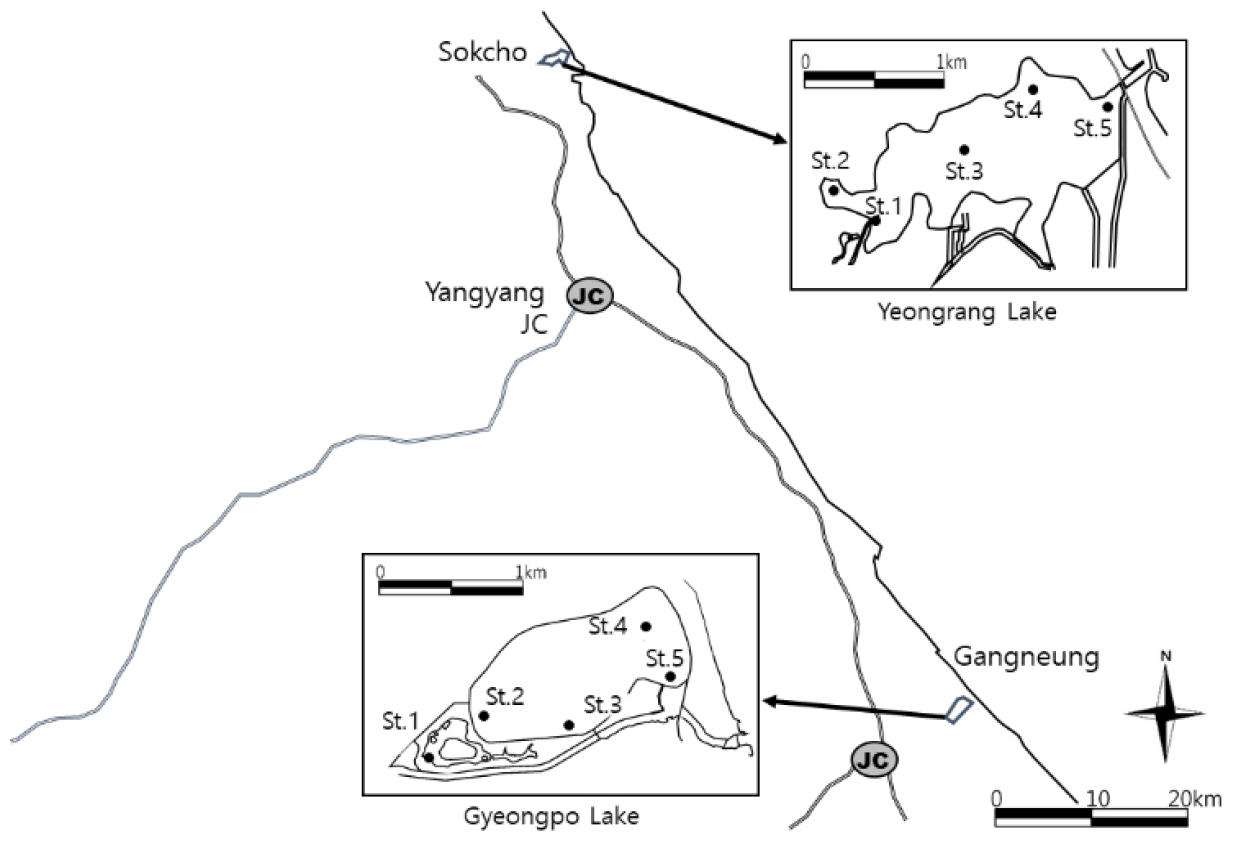
Table 1
Study period at Yeongrangho and Gyeongpoho
Bird Surveys
Bird surveys were conducted using binoculars (Kowa 8 × 32) and spotting scopes (Swarovski 20 × 65). We used a combination of line transects and point counts along the lakeshore to observe and record birds appearing on the lake and at the water’s edge. The observed birds were identified to the species level using field guides (Kim et al., 2003; Lee et al., 2000), and their numbers were recorded. Piscivorous birds were categorized based on their foraging behavior, differentiating between species that take prey from the water surface and those that dive to forage. The numbers of species and individuals in each category were recorded. Biological indices were calculated to understand the characteristics of bird communities. The indices used were based on accumulated counts and included the Dominance Index (DI; McNaughton, 1967), Species Diversity Index (H’; Pielou, 1966), Evenness Index (EI; Pielou, 1975), and Species Richness Index (RI; Margalef, 1957). These indices were used to compare and analyze the number of species, individuals, and dominant species in each survey area.
Fish Surveys
Fish Collection
Fish were collected seasonally, four times (once per season), from five sites in both Yeongrangho and Gyeongpoho at two inflow points, two inner lake points, and one outflow point.
∙ Upstream areas: To understand the characteristics of the fish community, quantitative surveys were conducted for one hour using hand nets (5 × 5 mm mesh) and cast nets (7 × 7 mm mesh).
∙ Inner lake areas: Fish were collected from the main body of the lake by setting and retrieving a fyke net (5 mm × 5 mm mesh) after 24 h.
All the collected fish were identified and measured onsite before release. Fish identification and collection methods followed those used in previous studies (Choi et al., 2002; Kim and Kang, 1993; Kim et al., 2005).
Fish Population Analysis
The collected fish data were analyzed separately for each lake and survey period.
∙ Quantitative index calculation: To understand the characteristics of the fish community, we calculated species richness, total abundance, and relative abundance. We also computed biological indices, including Dominance (DI), Species Diversity (H’), Evenness (EI), and Species Richness (RI).
∙ Dominant species and ecological type analysis: To identify the core species of the community, we selected the top 10 dominant species and compared their dominance ratios. Fish were classified by ecological type into primary freshwater fish (Pr), peripheral freshwater fish (Ph), and seawater fish (S), and the proportional changes in each type were examined (Hong et al., 2024).
∙ Seasonal trend analysis: The seasonal trends and characteristics of population fluctuations were analyzed, focusing on the dominant species.
Analysis of the Relationship Between Birds and Fish
We investigated the interrelationships between two taxonomic groups, piscivorous waterbirds (fish-eaters), and fish fauna, by comparing their spatiotemporal changes. The following analytical methods were used to interpret the characteristics of each lake ecosystem.
∙ Spatiotemporal comparison: We compared the fluctuations in piscivorous waterbird species richness and abundance with changes in fish fauna according to the survey period (season) and location (lake). This allowed us to determine how the abundance of fish at a specific time and place affected bird arrivals.
∙ Analysis of proportional changes by ecological type: We classified fish according to their ecological type, namely, freshwater, brackish, and marine, and examined the relationship between the proportional changes in these types and the presence of piscivorous birds. This provides important data for understanding how changes in the fish habitat environment influence the composition of bird food sources.
∙ Analysis of colonial breeding bird presence: We confirmed the presence or absence of colonial breeding birds to determine whether a stable food source (fish) influenced the formation of breeding grounds for specific bird species. This is a crucial indicator of long-term ecological connections between the two taxonomic groups beyond a simple predator-prey relationship.
Through these analyses, we sought to understand the complex relationship between fish and piscivorous birds in Yeongrangho and Gyeongpoho, and to identify the ecological characteristics of each lake.
Results
Bird fauna and piscivorous bird community
During the survey period, 57 species and 1,836 birds were identified in Yeongrangho. Meanwhile, 64 species and 2,821 individuals were observed in Gyeongpoho. This shows that Gyeongpoho had a higher number of both species and individuals than Yeongrangho. Among these, waterbirds closely associated with the aquatic ecosystem totaled 25 species and 1,057 individuals in Yeongrangho and 29 species and 2,178 individuals in Gyeongpoho, with a combined total of 32 species and 3,235 individuals confirmed across both lakes.
A breakdown of waterbirds by taxonomic order showed that the Anatidae family of the order Anseriformes accounted for the largest proportion, with 13 species and 2,008 individuals. This was followed by the Ardeidae family of the order Ciconiiformes (four species, 700 individuals), the Phalacrocoracidae family of the order Pelecaniformes (one species, 575 individuals), and the Laridae family of the order Charadriiformes (six species, 718 individuals). The other observed species included two species and 138 individuals of the order Podicipediformes, two species and 162 individuals of the order Gruiformes (family Rallidae), one species and one individual of the order Charadriiformes (family Charadriidae), and three species and six individuals of the family Scolopacidae (order Charadriiformes).
Nine species of piscivorous birds that primarily feed on fish were identified. These included Mergus merganser, Mergellus albellus, Podiceps cristatus, Tachybaptus ruficollis, Phalacrocorax carbo, Ardea cinerea, Ardea alba modesta, Ardea alba alba, and Egretta garzetta. The total number of individuals of these piscivorous birds was 608 in Yeongrangho and 866 in Gyeongpoho, with a cumulative total of 1,474 individuals across both lakes.
The dominant species among the piscivorous birds were P. carbo (575 individuals), A. cinerea (363 individuals), A. alba modesta (316 individuals), and M. merganser (110 individuals) (Table 2). A comparison by location showed that P. carbo was most frequently observed in Gyeongpoho (477 individuals), suggesting that it is the primary habitat for this species. In contrast, A. alba modesta was most abundant (252 individuals) in Yeongrangho. Seasonally, A. alba modesta was most abundant in Yeongrangho in May (232 individuals). Meanwhile, P. carbo was recorded at its highest numbers in Gyeongpoho in May (207 individuals).
Table 2
Number of fish-eating birds by survey site and season (Y: Yeongrangho, G: Gyeongpoho, DI: Dominance index of species)
|
Food type (Lee et al., 2000) | Family | Scientific name | Korean name | Y | G |
Sum of Y |
Sum of G | Total No. of birds | DI | Eco- type | ||||||
| Dec | May | July | Oct | Dec | May | July | Oct | |||||||||
|
Fisheating birds | Anatidae | Mergellus albellus | 흰비오리 | 6 | 14 | 6 | 14 | 20 | 0.618 | wv | ||||||
| Mergus merganser | 비오리 | 16 | 94 | 16 | 94 | 110 | 3.400 | res | ||||||||
| Podicipedidae | Tachybaptus ruficollis | 논병아리 | 4 | 9 | 8 | 4 | 17 | 21 | 0.649 | res | ||||||
| Podiceps cristatus | 뿔논병아리 | 6 | 1 | 17 | 19 | 5 | 7 | 41 | 48 | 1.484 | Res | |||||
| Ardeidae | Ardea cinerea | 왜가리 | 9 | 22 | 148 | 31 | 8 | 54 | 18 | 73 | 210 | 153 | 363 | 11.221 | res | |
| Ardea alba alba | 대백로 | 15 | 5 | 15 | 5 | 20 | 0.618 | Wv | ||||||||
| Ardea alba modesta | 중대백로 | 20 | 232 | 1 | 63 | 252 | 64 | 316 | 9.768 | sv | ||||||
| Egretta garzetta | 쇠백로 | 1 | 1 | 1 | 0.031 | sv | ||||||||||
| Phalacrocoracidae | Phalacrocorax carbo | 민물가마우지 | 2 | 34 | 62 | 26 | 207 | 90 | 154 | 98 | 477 | 575 | 17.774 | res | ||
| Sum of Fish-eating birds | 50 | 50 | 414 | 94 | 173 | 288 | 109 | 296 | 608 | 866 | 1,474 | 45.563 | ||||
|
Herbivorous birds | Anatidae | Aix galericulata | 원앙 | 4 | 2 | 4 | 2 | 6 | 0.185 | Res | ||||||
| Anas strepera | 알락오리 | 4 | 4 | 4 | 0.124 | Wv | ||||||||||
| Anas falcata | 청머리오리 | 9 | 9 | 9 | 0.278 | Wv | ||||||||||
| Anas platyrhynchos | 청둥오리 | 109 | 1 | 10 | 50 | 13 | 120 | 63 | 183 | 5.657 | Wv | |||||
| Anas poecilorhyncha | 흰뺨검둥오리 | 39 | 4 | 22 | 3 | 11 | 17 | 28 | 40 | 68 | 96 | 164 | 5.070 | Res | ||
| Anas acuta | 고방오리 | 15 | 6 | 3 | 15 | 9 | 24 | 0.742 | Wv | |||||||
| Anas crecca | 쇠오리 | 10 | 3 | 10 | 3 | 13 | 0.402 | Wv | ||||||||
| Sum of Herbivorous birds | 148 | 4 | 23 | 42 | 70 | 32 | 28 | 56 | 217 | 186 | 403 | 12.458 | ||||
| Omnivorous birds & others | Anatidae | Aythya ferina | 흰죽지 | 3 | 1 | 32 | 23 | 6 | 4 | 61 | 65 | 2.009 | Wv | |||
| Aythya fuligula | 댕기흰죽지 | 1 | 20 | 68 | 24 | 1 | 112 | 113 | 3.493 | wv | ||||||
| Aythya marila | 검은머리흰죽지 | 4 | 169 | 19 | 35 | 4 | 223 | 227 | 7.017 | wv | ||||||
| Bucephala clangula | 흰뺨오리 | 28 | 38 | 28 | 38 | 66 | 2.040 | wv | ||||||||
| Rallidae | Gallinula chloropus | 쇠물닭 | 2 | 2 | 4 | 0.062 | sv | |||||||||
| Fulica atra | 물닭 | 2 | 119 | 39 | 2 | 158 | 475 | 14.621 | res | |||||||
|
Charadriidae & Scolopacidae | Vanellus cinereus | 민댕기물떼새 | 1 | 1 | 1 | 0.031 | Pm | |||||||||
| Tringa ochropus | 삑삑도요 | 1 | 1 | 1 | 0.031 | wv | ||||||||||
| Tringa glareola | 알락도요 | 4 | 4 | 4 | 0.124 | Pm | ||||||||||
| Actitis hypoleucos | 깝작도요 | 1 | 1 | 1 | 0.031 | sv | ||||||||||
| Laridae | Larus crassirostris | 괭이갈매기 | 85 | 6 | 1 | 114 | 3 | 92 | 117 | 209 | 6.461 | res | ||||
| Larus canus | 갈매기 | 12 | 201 | 12 | 201 | 213 | 6.584 | Wv | ||||||||
| Larus vegae | 재갈매기 | 67 | 6 | 79 | 73 | 79 | 152 | 4.699 | Wv | |||||||
| Larus schistisagus | 큰재갈매기 | 7 | 3 | 7 | 3 | 10 | 0.309 | Wv | ||||||||
| Larus ridibundus | 붉은부리갈매기 | 130 | 130 | 130 | 4.019 | Wv | ||||||||||
| Rissa tridactyla | 세가락갈매기 | 4 | 4 | 4 | 0.124 | Wv | ||||||||||
| Sum of Omnivorous birds | 124 | 94 | 6 | 8 | 905 | 151 | 4 | 66 | 232 | 1,126 | 725 | 22.413 | ||||
| Number of total individuals | 322 | 148 | 443 | 144 | 1,148 | 471 | 141 | 418 | 1,057 | 2,178 | 3,235 | 100.0 | ||||
| Number of species | 14 | 10 | 6 | 11 | 21 | 13 | 6 | 12 | 25 | 29 | 32 | |||||
| Dominance index (DI) | 0.547 | 0.723 | 0.858 | 0.646 | 0.322 | 0.584 | 0.837 | 0.543 | 0.437 | 0.321 | 0.290 | |||||
| Diversity index (H’) | 2.029 | 1.402 | 1.123 | 1.716 | 2.508 | 1.853 | 1.022 | 1.840 | 2.327 | 2.669 | 2.749 | |||||
| Evenness index (EI) | 0.769 | 0.609 | 0.627 | 0.715 | 0.824 | 0.723 | 0.571 | 0.741 | 0.723 | 0.793 | 0.793 | |||||
| Richness index (RI) | 2.251 | 1.801 | 0.821 | 2.012 | 2.839 | 1.950 | 1.010 | 1.823 | 3.447 | 3.643 | 3.836 | |||||
Comparison of Fish Fauna and Fish Community Characteristics
Yeongrangho had 42 species belonging to 26 families and 11 orders, with a total of 3,478 individuals. Gyeongpoho contains 25 species from 14 families and 10 orders, totaling 10,671 individuals. This indicates that Gyeongpoho had 3.07 times more individuals but only 0.60 times the number of species compared to Yeongrangho. The dominant species in Yeongrangho were, in order, Tribolodon hakonensis, Acanthogobius flavimanus, and Konosirus punctatus. Their relative abundances were 24.76% (866 individuals) in T. hakonensis, 23.93% (847 individuals) in A. flavimanus, 10.23% (595 individuals) in K. punctatus, and 9.9% (358 individuals) in Engraulis japonicus (Fig. 2). These four species accounted for 58.92% of the total fish population in Yeongrangho. The dominant species in Gyeongpoho Province were K. punctatus, A. flavimanus, and T. hakonensis. The relative abundances were 48.67% (5,194 individuals) for K. punctatus, 21.66% (2,311 individuals) for A. flavimanus, and 16.37% (1,747 individuals) for T. hakonensis. These three species constitute 86.70% of the total fish population in Gyeongpoho.
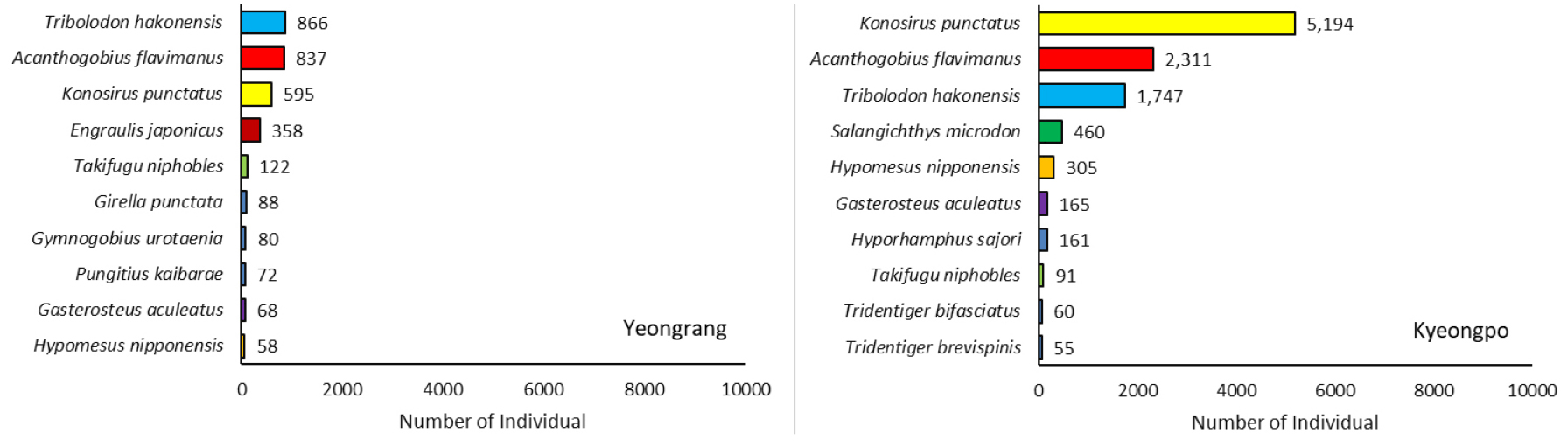
Looking at the fish species confirmed in both lakes, K. punctatus accounted for 5,789 individuals (29.45% of the total fish population), A. flavimanus for 3,158 individuals (22.80%), and T. hakonensis for 2,613 individuals (20.57%). Together, these three species constituted 72.81% of the total fish population (Fig. 2, Fig. 3). In terms of the seasonal distribution, Yeongrangho had more than three times the number of individuals in July (1,510 individuals) and October (1,167 individuals) than in December (215 individuals) or May (596 individuals). Gyeongpoho had 1,099 individuals in July, 2,768 in October, and 6,561 in May, but only 243 in December, indicating a significant decrease in the fish population during winter (Fig. 2 and Table 3). The dominance index of Yeongrangho was 0.490, whereas that of Gyeongpoho was 0.703. Yeongrangho also showed higher values for all other indices, with a species diversity of 2.249 (vs. 1.156 for Gyeongpoho) and evenness of 0.602 (vs. 0.471 for Gyeongpoho). This suggests that while Gyeongpoho has a larger fish population, it has fewer species and experiences a concentration phenomenon at certain times of the year.
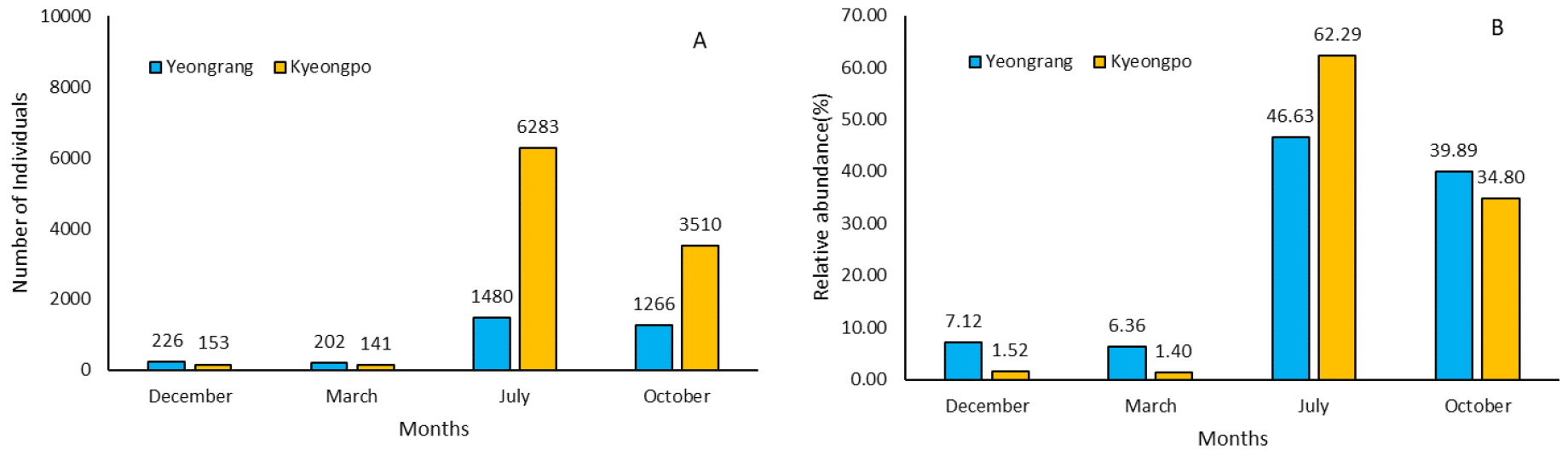
Table 3
List of top dominant fish species in Yeongrangho and Gyeongpoho by season (RA: Relative Abundance; Hong et al., 2024)
| Order | Family | Scientific name | Korean name | Yeongrangho | Gyeongpoho |
Eco- type | ||||||||||
| Dec | May | July | Oct | Sum | RA | Dec | May | July | Oct | Sum | RA | |||||
|
CLUPEIFORMES 청어목 | ENGRAULIDAE | Engraulis japonicus | 멸치 | 251 | 107 | 358 | 10.23 | 7 | 19 | 26 | 0.24 | S | ||||
| CLUPEIDAE | Konosirus punctatus | 전어 | 29 | 368 | 198 | 595 | 17.16 | 4,997 | 156 | 41 | 5,194 | 48.67 | ph | |||
|
CYPRINIFORMES 잉어목 | CYPRINIDAE | Tribolodon hakonensis | 황어 | 6 | 215 | 281 | 364 | 866 | 24.97 | 161 | 178 | 398 | 1,010 | 1,747 | 16.37 | ph |
| Zacco platypus | 피라미 | 1 | 4 | 3 | 41 | 49 | 1.41 | pr | ||||||||
|
OSMERIFORMES 바다빙어목 | OSMERIDAE | Hypomesus nipponensis | 빙어 | 43 | 5 | 48 | 1.67 | 304 | 1 | 305 | 2.86 | ph | ||||
| Salangichthys microdon | 뱅어 | 18 | 18 | 0.52 | 459 | 1 | 460 | 4.31 | ph | |||||||
|
MUGILIFORMES 숭어목 | MUGILIDAE | Mugil cephalus | 숭어 | 1 | 13 | 5 | 19 | 0.55 | 3 | 13 | 2 | 18 | 0.17 | ph | ||
|
BELONIFORMES 동갈치목 | HEMIRAMPHIDAE | Hyporhamphus sajori | 학공치 | 1 | 3 | 4 | 0.12 | 93 | 68 | 161 | 1.51 | ph | ||||
|
GASTEROSTEIFORMES 큰가시고기목 | GASTEROSTEIDAE | Gasterosteus aculeatus | 큰가시고기 | 68 | 68 | 1.96 | 165 | 165 | 1.55 | ph | ||||||
| Pungitius kaibarae | 잔가시고기 | 7 | 19 | 32 | 14 | 72 | 2.08 | pr | ||||||||
|
PERCIFORMES 농어목 | KYPHOSIDAE | Girella punctata | 벵에돔 | 88 | 88 | 2.54 | 2.54 | |||||||||
| EMBIOTOCIDAE | Ditrema temminckii | 망상어 | 1 | 40 | 6 | 48 | 1.36 | S | ||||||||
| GOBIIDAE | Acanthogobius flavimanus | 문절망둑 | 167 | 68 | 273 | 329 | 937 | 24.13 | 64 | 395 | 323 | 1,529 | 2,311 | 21.66 | ph | |
| Gymnogobius urotaenia | 꾹저구 | 6 | 41 | 20 | 13 | 80 | 2.31 | Pr | ||||||||
| Tridentiger bifasciatus | 민물두줄망둑 | 12 | 1 | 5 | 1 | 19 | 0.52 | 15 | 18 | 19 | 8 | 60 | 0.56 | pr | ||
| Tridentiger brevispinis | 민물검정망둑 | 1 | 46 | 3 | 50 | 1.44 | 2 | 7 | 46 | 55 | 0.52 | pr | ||||
|
TETRAODONTIFORMES 복어목 | TETRATODONTIDAE | Takifugu niphobles | 복섬 | 109 | 13 | 122 | 3.52 | 38 | 43 | 10 | 91 | 0.85 | ph | |||
| Other Species | 14 | 43 | 23 | 68 | 138 | 6.05 | 0.46 | 2 | 40 | 33 | 75.46 | 0.73 | ||||
| Number of individuals | 215 | 586 | 1,510 | 1,167 | 3,478 | 243 | 6,561 | 1,099 | 2,768 | 10,671 | ||||||
| Number of species | 14 | 20 | 22 | 29 | 42 | 6 | 11 | 14 | 22 | 25 | ||||||
| Dominance index (DI) | 0.833 | 0.483 | 0.430 | 0.594 | 0.490 | 0.926 | 0.832 | 0.656 | 0.917 | 0.703 | ||||||
| Diversity index (H’) | 1.015 | 2.118 | 2.036 | 1.906 | 2.249 | 0.864 | 0.950 | 1.688 | 1.077 | 1.516 | ||||||
| Evenness index (EI) | 0.384 | 0.707 | 0.659 | 0.566 | 0.602 | 0.482 | 0.396 | 0.640 | 0.348 | 0.471 | ||||||
| Richness index (RI) | 2.421 | 2.981 | 2.869 | 3.965 | 5.028 | 0.910 | 1.138 | 1.857 | 2.650 | 2.588 | ||||||
Regarding the proportion of individuals according to ecological type, Yeongrangho contained 16.49% marine fish, 75.49% brackish fish, and 8.03% freshwater fish. Gyeongpoho contained 9.83% marine fish, 89.03% brackish fish, and 1.14% freshwater fish. This shows that in both lakes, brackish species accounted for the majority, whereas the proportion of freshwater fish was low (Table 4). In contrast, the proportion of marine fish was higher at Yeongrangho (16.49%) than at Gyeongpoho (9.83%). When analyzed by season, the proportion of marine fish in Yeongrangho increased to 25.96% in July. Meanwhile, the proportion of freshwater fish was highest at 17.67% in December. In Gyeongpoho, the proportion of marine fish rose to 93.36% in July but was low at 0.41% in both December and May. The proportion of brackish fish in Gyeongpoho varied, reaching 93.00%, 99.70%, and 96.78% in December, May, and October, respectively. Therefore, in both lakes, the proportion of brackish-water species was high, ranging from 75% to 89%, and marine fish migrated to or inhabited the lakes.
Table 4
Number and proportion of fish by ecological type according to the survey period (Percentage in parentheses)
| Eco type | Yeongrangho | Gyeongpoho | ||||||||
| Dec | May | July | Oct | Total | Dec | May | July | Oct | Total | |
| Pr |
38 (17.67) |
96 (16.11) |
66 (4.37) |
80 (6.86) |
280 (8.03) |
16 (6.58) |
20 (0.30) |
19 (1.73) |
67 (2.42) |
122 (1.14) |
| Ph |
175 (81.40) |
489 (82.05 |
1,052 (69.67) |
917 (78.58) |
2,633 (75.49) |
226 (93.00) |
6,541 (99.70) |
54 (4.91) |
2,679 (96.78) |
9,500 (89.03) |
| S |
2 (0.93) |
11 (1.85) |
392 (25.96) |
170 (14.57) |
575 (16.49) |
1 (0.41) |
0 (0.00) |
1,026 (93.36) |
22 (0.79) |
1,049 (9.83) |
| total |
215 (100.0) |
596 (100.0) |
1,510 (100.0) |
1,167 (100.0) |
3,478 (100.0) |
243 (100.0) |
6,561 (100.0) |
1,099 (100.0) |
2,768 (100.0) |
10,671 (100.0) |
Relationship Between Birds and Fish
The results of seasonal comparisons between piscivorous bird and fish fauna are shown in Fig. 4. Population changes in the two taxonomic groups showed similar patterns at both Yeongrangho and Gyeongpoho. Although the fish population in Gyeongpoho surged in May, the bird population did not increase sharply. This appears to be due to the confirmed presence of 4,997 K. punctatus individuals that were presumed to have migrated from the sea. Piscivorous birds that use lakes as habitats for colonial breeding were identified as A. cinerea and A. alba modesta in Yeongrangho and P. carbo in Gyeongpoho. In Yeongrangho, the populations of A. alba modesta and A. cinerea increased in July when fledglings from a nearby Ardeidae breeding ground moved to the lake and showed a decreasing trend in October. In Gyeongpoho, the population of P. carbo increased in May because of foraging activities by birds breeding in the Sagimak Reservoir, which is located approximately 5 km west (Park and Park 2022).
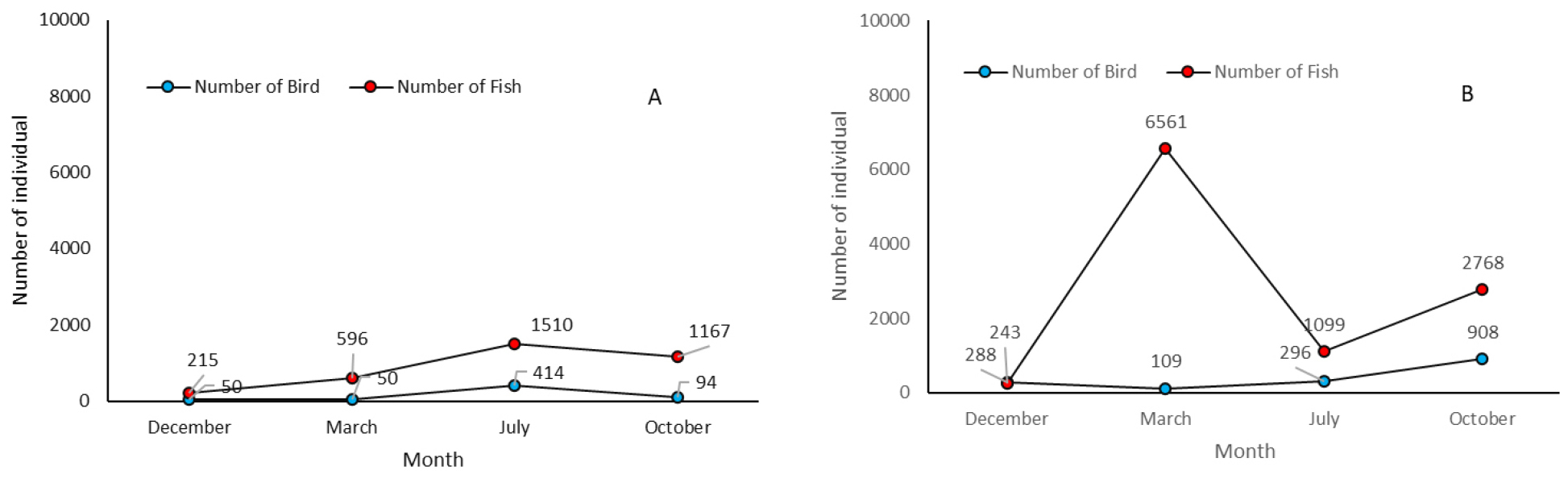
Although the proportion of marine fish was higher in Yeongrangho (16.49%) than in Gyeongpoho (9.83%), the overall proportion was low. Both Yeongrangho (75.49%) and Gyeongpoho (89.03%) had high proportions of brackish water species. Regarding the population changes of dominant fish species and piscivorous birds, the dominant fish species in Yeongrangho, T. hakonensis (24.76%) and A. flavimanus (24.13%), were abundant during most of the study period. Meanwhile, K. punctatus (17.01%) was abundant in July and October. The piscivorous bird population was highest in July and showed a similar increasing trend. In Gyeongpoho, the dominant species, K. punctatus (48.67%), was observed in high numbers in May, whereas A. flavimanus (21.66%) and T. hakonensis (16.37%) were abundant in October. The piscivorous bird population was highest in October, indicating that the bird population increased during periods of high fish abundance. Excluding the observation of K. punctatus in Gyeongpoho in May, the fish and piscivorous bird populations were proportional in both lakes. The ratio of piscivorous bird population to fish population was 1:12.51 on average. However, the seasonal ratio varied significantly, with a standard deviation of 8.07 ± 4.74 in Yeongrangho and 16.95 ± 28.85 in Gyeongpoho, indicating a lack of consistency.
Discussion
In this study, we compared and analyzed the piscivorous bird and fish communities in Yeongrangho and Gyeongpoho, two eastern coastal lagoons with similar geographical locations and proximity to urban areas. We aimed to examine how the environmental factors in each lake influenced the composition of their ecosystems. Lagoon ecosystems are of high ecological value because their unique biological communities are formed by the interactions between freshwater and seawater. Fish are core components that directly influence the distribution and abundance of top predators, such as piscivorous birds.
Comparison of Fish Community Characteristics and Environmental Factors
The survey results of the fish fauna in Yeongrangho and Gyeongpoho showed clear differences between the two lakes. Gyeongpoho had fewer species (25) than Yeongrangho (42 ); however, the total number of individuals (10,671) was approximately 3.07 times higher than that of Yeongrangho (3,478). This suggests that Gyeongpoho has high biological productivity, but its species diversity (H’ = 1.156) and evenness (EI = 0.471) were lower than Yeongrangho’s (H’ = 2.249, EI = 0.602), indicating a prominent concentration phenomenon. Here, the population is dominated by a few specific species, such as Konosirus punctatus (48.67%). While the dominant species in Gyeongpoho were K. punctatus (48.67%), Acanthogobius flavimanus (21.66%), and T. hakonensis (16.37%), Yeongrangho’s were T. hakonensis (24.76%), A. flavimanus (23.93%), and K. punctatus (10.23%), showing a difference in the composition of dominant species. The overwhelming dominance of K. punctatus in Gyeongpoho, accounting for 86.70% of the total fish population, and the resulting concentration phenomenon, suggests that the relatively stable brackish environment provided favorable conditions for the mass inflow and breeding of specific brackish/marine species. This is further supported by the ecological characteristics of K. punctatus, which migrates into bays with rising spring temperatures during the spawning season (March) (Choi et al., 2006; Ko, 2006; Lee, 1983).
In terms of the ecological indices for the fish community, Yeongrangho (species diversity 2.249, evenness 0.602, and dominance 0.490) had higher values for most indices than Gyeongpoho (species diversity 1.156, evenness 0.471, and dominance 0.703). This suggests that the species distribution of the fish community in Yeongrangho was more diverse than that in Gyeongpoho. Fish habitats in lagoons are influenced by various environmental factors, including water depth, salinity, plankton quantity, turbidity, degree of eutrophication, sandbar width, and the level of damage from human intervention (Byeon, 2018; Park et al., 2014).
Despite having a smaller total population, Yeongrangho maintained a higher species diversity, with a greater number of species (42) and a more even distribution. This suggests that the fish community in Yeongrangho was exposed to different environmental pressures than those in Gyeongpoho. Yeongrangho has a history of mass fish die-offs owing to eutrophication and stratification (Kim et al., 2008), followed by efforts to increase artificial seawater circulation (Hong et al., 2024). This expansion of seawater inflow appeared to have accelerated the marineization of the fish community, causing a shift from the dominance of freshwater/brackish fish to a higher proportion of marine species (Choi et al., 2007; Hong et al., 2024). The high salinity, which reached around 30.00‰, and the higher proportion of brackish and marine species among the dominant fish further support this finding (Hong et al., 2024). Artificial structures, such as pontoons, can indirectly affect fish density and distribution by causing changes in water flow, dissolved oxygen concentration, and sediment composition (Park et al., 2024).
Piscivorous Bird Community and Relationship with Fish
Our survey results showed that the number of individual piscivorous waterbirds that preyed on fish was higher in Gyeongpoho (1,474 individuals) than in Yeongrangho (866 individuals). The number of species was higher in Gyeongpoho (29) than in Yeongrangho (25). As piscivorous birds respond highly sensitively to the abundance of fish (their food source), their population size can be interpreted as a crucial indicator of the quantity of fish and the diversity and health of lower trophic levels. The total fish population of Gyeongpoho, being approximately three times larger than that of Yeongrangho, is a key factor supporting the higher piscivorous bird population in Gyeongpoho.
A proportional relationship was generally observed between seasonal fish population sizes, excluding K. punctatus, and piscivorous bird population sizes. This suggests that the food chain influences the population dynamics of top predators. The number of key piscivorous birds, such as P. cristatus (seven individuals in Yeongrangho vs. 41 in Gyeongpoho) and P. carbo (98 individuals vs. 575), was also significantly higher in Gyeongpoho. This indicates a direct correlation with the quantity of their food sources (top three dominant species: 2,398 individuals in Yeongrangho vs. 9,252 in Gyeongpoho).
The significant decrease in fish population in December can be attributed to a combination of freezing, decreased fish activity due to lower water temperatures, increased predation pressure from overwintering piscivorous birds such as P. cristatus, seasonal changes in food sources such as plankton (Choi, 2011), and the potential migration of marine fish to the sea (Kang et al., 2006). Nevertheless, the East Sea lagoons are important habitats and foraging grounds for various waterfowl species, especially for piscivorous birds that arrive during winter (Park and Jeong, 2012). High fish productivity for specific species, which is a crucial food source for birds, was confirmed in Gyeongpoho during winter.
Breeding Grounds and Physical Environmental Factors
The presence of colonial bird breeding grounds is closely related to the availability of adjacent habitats that can supply food. Due to the influence of a nearby Ardeidae family breeding ground, the number of A. alba modesta and A. cinerea in Yeongrangho increased in July when fledglings moved to the lake and then showed a decreasing trend in October. In Gyeongpoho, the population of P. carbo increases in May because of foraging activities by birds breeding in the Sagimak Reservoir, located approximately 5 km to the west (Park and Park, 2022). Therefore, the presence of adjacent breeding grounds has likely had a certain level of predation pressure on the fish fauna in each lake.
P. carbo is a representative piscivorous bird, whose population has recently increased. In the present study, a larger population was observed in Gyeongpoho than in Yeongrangho. Considering that the daily food intake (DFI) of P. carbo is approximately 672 g/day (441-1,095 g/day; Gremillet et al., 2003). If all 207 individuals observed in Gyeongpoho in May consumed fish from the lake, this would result in a daily consumption of approximately 139.1 kg of fish. This suggests that the fish supply from the lake itself is limited, and foraging activities likely occurred actively in the surrounding waters, such as the Gyeongpo Detention Basin, Gasiyeon Wetland, Gyeongpo Reservoir, Sunpoho, and Namdaecheon River. This implies that the habitat distribution of piscivorous birds is influenced by food availability within a specific lagoon, and by broader ecological connectivity with adjacent areas.
Water depth may not directly affect the fish-catching ability of diving birds. However, water clarity is a crucial factor (Ko, 2006; Park and Choi, 2014). Despite being deeper than Gyeongpoho, the high transparency of Yeongrangho is advantageous for fish capture. Meanwhile, Gyeongpoho is shallow but highly turbid (Choi, 2011). This turbidity is likely caused by the mixing of inflowing freshwater from the downstream area, which then backflows into the lake, reducing transparency even in the upper parts of the lake. The high turbidity in Gyeongpoho is predicted to partially hinder the foraging efficiency of piscivorous birds.
Changes in Ecological Type and the Impacts of Human Intervention
The proportion of fish by ecological type, that is, freshwater, brackish, and marine, changes with events, such as sandbar breaches, with a higher proportion of marine fish appearing during periods of active seawater inflow (Choi et al., 2007). Fish communities in the East Sea lagoons are changing because of natural succession, artificial seawater flow control, and surrounding environmental changes. These are seen as a decrease in freshwater and brackish fish and an increase in marine fish (Park et al., 2014). Waterbirds that eat fish forage in lagoons, as well as on the coast. Therefore, they tend to use freshwater, brackish, and marine fish without much distinction. Both Yeongrangho and Gyeongpoho have high salinity levels of around 30.00‰, and the high proportion of brackish and marine species among the dominant fish is closely related to these salinity changes (Hong et al., 2024).
Lake freezing is heavily influenced by temperature. However, changes in salinity can also have effects (Hong et al., 2024). Upstream areas, where freshwater flows in and water movement is restricted, are particularly vulnerable to freezing due to lower salinity. Lake freezing is an important factor negatively affecting the habitats of waterbirds that use shorelines (Park and Choi, 2014). Although Yeongrangho is located farther north and may be more affected by temperature, the similar salinity levels of the two lakes suggest that the impact of salinity on freezing is limited. In both lakes, freezing occurred in the shallow upstream sections during winter. In Yeongrangho, freezing also occurred around the pontoon, suggesting that the structure may influence the freezing pattern.
The pontoons installed in Yeongrangho in 2021 will not have a clear direct impact on bird distribution within the lake. This could be because of the high mobility of birds and their decreased avoidance of people and structures (Lethlean et al., 2017; Mikula et al., 2024). However, the installation of artificial structures, such as walking paths and pontoons, raises concerns about their potential negative impacts on the lagoon ecosystem (Hong et al., 2024). This highlights the importance of balancing development and conservation. In terms of habitat conservation and restoration, Yeongrangho has not experienced a physical increase in bird habitats. Meanwhile, Gyeongpoho has expanded its habitat through the Gyeongpo Wetland restoration project. This, along with connectivity to adjacent farmlands, the Gyeongpocheon River, and detention ponds, provides sufficient habitat. This expansion of habitat area is believed to have had a positive effect on the maintenance of the population of piscivorous birds in Gyeongpoho.
Comparison with Other Lagoons and Study Limitations
The fish community of Yeongrangho and Gyeongpoho analyzed in this study can be understood more deeply by comparing them with those of other East Sea lagoons. Hwajinpo Lake has undergone changes in its fish community owing to human-induced hydro-environmental changes (wetland development) and fluctuations in seawater circulation methods (artificial sandbar breaching) (Park et al., 2007). It has also shown a pattern of marineization similar to Yeongrangho, with a high dominance of specific marine fish species (Hong et al., 2024). Such comparisons can help clarify the commonalities and differences in the environmental changes experienced by the East Sea lagoons.
Furthermore, the East Sea lagoons are undergoing eutrophication, as evidenced by high concentrations of total nitrogen (TN) and total phosphorus (TP) from agricultural and residential runoff (Moon et al., 2015). These changes in water quality directly affect phytoplankton communities (Moon et al., 2015), and differences in zooplankton community structure due to salinity (Lee et al., 2024) influence the diversity of fish food sources, indirectly affecting piscivorous birds. Therefore, future research should include a more in-depth analysis of these lower trophic-level changes.
The results suggest that due to complex environmental changes such as increased artificial seawater circulation and pontoon installation, Yeongrangho exhibits unstable ecological characteristics, including the marineization of its fish community and high species diversity, but a relatively low total number of individuals. In contrast, Gyeongpoho maintains a relatively stable brackish environment and supports a rich population of piscivorous birds with relatively high fish productivity, albeit dominated by a few species. This implies that when establishing conservation and management strategies for lagoon ecosystems, it is crucial to carefully consider each lake’s environmental change patterns and the resulting fish-bird food chain relationship.
The East Sea lagoons are important habitats and wintering grounds for various waterfowl species because of their geographical location and environmental characteristics (Park and Jeong, 2012). In this study, we elucidated the relationship between piscivorous birds and fish communities. However, owing to the mobility of fish and the wide foraging range of birds, it is difficult to quantify the birds’ dependence on food sources within lagoons. A more detailed study of the seasonal survey frequency and number of survey points would enable a more accurate understanding of subtle fluctuations in fish and bird populations. Future research should include long-term monitoring and employ various ecological analysis techniques, such as stable isotope analysis, to investigate the fish-bird food chain relationship more precisely.