


Introduction
Market Openings and Changes in the Livestock Industry
Analysis Methods and Data
Analysis methods
Analysis data
Analysis Results
Impact of market openings
Analysis of the impact of market access on agricultural income of livestock farmers
Conclusion
Introduction
Since the launch of the WTO, South Korea has begun liberalizing trade in agricultural and livestock products, and has since signed a total of 18 FTAs with 58 countries, starting with the Korea-Chile FTA followed by the Regional Comprehensive Economic Partnership (RCEP), thereby opening its markets. In particular, in the livestock sector, imports from developed countries such as the United States, the European Union, and the Commonwealth of Nations have surged, causing massive damage to the domestic livestock industry. In response, various financial investment and financing policies for the livestock industry were promoted by the government, which either led to an increase in agricultural productivity or slowed restructuring. As a result, the supply of livestock products remained stable despite the expanded import of livestock products. In the end, real domestic livestock prices became lower than in the past, but the increase in international oil and grain prices raised the prices of feed grain inputs, leading to a rapid deterioration in the terms of trade of livestock farmers. As a result, the share of agricultural income among livestock farmers also decreased, leading to widening disparities in agricultural income between livestock farmers, between livestock species, and between regions depending on productivity levels. Furthermore, the instability of livestock farmers’ agricultural income has increased. Prior to market liberalization, domestic livestock farmers were engaged in limited competition with imported livestock products under conditions of imperfect competition. However, with the opening of the market to unlimited competition, livestock farmers now compete not only with imported livestock products but also with domestic livestock products, resulting in increased or decreased volatility in agricultural income depending on the type of livestock. Increased instability in agricultural incomes can have a significantly negative impact on the sustainability of agriculture and revitalization of rural economies. There is significant potential for livestock farmers to abandon the industry, threatening its very foundation. Therefore, it is urgent to analyze the current situation of livestock farming income instability, identify its causes, and take appropriate countermeasures, such as promoting relevant agricultural policies.
This study aims to understand the impact of market openings, such as FTAs, on agricultural incomes in the livestock sector from diverse perspectives by livestock species, and to suggest relevant countermeasures. Specifically, we sought to analyze how market opening along with livestock product prices, production quantity, input costs, and other factors affected livestock farmers’ agricultural income. To this end, we used a production function to examine changes in livestock productivity, and finally, estimated an agricultural income function to identify the effects of market opening. This study is organized as follows: Chapter 2 examines the trends in imports of major livestock products and the changes in livestock farmers’ agricultural management balance and income through a time series analysis of livestock management before and after market opening. In Chapter 3, we conduct an empirical analysis. Chapter 4 provides a summary and suggestions.
Market Openings and Changes in the Livestock Industry
Livestock products were imported in limited quantities after the 1995 WTO beef panel loss. However, the Korea-Chile FTA, followed by the Korea-US FTA in 2007 and the Korea-EU FTA in 2011, significantly expanded livestock imports. In addition, the promotion of FTAs with three Commonwealth countries, including the Korea-Australia FTA in 2013, the Korea-Canada FTA in 2014, and the Korea-New Zealand FTA in 2015, has had a significant impact on the domestic livestock industry (Fig. 1).
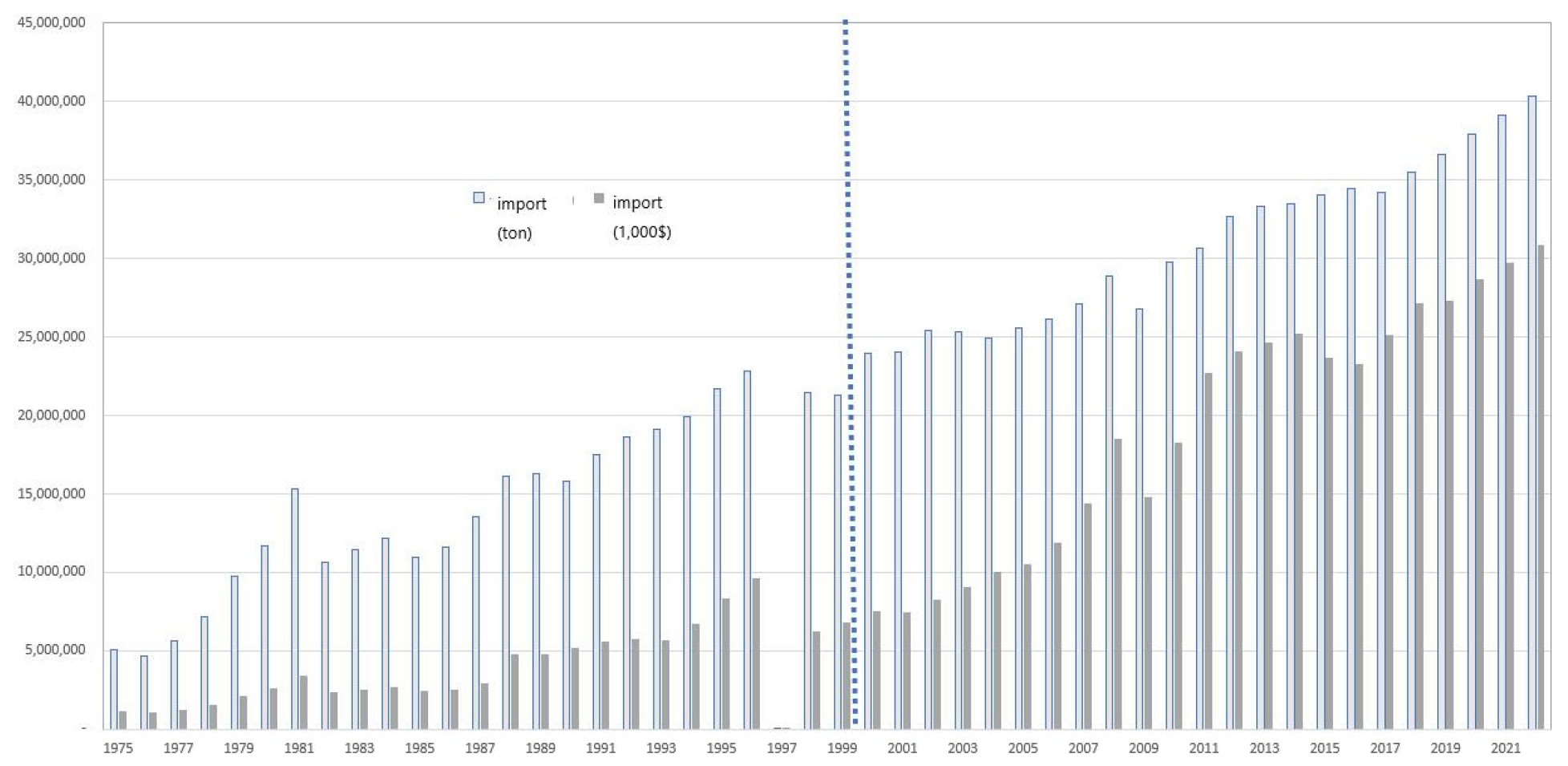
Since establishing the Korea-Chile FTA in 2004, Korea’s market opening for livestock products has rapidly expanded. As shown in Table 1, changes in agricultural income by livestock type from 1998-2000 (the last period before the market opening) to 2018-2021 (the latest period after the market opening) shows a steep increase in the revenue for Hanwoo. However, management costs have also increased. Accordingly, the agricultural income rate fell steadily from 21.5% before market opening to 12.5% on average over the last three years. For pigs, the change in agricultural income per head decreased by -3.3 percentage points (16.9% to 13.6%). This was due to a sharp increase in revenue growth by livestock species between the period before market opening and the last three years, but income declined as the growth in operating expenses outpaced the growth in revenue. Meanwhile, in the case of broiler farming, the percentage change in revenue and operating expenses before and after market opening was -25.1% and -20.4%, respectively, resulting in a 51.1% decrease in income and a 5.5% decrease in income rate.
Table 1.
Changes in Revenue, Operating Expenses, and Income of Major Livestock Products Before and After Market Liberalization (1998/2000-2018/2021)
Analysis Methods and Data
Analysis methods
The volatility of agricultural income among livestock farmers is caused by various factors, including production, supply and demand, economic conditions, livestock diseases, climate change, and input and output prices. Among these, we aimed to identify how and to what extent market opening measures such as the establishment of the WTO and FTAs have affected the agricultural income of livestock farmers. Specifically, we analyzed how livestock product prices (P), production quantity (Q), and input costs (C), which constitute the agricultural income () of livestock farmers, affected agricultural income () as a result of market opening. Market opening affects livestock product and input costs, which in turn determine production quantity and productivity. Thus, we estimated a production function to examine the effect of market opening on livestock productivity. Finally, based on the analysis of these components, we estimated an agricultural income function () to determine the overall effect of market opening.
Most of the previous studies on agricultural income volatility have focused on farmers’ business risks, analyzing farmers’ income volatility and price instability. In particular, through research on the determination and distribution of farm income, we aimed to contribute to the distribution of farm income and the establishment of policies for low-income farmers by analyzing the determinants of farm income and suggesting prospects and policy directions for farm income (Hwang and Moon, 2003; Kim et al., 2002; Kim and Jung, 2017; Kwon and Kang, 2008; Kwon and Choi, 2006; Park et al., 2012). On the other hand, most studies on market openings such as the WTO and FTAs and changes in agricultural incomes have been conducted on the level of damage to major commodities, price instability, and income changes before and after market openings, and related industry spillover effects (Kim et al., 2001; Lee, 2008; Lim et al., 2009, Lim et al., 2011).
Previous studies focused on how current events, institutions, and government policies, including market opening, affected changes in agricultural incomes. However, few studies have simultaneously analyzed the impact of market opening on key factors such as output prices, input costs, and key factors of production that directly contribute to agricultural income. This study is unique in that it addresses the limitations of existing research and takes a step toward increasing livestock farmers’ incomes and mitigating volatility.
Analysis of the productivity impact of market openings
The opening of the market to unlimited competition has led to competition not only between imported livestock products but also between domestic products, although the conventional wisdom holds that this improves productivity. As such, it can be assumed that market opening would have a significant impact on production quantity, a key component of agricultural income determination. Therefore, this section analyzes the impact of market opening on livestock production in Korea using production functions.
The data used for estimating the production function were divided into four input factors, namely (1) capital, (2) labor, (3) land, and (4) intermediate goods, as explanatory variables, and production value as the dependent variable. Based on the National Farm Economic Survey data from Statistics Korea, the number of farm households was multiplied to construct each value data, and the GDP deflator was used to convert the data to real values based on 2015 values. We used the cost of livestock imports as a proxy for market openness.
Assuming that output (Q) is produced by two factors, capital (K) and labor (L), we can use an extended Cobb-Douglas-type production function to estimate the change in productivity by market opening as follows:
Where Q is production value, K is capital, L is labor, IM is livestock imports, is the factor that affects production over time, and represents elasticity (Park et al., 2012). Total factor productivity is denoted as TFP, and dividing Eq. (1) by Eq. (2). After taking the logarithm and differentiating with respect to time, we obtained Eq. (3).
Where, denotes the elasticity, combining and Eq. (3) becomes Eq. (4).
Here is the marginal productivity of livestock imports, is the growth rate of livestock imports during the market opening period, and is the growth rate of total factor productivity. Using Eq. (4), we estimated the extent to which the increase in livestock imports due to market opening increased productivity before and after 1999. Initial market openings are known to lower livestock prices due to competition between imported and domestic livestock. However, after a significant period, the demand for high-quality livestock products increases and capital investment may increase to improve the quality of livestock products, such as the development of new breeds, improved specification technology, and modernization of livestock facilities, leading to an increase in livestock prices. Therefore, accounting for the differences in market opening between periods, we divided the entire analysis period into two and utilized a production function. To set the period, we evaluated structural changes in imported livestock products and used FAO data to find structural changes that appeared in both total imports and import value (the result of the Bai-Perron test for structural change (break point) was = 7.53). Thus, we estimated production functions based on the period before and after 1999.
Analysis of the impact of market access on agricultural income of livestock farmers
This study aimed to estimate how various factors have influenced changes in agricultural income and its volatility alongside market liberalization. To this end, a model assuming multiplicative heteroscedasticity as proposed by Harvey (1976) was applied. First, the general regression model can be represented in a matrix form as in Eq. (5).
Where is the dependent variable vector, is the matrix of explanatory variables, and is the error vector. Here, the dependent variable is set as the per-unit agricultural income for each livestock species (). The explanatory variables () include livestock-specific prices corresponding to the price component (P) of agricultural income, per-unit production data (per head, per 100 kg, per 100 items) for production value (Q), input cost-related variables such as labor productivity (revenue per head/labor input per head), capital productivity (revenue per head/capital valuation per head), the share of intermediate input costs (feed, utilities, veterinary and treatment expenses), a time variable to capture technology level, and a dummy variable to reflect the effects of market opening. This can be expressed empirically in the form of a linear-log function, as shown in Eq. (6).
For the analysis, we used time series data by major livestock types for the available period (1998-2021), during which market opening led to both direct and indirect substitution in consumption and production, based on the criteria specified in Table 2. Eligible products were Hanwoo, pigs, and broilers.
Table 2.
Data for Estimating Livestock Productivity and Agricultural Income
Analysis data
For livestock prices, we used the Classification of National Statistical Price Indices and input costs such as capital, labor, land, and intermediate goods. For agricultural products, we used national statistics such as the Farm Sell Index and the Farm Purchasing Price Index provided by Statistics Korea. Import quantity data were obtained from the Korea Meat Trade Association; and the construction of the price index was based on the available data from 1975 to 2021.
Analysis Results
Impact of market openings
The production function was used to analyze the impact of market opening on Korea’s livestock production. Eq. (7) shows that the marginal productivity of total livestock imports in the pre-market opening period was approximately 1.25%, while the productivity growth rate of total livestock imports was 2.82% in the post-market opening period in Eq. (8), which is 1.57% higher than the previous period. This can be attributed to the impact of government financial investment and financing policies such as the Quality Improvement and Livestock Facility Modernization Support Program. Fortunately, considering that market opening is limited due to quarantine and residual tariffs, it is possible to predict that even if imports expand and competition intensifies in the future, it will be possible to defend the market to a certain extent through increased productivity.
(-1.836*) (4.180***)
(-1.814*) (4.831***)
Note: parentheses is t-value * p < 0.1, ** p < 0.05, *** p < 0.01
Based on these results, the increase in livestock imports due to market opening could simply be attributed to the increase in productivity of the Korean livestock industry. However, these results should be interpreted in light of the exit of marginal livestock farmers with relatively weak competitiveness, such as small and elderly farmers, as well as the results of the tireless efforts of livestock farmers who have fought against imported livestock products.
Analysis of the impact of market access on agricultural income of livestock farmers
The mean equation estimation of the income function for each livestock species in Table 3 shows that agricultural income per unit for each livestock species is significantly affected by various factors centered on producer price, mid cost ratio, productivity, and market opening (To minimize the problem of endogeneity, the model was constructed around exponential forms and ratios of a proxy nature instead of explanatory variables that are directly related to the dependent variable, agricultural income). Price seemed to have a positive effect on farm income for all livestock species with statistical significance, while the mid cost ratio appeared to have a negative effect on farm income for all livestock species as a proxy for operating costs. Higher labor and capital productivity was found to have a positive impact on agricultural income. The results of the open dummy estimation for the market opening effect were statistically significant for all livestock species, but with a positive sign for some livestock species, suggesting that market opening increases per unit agricultural income. Specifically, here is a breakdown of the estimation results for each livestock species. Estimating the income function of Hanwoo showed that producer price, labor productivity, and capital productivity contributed to improved income, while variables such as the mid-cost ratio and time hindered improvement. Specifically, as the estimated coefficients of the capital productivity and labor productivity variables were positive, it is inferred that the Hanwoo industry is capital intensive while still effectively utilizing labor. The sign of the time variable estimate was negative, contrary to the expectation that technological advancement would improve income, which may be attributable to the strong downward trend in agricultural income of Hanwoo farmers. On the other hand, the sign of the estimated coefficient on the market opening dummy is positive, suggesting that the expansion of agricultural imports has an expansionary effect rather than a contractionary effect on agricultural income. This proves that the reduced farm income of Hanwoo farmers due to the opening of imported beef is limited, as the market for Hanwoo is separated from the market for imported beef. In addition, it is inferred that the government’s active support for upgrading the quality of Hanwoo and modernizing facilities in response to market opening has led to an improvement in Hanwoo farming income. Variance estimation of the Hanwoo income function revealed that the volatility of Hanwoo agricultural income is significantly influenced by the production per unit and the purchase price index, confirming the importance of feed, which accounts for a large proportion of production costs. On the other hand, the estimated coefficient of the open dummy is not statistically significant, but its sign is positive, suggesting that the expansion of agricultural imports has increased the volatility of Hanwoo farming income, which has increased the income instability of Hanwoo farmers.
Table 3.
Estimation Results of Livestock Income Function () Reflecting Market Liberalization Effects (1998-2021)
| Hanwoo (Head) | Pig (Head) | Broiler (100) | |
| Dependent Variable (Ag. Income) | Coefficient | Coefficient | Coefficient |
| Mean Equation | |||
| Constant | 2.77E+08*** | 4.45E+05* | 1.35E+05* |
| Price (Farm sell index) | 3.41E+02*** | 5.06E+02*** | -1.23E+00 |
| Unit quantity (Revenue/Feed quantity) | -1.19E+03 | 4.50E+01 | 1.42E+02*** |
| Buy Index (Feed type) | -1.67E+03 | -7.20E+02*** | -4.37E+01** |
| Mid cost ratio | -4.17E+06* | -4.93E+05*** | -5.30E+04* |
| Laber productivity | 2.04E+01*** | 5.84E-02 | 7.72E-02* |
| Capital productivity | 2.10E+06*** | 9.59E+04* | 4.89E+04*** |
| Time | -1.38E+05*** | -5.99E+01 | -4.69E+01 |
| Open Dummy | 5.51E+05** | -3.92E+04** | -9.53E+02*** |
| Variance Equation1) | |||
| Constant | 6600.36 | 999.805 | -6656.418 |
| Price (Farm sell index) | -3.361 | -6.882 | -0.735 |
| Unit quantity (Revenue/Feed quantity) | 20.912* | 4.751 | 21.817 |
| Buy Index (Feed type) | 9.281** | 1.203 | -16.418** |
| Mide cost ratio | 41.482 | 52.663 | 122.970 |
| Labor productivity | -7.727 | 3.782* | -6.100 |
| Capital productivity | -2.532 | -11.775 | -4.127 |
| Time | -872.417 | -135.643 | 881.551* |
| Open dummy | 2.746 | 2.538 | 1.839 |
| Goodness fit | |||
| Pesud. | 0.9431 | 0.9868 | 0.9536 |
| F-statistic | 48.64 | 215.2 | 60.08 |
Estimation of the pig income function shows that a higher producer price resulted in lower feed purchase price and mid-cost ratio, whereas greater productivity resulted in greater farm income. On the other hand, unlike Hanwoo, the estimated coefficient sign of the market opening variable is estimated to be negative, indicating that import expansion has a negative impact on pig farm income. This is likely due to the fact that pork imports from the EU, Chile, and the US, directly competed with and was used as a substitute for domestic pork. On the other hand, the estimated coefficient of the labor productivity variable is positive in the variance estimation, suggesting that higher labor skill levels lead to greater income volatility. In other words, advanced digital technologies and facility automation reduce the amount of basic labor required, thus increasing agricultural income and income volatility.
Agricultural income from broiler farms increased with higher unit production and lower purchase price indices and mid-cost ratios, and expanded with higher labor and capital productivity. Market opening was estimated to have a statistically significant negative coefficient. Therefore, market opening is believed to have significantly reduced broiler farming incomes. The results of the variance estimation of the broiler farm income function show that a smaller purchase price index reduces income volatility, which can be inferred from the fact that a smaller feed cost burden reduces the volatility of agricultural income.
Conclusion
Since the UR, 18 FTAs with 58 countries have been signed, greatly expanding the market for Korean agricultural products. In recent years, the quantity of imported agricultural and livestock products has greatly improved. Additionally, the type of products and the number of import lines have been diversified. Under these conditions, domestic livestock products, in particular, are subject to competition for consumption due to the large-scale influx of imported livestock products from various countries throughout the year. As a result, the actual price of domestic livestock products has fallen compared to the past, but rising international oil and grain prices have led to higher prices for livestock inputs, rapidly worsening the terms of trade for livestock farmers. In particular, agricultural income, which accounts for a large proportion of livestock farmers’ income, declined sharply, and the instability of agricultural income worsened.
In this study, we focused on livestock prices, productivity, and input costs to analyze the impact of market opening on changes in the agricultural income of livestock farmers. Analyzing the productivity change of market opening, we found that the increase in livestock imports contributed to the increase in productivity of livestock farming. In the case of livestock, the increase in productivity was estimated to be 1.25% and 2.82% before and after market opening, respectively, indicating a contribution to the improvement of livestock productivity in Korea. While these results represent only a numerical analysis, the improvement can be attributed to the exit of marginal livestock farmers and the tireless efforts within the field. The analysis of changes in agricultural income and income volatility for each of the main livestock species directly or indirectly affected by market opening shows that market opening has a negative impact on agricultural income for most of the products examined, while there is no evidence of an impact on income volatility, contrary to expectations. Based on the analysis, the relevant implications are as follows.
Under the influence of market opening, the income gap among livestock breeds has gradually widened, and the income rate has continued to decline due to increasing management costs. This highlights the need for government support and self-reliance efforts by farmers to increase farm income and stabilize agricultural management, noting that if the income gap between livestock species is not narrowed and income rates are not improved, agricultural management will become increasingly unstable.
Specifically, it is necessary to develop and disseminate feeding technologies that promote quality improvement rather than an increase in production to increase the agricultural income of livestock farmers. It is necessary to move away from breeding practices excessively focused on quantitative production and support farms introducing domestic breeds by livestock species in connection with domestic breeding dissemination programs. Additionally, to encourage consumption, it is necessary to develop and distribute products that meet consumer satisfaction in terms of quality and storage properties.
For livestock breeds that have suffered or are expected to suffer from market opening, there is a need to extend income security insurance to cover price risk. This would enable effective responses to the operational and income stability of livestock farmers by comprehensively covering losses resulting from price declines in livestock products, increases in input costs, and reductions in production caused by market opening.