


Introduction
Materials and Methods
Materials
Preparation of the CoQ10 composites
Physical properties of the CoQ10 composites
Storage stability of the CoQ10 composites
Pharmacokinetic profile of the CoQ10 composites
Experimental design and statistical analysis
Results and Discussion
Effect of thermal treatment and surfactant concentration on CoQ10 solubility
Physicochemical properties of spray-dried CoQ10 with OSA starch
Aqueous solubility of spray-dried CoQ10 with OSA starch
Environmental stability of spray-dried CoQ10 with OSA starch
Pharmacokinetic parameters and bioavailability improvement by the encapsulation
Conclusion
Introduction
Coenzyme Q10 (CoQ10), or ubiquinone, is a vital endogenous compound found in the mitochondrial inner membrane of most eukaryotic cells. It plays a fundamental role in the electron transport chain for adenosine triphosphate (ATP) production and serves as a powerful lipophilic antioxidant that protects cellular membranes and lipoproteins from oxidative damage (Crane, 2001; Temova Rakuša, et al., 2021). Due to these physiological benefits, CoQ10 has been widely utilized in the functional food and nutraceutical industries to manage cardiovascular diseases, neurodegenerative disorders, and aging-related complications.
Despite its significant health potential, the practical application of CoQ10 is severely hindered by its physicochemical properties. CoQ10 is a highly lipophilic molecule with a relatively high molecular weight, leading to extremely low aqueous solubility and poor membrane permeability (Maciejewska-Stupska et al., 2024). Consequently, the oral bioavailability of crystalline CoQ10 is reported to be less than 5%, necessitating high dosages to achieve therapeutic plasma levels (Bhagavan and Chopra, 2006). Furthermore, its chemical stability is easily compromised when exposed to light, heat, and oxygen (Maciejewska-Stupska et al., 2024), making it challenging to incorporate into aqueous-based food systems.
To overcome these limitations, various solubilization and delivery techniques have been developed, including nanoemulsions, liposomes, and solid lipid nanoparticles (Gibbs et al., 1999). However, many of these systems rely on synthetic surfactants or complex manufacturing processes that may raise concerns regarding safety and production costs. Therefore, there is a growing demand for natural, food-grade carrier materials that can effectively encapsulate and stabilize CoQ10.
Starch-based encapsulation has emerged as a promising strategy due to its biodegradability, non-toxicity, and excellent film-forming properties (Zhu, 2017). In particular, octenyl succinic anhydride (OSA)-modified starch has gained prominence for delivering lipophilic bioactives (Agama-Acevedo and Bello-Perez, 2017). The introduction of hydrophobic octenyl groups onto the hydrophilic starch backbone allows it to act as an effective amphiphilic stabilizer, creating a robust interfacial barrier around hydrophobic cores (Agama-Acevedo and Bello-Perez, 2017).
While various OSA starches are commercially available, their performance as wall materials can vary significantly depending on their botanical origin and molecular weight. However, the specific impact of starch viscosity and amylose content on the thermal and pH stability of CoQ10 nano-capsules has not been systematically elucidated. Therefore, this study aims to evaluate the encapsulation efficiency and stability of CoQ10 using three types of OSA-modified starches, classified into high-viscosity (normal corn-based) and low-viscosity (waxy maize-based and hydrolyzed) groups, to identify the optimal carrier for enhanced aqueous delivery.
Materials and Methods
Materials
CoQ10 was purchased from DAEWOONG-BIO INC. (Hwaseong, Korea). Three types of OSA-modified starches were used as wall materials. These were categorized into two groups based on their viscosity: Sunfree (Samyang Corp., Seoul, Korea) as a high-viscosity starch, and Purity Gum® Ultra (Ingredion Inc., Bridgewater, NJ, USA) and EMCAP® 12633 (Cargill Inc., Wayzata, MN, USA) as low-viscosity starches. All other chemicals and reagents were of analytical grade.
Preparation of the CoQ10 composites
Solubilization of CoQ10
CoQ10 (11 mg) was transferred to a glass vial and Tween 80 (0-89 mg) was added to the vial. After tightly sealing the vial with cap, the mixture was incubated at 80°C for 1 h with stirring (250 rpm). After the incubation, the mixture was cooled at ambient temperature for 15 min. To evaluate the amount of solubilized CoQ10, deionized water (5.5 mL) was added to the samples and then incubated at 37°C for 24 h with stirring (250 rpm). The solution was filtered with a syringe filter (0.45 µm, Whatman, Maidstone, UK) and then the filtrate was diluted with DMSO. The CoQ10 content of DMSO phase was determined using a spectrophotometer (Versamax; Molecular Devices, San Jose, CA, USA) at 275 nm.
Encapsulation of the solubilized CoQ10
For solubilization of CoQ10, the mixture of CoQ10 (1.1 g) and Tween 80 (3.9 g) was incubated at 80°C for 1 h according to previously mentioned method. Starch (5 g, db) was dispersed in deionized water (100 mL), and then heated in water bath (80°C) for 1h to gelatinization of starch. The solubilized CoQ10 and starch solution was mixed for 30 min at an ambient temperature and then the mixture was subjected to the spray drying process. The process was conducted using a nozzle diameter of 0.4 mm, an inlet temperature of 100°C, an outlet temperature of 50°C, a liquid feed rate of 2 mL/min, an air flow rate of 0.42 m³/min, and an atomization pressure of 0.1 MPa.
Physical properties of the CoQ10 composites
Aqueous solubility of the CoQ10 composites
The CoQ10 composites (10~160 mg) was dispersed in deionized water (1 mL), and then vigorously vortexed for 4 min. The dispersion was heated in boiling water bath for 20 min and then cooled to an ambient temperature. The solution was centrifuged at 845 ×g for 10 min, followed by dilution of the resulting supernatant with absolute ethanol in a 10-fold ratio. The CoQ10 content of ethanol phase was determined using a spectrophotometer (Versamax; Molecular Devices, San Jose, CA, USA) at 275 nm. Aqueous solubility of the CoQ10 composites was determined using the following equation:
Hydrodynamic diameter of the CoQ10 composites
The mean hydrodynamic diameter of the CoQ10 composites was determined using dynamic light scattering (Nano Patica SZ-100; HORIBA, Kyoto, Japan). The composite (30 mg) was dispersed in deionized water (1 mL) followed by homogenization at 20,000 rpm for 2 min. The dispersion was diluted with deionized water and then scanned for 60 s.
Storage stability of the CoQ10 composites
The stability of free and encapsulated CoQ10 was evaluated under various thermal and pH conditions. All samples were dispersed in distilled water containing 25% Tween 80 (w/v) to achieve a final CoQ10 concentration of 0.55%.
For thermal stability analysis, the dispersions were placed in sealed glass vials and incubated in a temperature-controlled water bath at 60 and 100°C at specific time intervals, the vials were withdrawn and immediately cooled in an ice bath to terminate the degradation process.
For pH stability analysis, the pH of the dispersions was adjusted to 3, 5, 7, and 9 using 0.1 M HCl and NaOH. The samples were incubated at 37°C for 30 min. Following each treatment, the residual CoQ10 was determined using method previously described. The stability was expressed as the retention % according to the following equation:
where C0 is the initial concentration of CoQ10 and Ct is the residual concentration after treatment.
Pharmacokinetic profile of the CoQ10 composites
Animals and Ethics Statement
Eight-week-old male Sprague-Dawley (SD) rats (body weight: 250-300 g) were obtained from Koatech Inc. (South Korea). The animals were housed in an environmentally controlled facility with a 12 h light/12 h dark cycle and provided with free access to food and water. All animal experiments were performed in accordance with the protocols approved by the Institutional Animal Care and Use Committee (IACUC) of the Korea Research Institute of Bioscience and Biotechnology (KRIBB-AEC-20309).
Materials and Dosing Formulations
The test articles were classified into two groups: “Coenzyme Q10-Control” (pure CoQ10) and “Coenzyme Q10-Experimental” (encapsulated CoQ10 powder). The experimental formulation contained 115.43 mg/g of Coenzyme Q10. Both formulations were prepared using a vehicle composed of DMAC (20%), Cremophor EL (20%), and 20% hydroxypropyl beta cyclodextrin in saline (60%).
Experimental Design and Administration
Rats were randomly assigned to two groups (n = 3 per group). Both groups received a single oral (P.O.) dose of 100 mg/kg (total powder weight) at a dosing volume of 10 mL/kg. For the experimental group, the actual Coenzyme Q10 dose was calculated as 11.543 mg/kg based on the verified concentration 115.43 mg/g, which was used for subsequent dose-normalization of pharmacokinetic parameters.
Plasma Sample Collection and Preparation
Blood samples were collected via the saphenous vein at 4, 8, and 24 h post-administration. Plasma was separated by centrifugation and stored at -80°C until analysis. For sample preparation, 30 µL of plasma was spiked with an internal standard (carbamazepine, 100 ng/mL in acetonitrile) and extracted with 800 µ\L of n-hexane. The mixture was vortexed for 10 min and centrifuged at 12,000 rpm for 10 min. The organic layer was evaporated to dryness using a speed vacuum concentrator and reconstituted with 50 µL of methanol:n-hexane (90:10, v/v).
LC-MS/MS Analysis
The concentrations of Coenzyme Q10 in plasma were quantified using an Agilent 1260 HPLC system coupled with an API 3200 QTRAP tandem mass spectrometer (AB Sciex).
Column: Waters Xterra MS C18 (2.1 × 50 mm, 5 µm)
Mobile Phase: (A) 0.1% Formic acid in water, (B) 0.1% Formic acid in isopropyl alcohol
Gradient Program: Linear gradient from 10% B to 100% B at a flow rate of 0.23 mL/min
Mass Spectrometry: Positive electrospray ionization (ESI) mode using multiple reaction monitoring (MRM). The transitions were m/z 863.74 → 197.10 for Coenzyme Q10 and m/z 237.13 → 194.20 for the internal standard.
Pharmacokinetic and Statistical Analysis
Pharmacokinetic parameters, including the maximum plasma concentration (Cmax) and the area under the curve (AUClast), were calculated by non-compartmental analysis using WinNonlin software (version 8.1). Due to the difference in the amount of active Coenzyme Q10 administered, the AUC values were normalized by the actual dose (AUC/Dose). The relative bioavailability was determined by comparing the dose-normalized AUC of the experimental group to that of the control group.
Experimental design and statistical analysis
All experiments were conducted in triplicate, and the data are presented as the mean ± standard deviation (SD). Statistical significance was evaluated by one-way analysis of variance (ANOVA) followed by Duncan’s multiple range test to determine the differences between groups. Statistical analysis was performed using SPSS Statistics v26 (IBM, Chicago, USA).
Results and Discussion
Effect of thermal treatment and surfactant concentration on CoQ10 solubility
The aqueous solubility of Coenzyme Q10 (CoQ10) was investigated to optimize the delivery system for this highly lipophilic compound. As shown in Fig. 1A, thermal treatment at 80°C for 1 h was a critical prerequisite for achieving high aqueous solubility. In the absence of thermal processing, the water solubility of CoQ10 remained low at approximately 12.3%. However, the application of heat increased the solubility significantly to 96.9%. This effect is attributed to the physical state of CoQ10; since its melting point is approximately 48-52°C (Kommuru et al., 2001), heating the mixture to 80°C allows for the transition of crystalline CoQ10 into a liquid state, facilitating homogeneous molecular integration with the surfactant.
The titration of Tween 80 (0-89 mg) into a fixed amount of CoQ10 (11 mg) revealed a concentration-dependent solubilization profile (Fig. 1B). A significant threshold for efficient micellization was observed at the 19 mg addition level of Tween 80 (a mass ratio of approximately 1.7:1 surfactant to CoQ10), where solubility surged to 91.5%. Beyond this point, the solubility reached a plateau, maintaining stable values between 95.6% and 98.1% with no statistically significant differences observed at higher addition levels (p > 0.05).
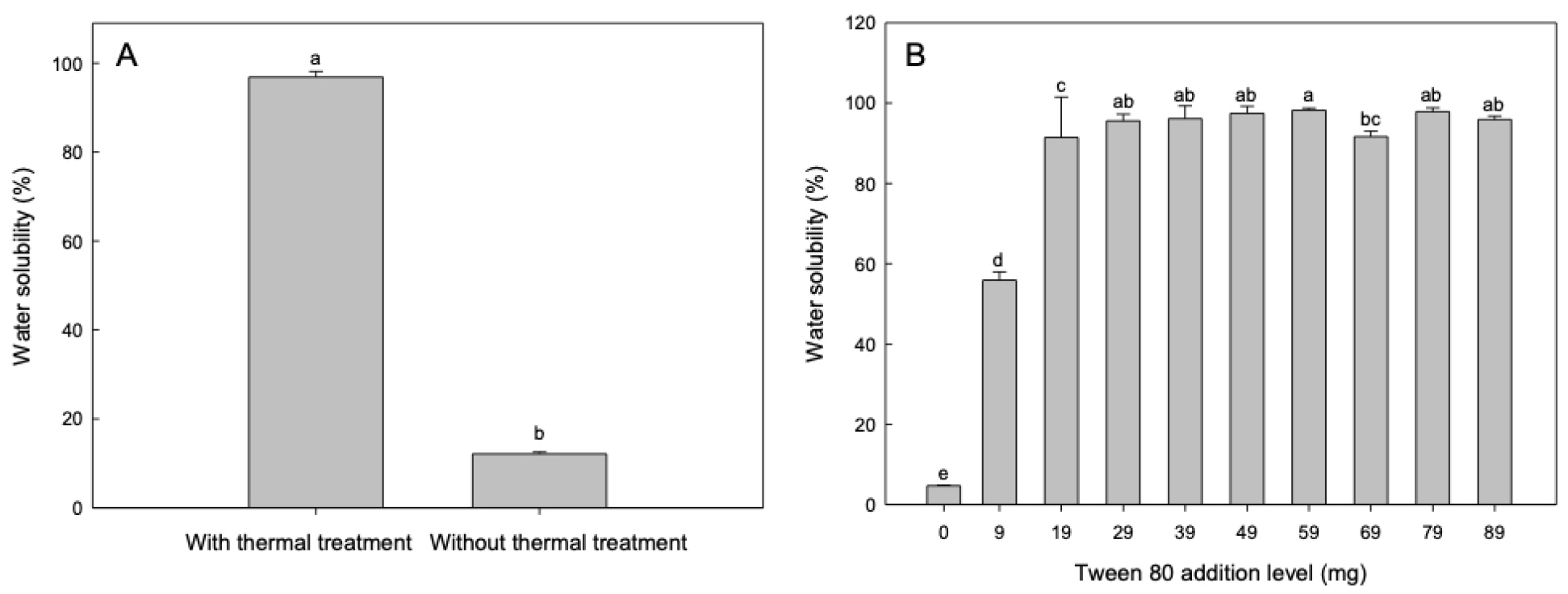
Fig. 1.
Effects of thermal treatment and surfactant concentration on the aqueous solubility of Coenzyme Q10 (CoQ10). (A) Comparison of CoQ10 water solubility with and without thermal treatment. (B) Concentration-dependent solubilization profile of CoQ10 as a function of Tween 80 addition level. Different letters above the bars indicate significant differences (p < 0.05).
This concentration-dependent increase in CoQ10 solubility is fundamentally driven by micellar solubilization, a process where surfactant molecules above their critical micelle concentration (CMC) form aggregates to encapsulate lipophilic solutes (Vinarov et al., 2018). According to this principle, increasing the concentration of Tween 80 expands the total volume of the hydrophobic micellar cores, which serve as micro-reservoirs for the CoQ10 molecules. These cores shield the CoQ10 from the surrounding aqueous environment through hydrophobic interactions, thereby increasing its apparent solubility. The plateau observed after 19 mg of Tween 80 suggests that the system reached its maximum solubilization capacity for the given dose, where all available CoQ10 molecules were successfully incorporated into stable micellar structures. These results demonstrate that the combination of thermal processing and an optimized surfactant-to-active ingredient ratio is essential for overcoming the inherent physical barriers to CoQ10 dispersion, providing a robust foundation for an effective delivery system.
Physicochemical properties of spray-dried CoQ10 with OSA starch
To investigate the effect of wall material characteristics on the encapsulation of CoQ10, the three OSA starches were classified into two groups based on their viscosity profiles and botanical origins: high-viscosity starch (Sunfree) and low-viscosity starches (Purity Gum Ultra and EMCAP).
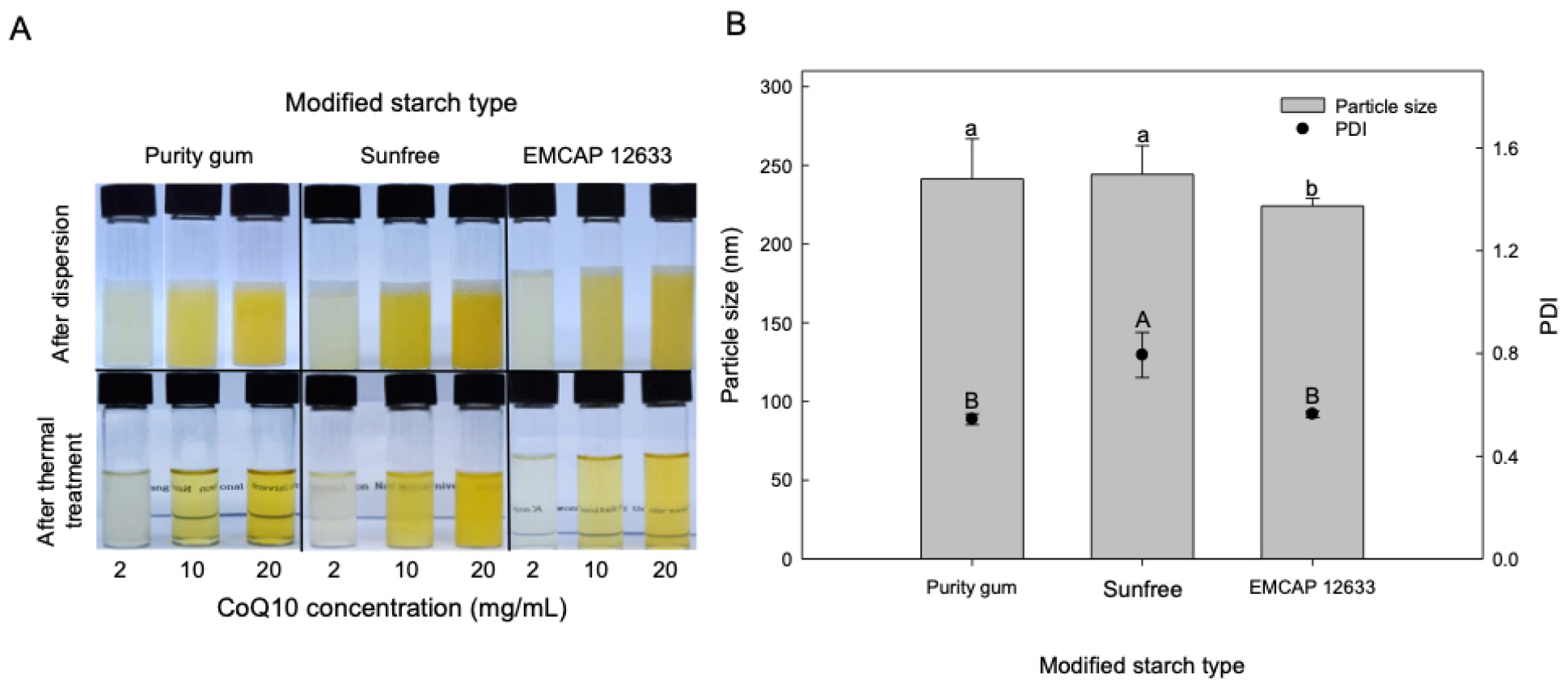
The physical appearance and reconstitution properties of the spray-dried CoQ10 powders were assessed to confirm the integrity of the microencapsulation system. Upon redispersion in deionized water, the powders exhibited excellent dispersibility, rapidly forming homogeneous suspensions without visible sedimentation. As shown in Fig. 2A, the initial dispersions appeared opaque and yellowish, a characteristic observation for particles or aggregates sized above the visible light wavelength scattering limit. Subsequent thermal treatment of these dispersions led to a dramatic transition from an opaque to a highly transparent state across all CoQ10 concentrations (2-20 mg/mL). This transparency serves as a definitive indicator of a significant reduction in hydrodynamic diameter to the nano-scale, allowing for unhindered light transmission. Notably, the CoQ10 remained stably encapsulated within the matrix even after reheating, with no signs of oil separation or precipitation. This phenomenon suggests that the formulation is highly stable under thermal stress; the heat likely induced the remelting of crystalline CoQ10 within the starch matrix, allowing it to re-partition into the optimized surfactant-starch micellar structures rather than dissociating from the carrier.
The quantitative results in Fig. 2B revealed a distinct correlation between the starch classification and particle uniformity. The high-viscosity group (Sunfree) exhibited a significantly higher PDI of approximately 0.8. This poor uniformity is likely attributed to the combined effect of high viscosity. High viscosity can hinder the efficient atomization of droplets during spray drying, leading to an irregular starch matrix that fails to maintain a uniform micellar distribution upon reconstitution. Conversely, the low-viscosity group (Purity Gum Ultra and EMCAP) produced highly uniform nano-dispersions with significantly lower PDI values. EMCAP, the hydrolyzed starch (Dapčević Hadnađev et al., 2013), yielded the smallest hydrodynamic diameter (225 nm), demonstrating that reduced molecular weight and low viscosity are advantageous for achieving minimal particle size. Purity Gum Ultra showed comparable PDI results to EMCAP despite a slightly larger particle size (240 nm), confirming its superior film-forming efficiency as a high-performance carrier. According to the technical report from Ingredion, Purity Gum Ultra features an optimized molecular structure that provides four times the emulsifying power of traditional OSA starches, which explains its ability to maintain stable nano-dispersions even at lower viscosity levels (Ingredion, 2012). Given that Purity Gum Ultra provided a stable, narrow particle size distribution equivalent to that of the hydrolyzed starch while maintaining the structural integrity, it was selected as the representative wall material for subsequent pharmacokinetic evaluations.
Aqueous solubility of spray-dried CoQ10 with OSA starch
The water solubility of the encapsulated CoQ10 was evaluated across a concentration range from 10 to 80 mg/mL to determine the solubilization capacity of the formulation (Fig. 3). In the concentration range of 10 to 30 mg/mL, the CoQ10 exhibited nearly complete solubilization, with solubility values maintained between 100.2% and 105.1%. This stable plateau indicates that the CoQ10 was effectively dispersed and maintained in a fully solubilized state within the aqueous medium without significant loss or precipitation.

However, a precipitous decline in solubility was observed when the CoQ10 concentration was increased to 40 mg/mL. At this point, the solubility dropped sharply to 55.4%, marking a critical inflection point for the stability of the dispersion. As the concentration further increased, the solubility reached its lowest value of 30.2% at the maximum tested concentration of 80 mg/mL. These results demonstrate that the formulation possesses a distinct solubility threshold between 30 and 40 mg/mL. Beyond this concentration limit, the relative solubilization efficiency decreases significantly, likely due to the formation of insoluble aggregates or the saturation of the starch matrix’s capacity to isolate individual hydrophobic cores in the aqueous environment.
Environmental stability of spray-dried CoQ10 with OSA starch
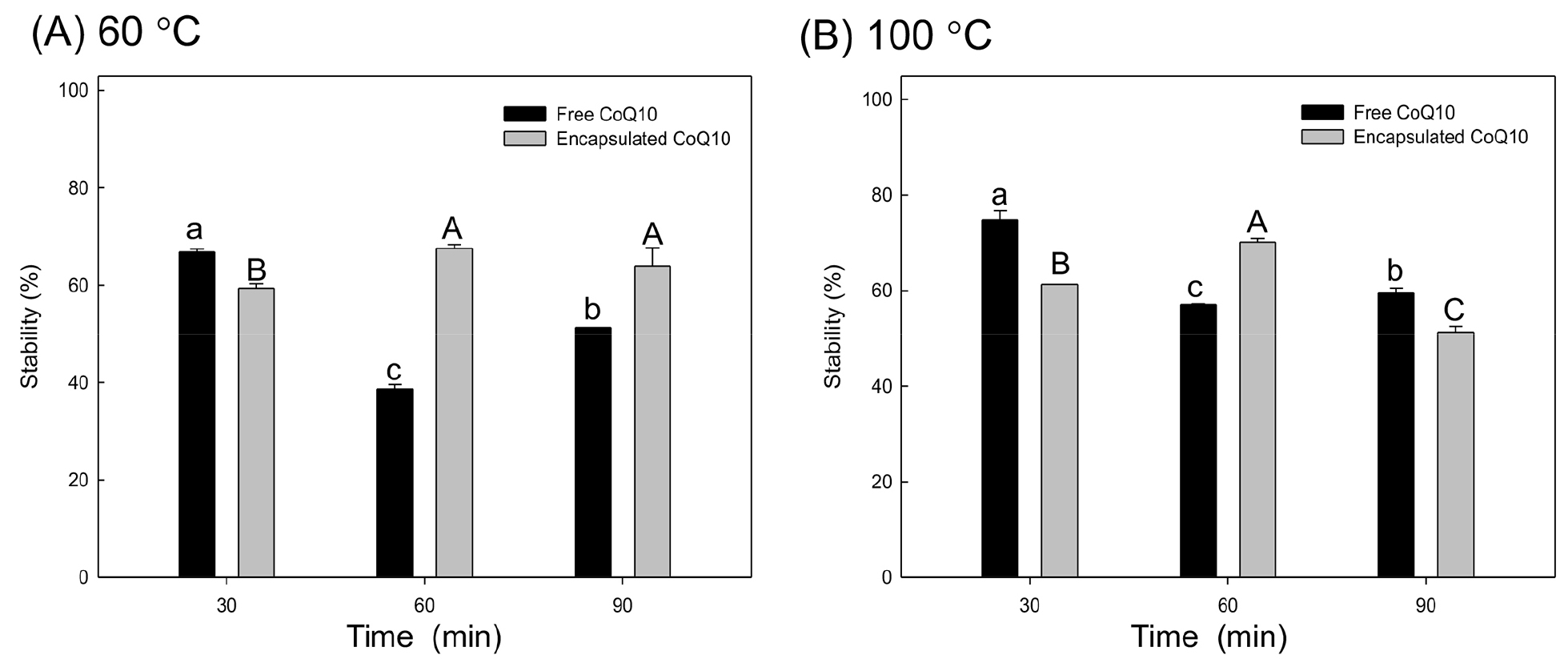
The thermal stability of free and encapsulated CoQ10 was investigated at 60°C and 100°C over course of a 90 min period to elucidate the protective role of the OSA starch matrix (Fig. 4). The chemical degradation of CoQ10 is primarily driven by two distinct pathways: the oxidative cleavage of the benzoquinone ring and the autoxidation of the unsaturated polyisoprenoid side chain (Temova Rakuša et al., 2021). As shown in Fig. 4A, free CoQ10 exhibited a sharp decline in retention, dropping to 38.9% after 60 min of heating at 60°C. This rapid degradation is closely linked to the phase transition of CoQ10; upon reaching its melting point 48-52°C, the increased molecular mobility in the liquid state facilitates the reaction between the quinone core and environmental reactive oxygen species (ROS). In contrast, the encapsulated CoQ10 demonstrated a unique “stability inversion” phenomenon. While its initial stability was lower than the free form at 30 min, it reached a peak retention of 67.8% at the 60 min mark, significantly outperforming the free form. This observation suggests a heat-induced structural optimization within the Purity Gum Ultra matrix. As the CoQ10 core melts, it undergoes a spontaneous redistribution into the stabilized hydrophobic “pockets” of the OSA starch. This transition from a bulk liquid to an organized “micelle-in-matrix” state maximizes the interfacial shielding effect, which is absent in the free form. The protective mechanism of the OSA starch can be attributed to both an interfacial barrier and steric hindrance. The robust film formed by Purity Gum Ultra acts as a physical shield, limiting oxygen diffusion and the penetration of pro-oxidants. Simultaneously, the encapsulation restricts the segmental motion of the long isoprenoid chains, thereby interfering with the radical-mediated autoxidation chain reactions.
Even under extreme conditions 100°C for 60 min, the encapsulated system maintained superior stability compared to the free form (Fig. 4B). However, the decline in retention observed after 90 min at 100°C indicates the eventual structural fatigue of the starch matrix under prolonged, excessive thermal stress. These findings confirm that the optimized nano-encapsulation system effectively interferes with the thermal degradation pathways of CoQ10, providing a critical window of protection essential for thermal food processing applications.
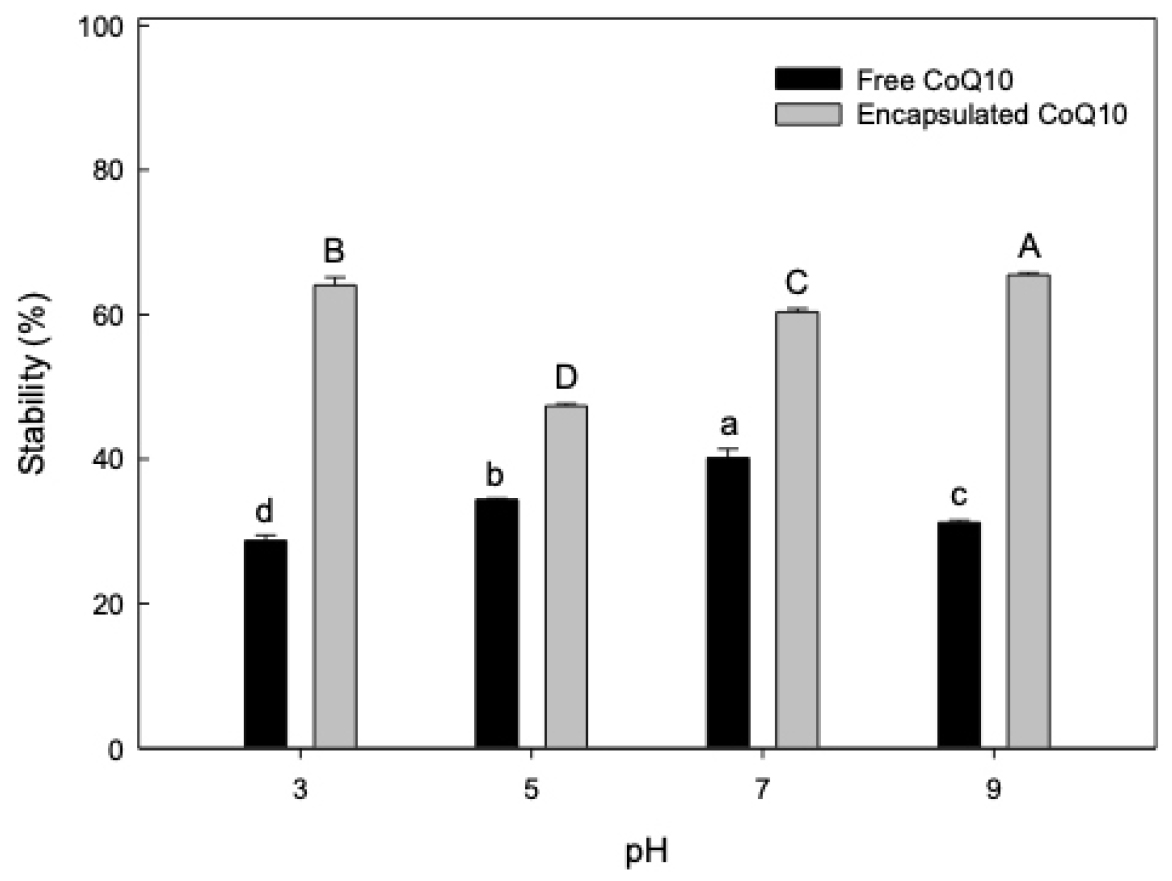
The chemical stability of free and encapsulated CoQ10 was evaluated across a broad pH range (3.0 to 9.0) (Fig. 5). Throughout all tested pH levels, the encapsulated form exhibited significantly higher stability compared to its free counterpart, confirming the robust shielding effect of the OSA starch matrix. Notably, a distinct contrast was observed under alkaline conditions (pH 9.0). While the stability of free CoQ10 decreased to 31.4% due to the susceptibility of its benzoquinone ring to nucleophilic attacks in basic environments, the encapsulated CoQ10 achieved its highest stability of 65.2%. This suggests that the Purity Gum Ultra-based matrix creates a dense physical barrier that effectively interferes with the diffusion of hydroxyl ions toward the CoQ10 core. Furthermore, the high retention (64.1%) at pH 3.0 indicates that the formulation remains intact under acidic conditions, which is crucial for maintaining bioavailability during gastric transit.
Pharmacokinetic parameters and bioavailability improvement by the encapsulation
The pharmacokinetic parameters of CoQ10 following oral administration are summarized in Table 1 and 2. To ensure the highest analytical reliability, the comparative analysis focused on the parameters derived from the 4 to 24 h post-dosing period. Despite the experimental group receiving a significantly lower actual dose of Coenzyme Q10 (11.54 mg/kg) compared to the control group (100 mg/kg), the encapsulated formulation using Purity Gum Ultra demonstrated superior absorption performance. The maximum plasma concentration (Cmax) for the encapsulated group reached 871.67 ± 425.63 ng/mL, which was approximately 1.61 times higher than that of the control group (541.33 ± 94.87 ng/mL). As detailed in Table 2, the experimental group achieved its highest plasma concentration at 4 h (871.67 ± 425.63 ng/mL) and subsequently exhibited a gradual decline over the 24 h period, reflecting the rapid initial uptake and systemic clearance of the encapsulated CoQ10. While the encapsulated group exhibited a relatively high standard deviation in its pharmacokinetic values (Table 1 and 2), indicating individual variability in the absorption of the encapsulated system, the overall magnitude of improvement was sufficient to outweigh this variability. When the area under the curve (AUClast) was normalized by the administered dose, the experimental formulation showed a normalized AUC of 709.53, compared to 83.70 for the control group. Consequently, the relative bioavailability of the encapsulated CoQ10 was determined to be 8.48, representing an 8.5-fold increase in delivery efficiency. This dramatic enhancement confirms that the encapsulation technology effectively overcomes the poor solubility of CoQ10, enabling significantly higher systemic exposure even at a reduced dosage.
Table 1
Pharmacokinetic parameters of Coenzyme Q10 formulations after oral administration in rats
Conclusion
This study demonstrates that a nano-encapsulation system using OSA-modified starch is a highly effective approach for overcoming the inherent solubility and stability limitations of CoQ10. Low-viscosity waxy maize starch, particularly Purity Gum Ultra, proved to be an ideal carrier due to its optimized molecular structure, which provides superior emulsifying power and robust film-forming properties. This starch matrix successfully interfered with the oxidative degradation pathways of CoQ10 by imposing steric hindrance and shielding the benzoquinone ring from nucleophilic attacks under harsh thermal and pH conditions. The resulting physical stabilization translated into a significant 8.5-fold improvement in oral bioavailability, confirming the potential for achieving high therapeutic efficacy even at lower dosages. Given its ability to maintain structural integrity and functionality during food processing, the developed nano-capsule formulation offers a versatile and scalable platform for incorporating hydrophobic nutrients into high-load, aqueous-based functional food systems.