


Introduction
Perilla frutescens is an annual herbaceous plant belonging to the genus Perilla in the family Lamiaceae. It is widely cultivated in Korea and other parts of East Asia as a leaf vegetable, oilseed crop, medicinal plant, and spice. Perilla leaves and seeds are not only used as food but also as ingredients for traditional medicines and cosmetics, and their commercial value has steadily increased owing to their high biological activity (Ahmed et al., 2018). Several viruses have been reported to infect perilla, including broad bean wilt virus 2 (BBWV2), perilla mosaic virus (PerMV), turnip mosaic virus (TuMV) and tomato spotted wilt virus (TSWV) (Cho et al., 2005; Oh et al., 2023; Park et al., 2020; Xia et al., 2020).
BBWV2 belongs to the famliy Secoviridae and the genus Fabavirus; it is known to be transmitted non-persistently, primarily by aphids. Its genome consists of two positive-sense single-stranded RNA segments, RNA1 and RNA2. BBWV2 is divided into five phylogenetic groups, namely, Groups I-a, I-b, II-a, II-b, and II-c, based on the sequence of the coat protein gene encoded in RNA2 (Kwak et al., 2013). It has a broad host range and is known to infect various horticultural crops, including chili peppers, tomatoes, perilla, snow peas, and spinach. Among these, BBWV2 commonly occurs in perilla, causing disease symptoms such as mosaic, vein clearing, yellowing, and growth inhibition, which significantly reduce its marketability. Although BBWV2 infections have been reported in perilla in Korea, few studies have compared the biological and molecular characteristics of BBWV2 isolates from different regions. In particular, studies comparing the pathogenicity and phylogenetic relationships among BBWV2 isolates derived from the same host are scarce. In this study, we aimed to identify BBWV2 in perilla samples collected in Chuncheon and Hwacheon, Gangwon Province, Korea, and analyze the biological and molecular characteristics of BBWV2 isolates derived from Korean perilla by comparing the host response and phylogenetic characteristics of two isolates.
Materials and Methods
In 2022, perilla samples exhibiting mosaic symptoms were collected from the Chuncheon and Hwacheon areas of Gangwon Province, Korea (Fig. 1). Total RNA was extracted from symptomatic leaves using the BCSTM Plant RNA Prep Kit (Biocube System Inc., Suwon, Korea). cDNA was synthesized with the extracted total RNA using M-MLV reverse transcriptase (Promega, Madison, WI, USA) and 3’ reverse primers used to detect each virus. Polymerase chain reaction (PCR) was performed using rTaq polymerase (Takara, Japan) with the synthesized cDNA as a template. Assays were conducted using specific primers for the four viruses reported in perilla, namely, BBWV2, PerMV, TuMV, and TSWV (Table 1). The reverse transcription reaction was set to 1 h at 42°C and 5 min at 92°C, and PCR amplification was repeated 35 times under the following conditions: 30 s at 95°C, 30 s at 52°C, and 1 min at 72°C. Reverse transcription (RT)-PCR products were electrophoresed on a 1% agarose gel for 30 min, and the bands were confirmed.
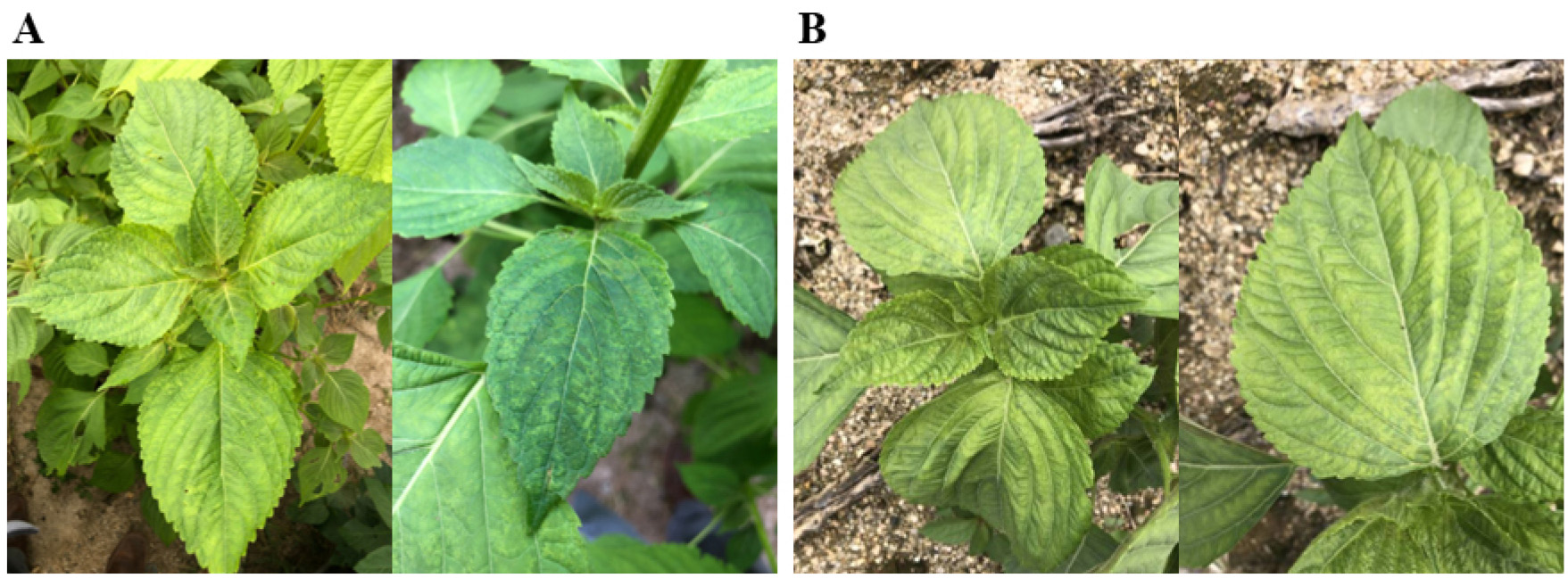
Table 1.
Primer list used for virus detection in Perilla frutescens
| Virus | Primer name | Sequence (5’ → 3’)1) | Size (bp) | Reference |
| BBWV2 | BBWV2-506-F | GGTGAGCAGTTTGTCAGAAGT | 506 | Choi et al. (2019) |
| BBWV2-506-R | CCAGATAATGCATATTCCACC | |||
| PerMV | PerMV-R4-F | GCAGTGATGCTGATATCTATGG | 753 | In this study |
| PerMV-R4-R | CGCATAGTTGACTGGTTGAAC | |||
| TSWV | TSWV-F | TGGATTCACGAACTTGGTACTG | 824 | Yoon and Ju (2025) |
| TSWV-R | GGAAGCTGATGCTTGCAAATAA | |||
| TuMV | TuMV-CP-F | AATGTGGGTGATGATGGACGG | 506 | In this study |
| TuMV-CP-R | CACACTGGCTGCTTTAACAAAC |
To compare the biological characteristics of the two BBWV2 isolates, sap inoculation was conducted on nine host plants species (Table 2). Each BBWV2 isolate was purified by mechanically inoculating Chenopodium amaranticolor and subsequently transferring a single local lesion onto the same host species. Subsequently, the upper leaves exhibiting symptoms were ground in a mortar with 0.01 M phosphate buffer (pH 7.2). The ground sap was inoculated by rubbing it onto the leaf surface of the host plant treated with carborundum. The inoculated plants were maintained in a constant-temperature and humidity chamber at 25-27°C and 60% relative humidity, with a 16-h light period and an 8-h dark period; they were monitored for the development of symptoms, and viral infection was confirmed by RT-PCR.
Table 2.
Host response to broad bean wilt virus 2 (BBWV2)-Ch and BBWV2-Hc
| Family | Host plants |
Symptoms of the leaves1) (RT-PCR detection) | |
| BBWV2-Ch | BBWV2-Hc | ||
| Chenopodiaceae | Chenopodium amaranticolor | CS/TN (+) | CS/CS, M (+) |
| C. quinoa | CS/TN (+) | CS/TN (+) | |
| Lamiaceae | Perilla frutescens | +/M (+) | +/M (+) |
| Solanaceae | Nicotiana benthamiana | +/M,Mal (+) | +/M,Mal (+) |
| Capsicum annuum cv. Cheongyang | +/+ (+) | +/+ (+) | |
| C. annuum cv. Baerotta | +/+ (+) | +/+ (+) | |
| C. annuum cv. Bukang | +/+ (+) | +/+ (+) | |
| Solanum lycopersicum cv. Moneymaker | +/+ (+) | +/+ (+) | |
| S. lycopersicum cv. Superdotaerang | +/+ (+) | +/+ (+) | |
The RT-PCR products obtained using BBWV2-506-F and BBWV2-506-R (Table 1), which amplify a portion of the BBWV2 small coat protein (SCP) gene, were cloned into the pGEM-T Easy TA cloning vector system (Promega, USA) and subsequently sequenced. The obtained nucleotide sequences were compared for sequence identity with BBWV2 isolates registered in GenBank using the Basic Local Alignment Search Tool (BLASTn) nucleotide (BLASTn) program of the National Center for Biotechnology Information (NCBI). The phylogenetic tree was constructed using the partial amino acid sequences of SCP; multiple alignments were conducted using ClustalW in MEGA 12 software, and the tree was generated using the maximum likelihood method with 1,000 bootstrap replicates (Fig. 2). Additionally, a pairwise sequence identity matrix was generated using the Sequence Demarcation Tool (SDT) version 1.3 based on the same SCP partial nucleotide sequences (Fig. 3). Multiple sequence alignment was conducted using the MAFFT algorithm, and clustering was based on a neighbor-joining tree.
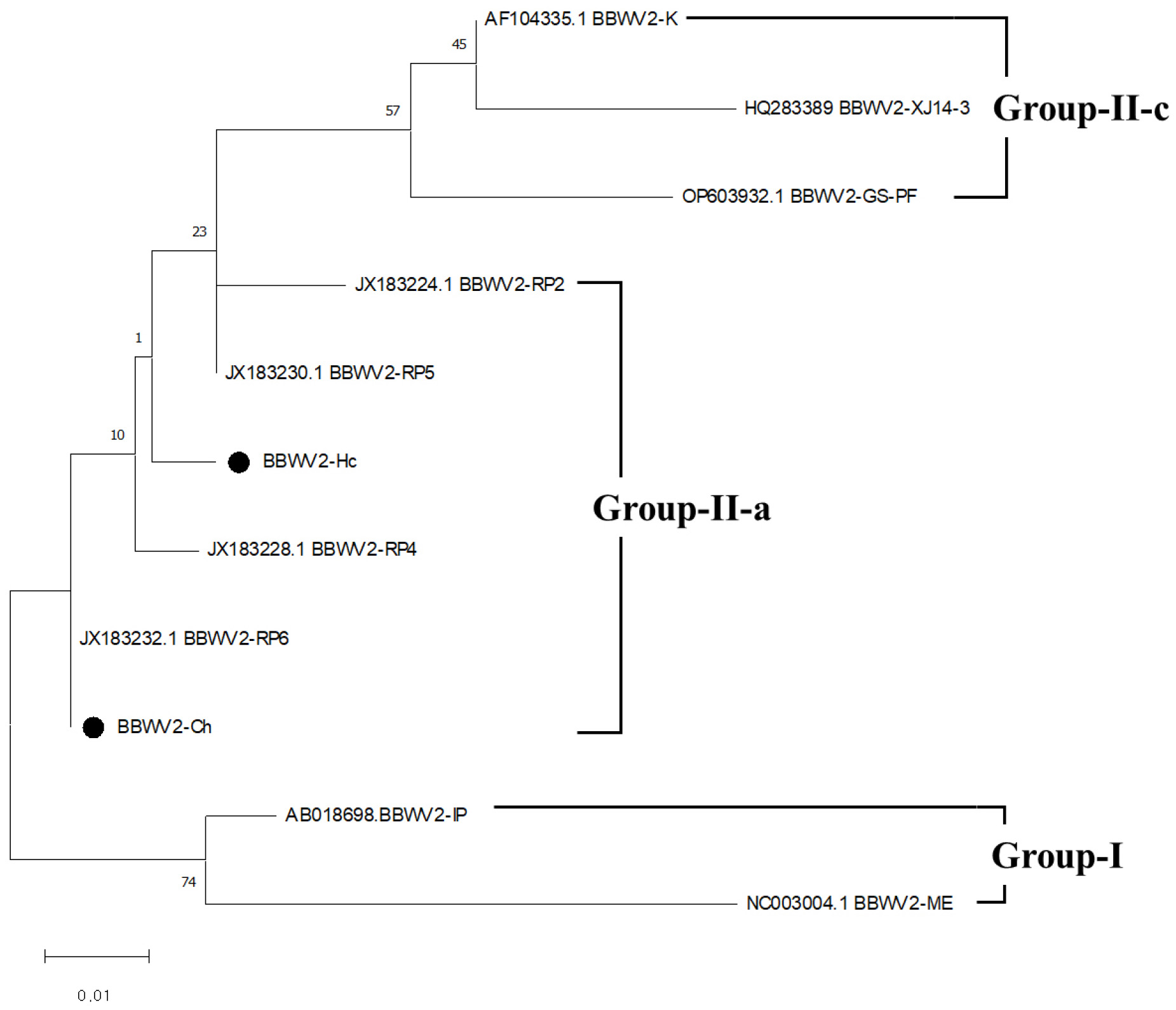
Fig. 2.
Phylogenetic analysis of partial small coat protein (SCP) amino acid sequences of broad bean wilt virus 2 (BBWV2). The phylogenetic tree was constructed at the amino acid level using the maximum likelihood method with 1,000 bootstrap replicates in MEGA12 software after multiple sequence alignment with ClustalW. The black dots indicate BBWV2-Ch and BBWV2-Hc.
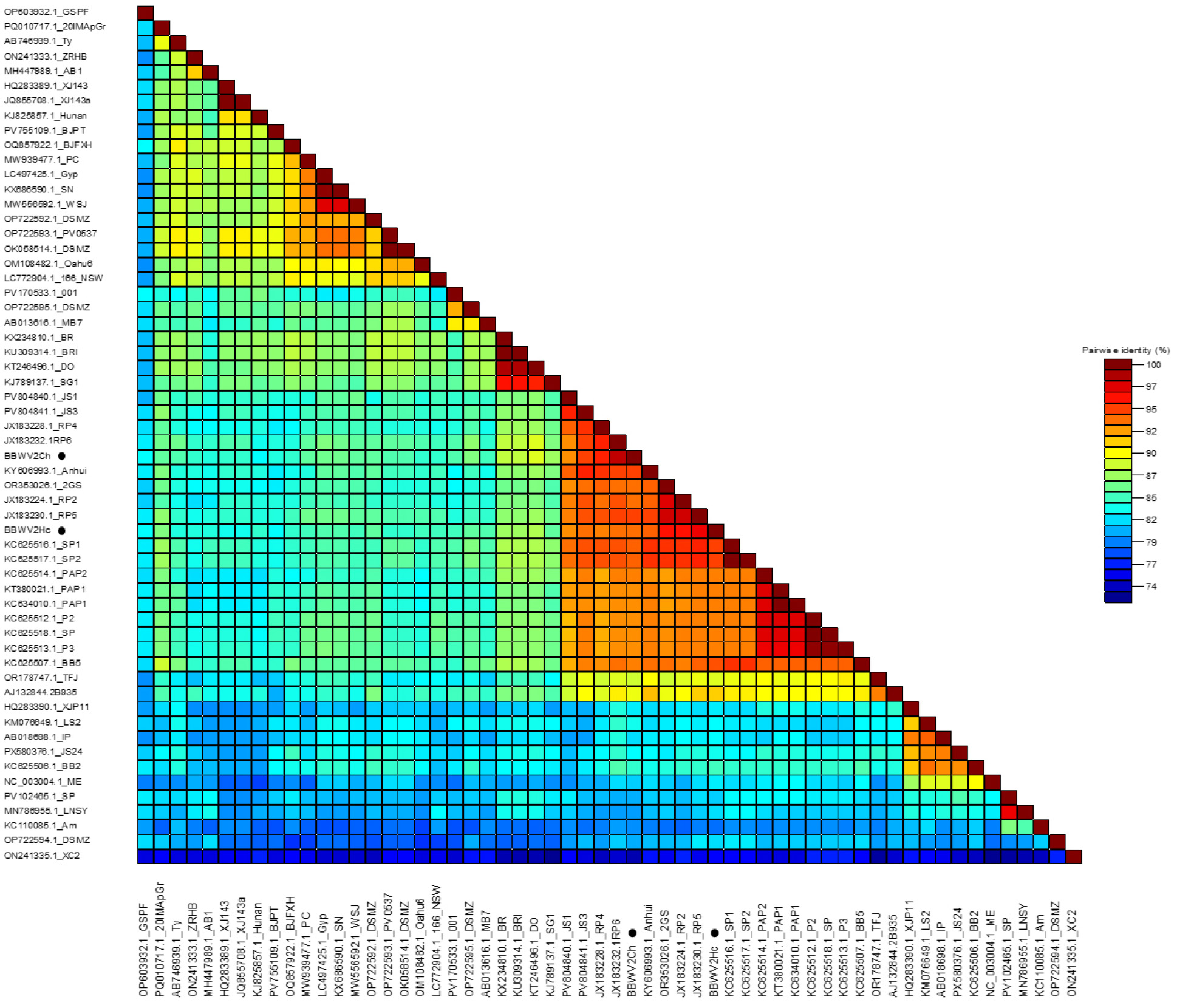
Fig. 3.
Pairwise nucleotide sequence identity matrix of partial small coat protein (SCP) sequences of broad bean wilt virus 2 (BBWV2). The pairwise nucleotide sequence identity matrix was generated using Sequence Demarcation Tool (SDT) version 1.3 after multiple sequence alignment with MAFFT. The sequences were clustered using a neighbor-joining tree. The black dots indicate BBWV2-Ch and BBWV2-Hc.
Results and Discussion
Perilla plants exhibiting mosaic symptoms were collected in Chuncheon and Hwacheon, and RT-PCR was conducted to confirm viral infection. Total RNA was extracted from the collected samples, and diagnostic testing was performed for previously reported viruses, BBWV2, PerMV, TuMV, and TSWV. Consequently, amplification products of the expected size (506 bp) were detected only with BBWV2-specific primers in both samples, whereas no amplification products were detected for PerMV, TuMV, or TSWV (data not shown). Sequence analysis of the amplification products confirmed BBWV2 infection in both samples, and the corresponding isolates were designated BBWV2-Ch (GenBank accession no. LC943773.1) and BBWV2-Hc (LC943774.1), respectively. Based on the 506-bp partial SCP sequence of RNA2, BBWV2-Ch and BBWV2-Hc showed the highest nucleotide sequence identities of 98.14% and 97.10% with the pepper isolates BBWV2-RP6 (JX183232.1) and BBWV2-RP5 (JX183230.1), respectively.
To characterize the biological properties of BBWV2-Ch and BBWV2-Hc, sap inoculation was conducted on nine host plants. Both isolates caused upper-leaf mosaic and leaf malformation in Nicotiana benthamiana. In perilla, both isolates induced mosaic symptoms on the upper leaves, similar to those observed in the collected samples, similar to that in the collected samples (Table 2). In C. quinoa, chlorotic spots appeared on the inoculated leaves, and necrotic symptoms were observed on the upper leaves. On the inoculated leaves of C. amaranticolor, both isolates exhibited chlorotic spots; however, BBWV2-Ch caused necrosis on the upper leaves, whereas BBWV2-Hc exhibited systemic chlorotic spots and mosaic symptoms, confirming the differences in symptoms between the two isolates. In contrast, in pepper and tomato cultivars, neither BBWV2-Ch nor BBWV2-Hc induced visible symptoms; however, BBWV2 was detected by RT-PCR in the upper leaves of plants inoculated with either isolate, confirming systemic infection without visible symptoms (Table 2). BBWV2-Ch and BBWV2-Hc exhibited similar host responses in eight host plants; however, in C. amaranticolor, they exhibited different symptoms on the upper leaves, confirming differences in their biological characteristics.
To compare the genetic characteristics of BBWV2-Ch and BBWV2-Hc, a phylogenetic analysis was conducted by targeting the partial sequences of the SCP gene encoded by RNA2. Both isolates were confirmed to belong to Group II-a and showed close phylogenetic relationships with the RP5 and RP6 isolates from pepper (Fig. 2). This result differed from that previously reported for BBWV2-GS-PF in perilla in Korea, which belongs to Group II-c. Furthermore, pairwise nucleotide sequence identity analysis showed that the two isolates exhibited the highest sequence identity with the RP5 and RP6 isolates, whereas they showed relatively low nucleic acid sequence homology with the GS-PF isolate, consistent with the results of phylogenetic analysis (Fig. 3). These results indicate that BBWV2-Ch and BBWV2-Hc belong to a genetic lineage distinct from that of the previously reported Korean perilla isolate BBWV2-GS-PF, demonstrating the presence of genetically distinct BBWV2 lineages belonging to Groups II-a and II-c in perilla in Korea. BBWV2 is a virus with a segmented genome comprising RNA1 and RNA2; therefore, both genomic RNAs must be considered together to understand the genetic characteristics of the isolates. Through full-length genomic analysis of BBWV2, Kwak et al. (2013) reported that the recombination between isolates and reassortants of RNA1 and RNA2 can occur, and specifically suggested that reassortants may play an important role in the formation of genetic diversity in BBWV2. Therefore, the results of this study, wherein we analyzed only partial SCP sequences of RNA2, are limited in their ability to determine the genetic differences between BBWV2-Ch and BBWV2-Hc.
Kwak et al. (2016) confirmed that the factor determining the severity of disease symptoms in pepper plants is located in RNA2 through pseudorecombinant analysis using RNA1 and RNA2 from BBWV2 isolates exhibiting different levels of severity. Furthermore, they reported that the movement protein (MP) encoded by RNA2 is a major factor determining symptom severity in N. benthamiana and pepper plants (Seo et al., 2017). Considering these previous studies, the differences in symptoms between BBWV2-Ch and BBWV2-Hc observed in this study are potentially related to genetic differences between the two isolates. However, as we only analyzed a portion of the SCP gene rather than the entire RNA2, further analysis is required to determine the correlation between the differences in symptoms observed in BBWV2-Ch and BBWV2-Hc and their genetic causes. Therefore, in future studies, a clearer relationship between the differences in symptoms observed in C. amaranticolor and genetic characteristics of the virus can be identified by analyzing the complete nucleotide sequences of RNA1 and RNA2 from both isolates and comparing genetic variations in RNA2, including the MP.
In this study, BBWV2 was detected in perilla samples collected from Chuncheon and Hwacheon in Gangwon Province, Korea, and the biological and molecular characteristics of the two isolates were compared. Although the two isolates were isolated from the same host, they induced different symptoms in C. amaranticolor, suggesting the possibility of genetic differences related to pathogenicity.