


Introduction
Materials and Methods
Analytical Technique
Results
SCM Analysis for RA 8048
SCM Analysis for RA 10593
Placebo Study for RA 8048
Placebo Study for RA 10593
Conclusion and Recommendation
Introduction
The Philippine economy is composed of three (3) main sectors: industry, service, and agriculture sectors. Agriculture contributes to 8.9% of the country’s gross domestic product (GDP) and employs 23.8% of the total labor force in the Philippines (Philippine Statistical Authority, 2022). Agriculture is composed of several subsectors; one of its subsectors is the coconut industry, which has been a major dollar earner and contributor to the Philippine economy for the longest time, driven by its export performance (Cañeda and Bathan, 2019; Philippine Coconut Authority, 2013). Coconut is considered as one of the major pillars of the agriculture sector in the country, with 69 out of 82 provinces producing coconut fruits. Its total production area is 3.62 million (M) hectares (ha), with estimated 2.5 M farmers employed in the coconut industry, and contributes around 60% of the world’s coconut exports. The Philippines remains the second-largest producer of coconut in the world, wherein it comprises 40% of Association of the Southeast Asian Nations (ASEAN) total coconut production (Philippine Council for Agriculture, Aquatic, and Natural Resource Research and Development, 2023). However, the coconut industry in the Philippines faces several challenges and problems that significantly influenced the productivity of the industry, and whole agriculture sector. One of the problems of the coconut industry is the fragmented policies affecting its productivity. Ultimately, making the farmgate price and quantity of coconut volatile which decreases the productivity of coconut and the country’s GDP since coconut has been a major income-generating industry for the agriculture sector. Several studies have shown that agricultural policies have implications on the farmgate price and quantity of agricultural commodities. Research on the effects of overcutting of trees shows that overcutting decreases the quantity supply and increases the farmgate prices of agricultural commodities. This is due to the fact that with no regulation in place encourages unabated cutting of trees, pushing down the quantity supply. Moreover, the effects if conservation policy for agricultural commodities shows that conservation policy raises the quantity supplied which decreases the farmgate price for the agricultural commodities. Republic Act No. 8048, also known as the Coconut Preservation Act of 1995, was enacted to regulate the cutting of coconut trees and to protect the coconut industry from resource depletion, ensuring sustainable production of coconut in the Philippines. It mandates stringent conditions for tree cutting, including permits from relevant authorities and replanting requirements. Republic Act No. 10593, enacted in 2013, amended RA 8048 was enacted to strengthen the conservation measures and enhance enforcement mechanisms, reflecting a heightened commitment to preserving the coconut resource base. These laws play a critical role in shaping the dynamics of the coconut industry, including their potential influence on the domestic farmgate price of coconuts. These laws exemplify how effective government intervention can influence farmgate prices and production, affecting the income of the farmers. An overall increase in coconut supply due to conservation policies may lead to a drop in coconut price, potentially reducing farmers’ incomes. However, the higher supply could also boost local production and expand the international market for coconuts, ultimately enhancing farmers’ incomes. This study examines the impact of these conservation policies on coconut farmgate prices by analyzing actual and counterfactual scenarios. The findings aim to provide policy recommendations that improve the productivity, efficiency, and sustainability of the coconut industry in the Philippines.
Materials and Methods
This study outlines the criteria for selecting control units in the Synthetic Control Method (SCM) to create a valid counterfactual for the treated unit, which in this case is the coconut. The control units must represent what would have happened to coconut farmgate prices in the absence of conservation policies. To construct a synthetic coconut, the study used a weighted average of 70 other agricultural commodities that matched the characteristics of coconut before the implementation of the two conservation policies.
The criteria for control units included agricultural commodities produced in the Philippines, highly valued crops, and those intended for food consumption, excluding those with government interventions (e.g., rice, tobacco, sugar, and abaca). The chosen commodities closely resemble coconut in terms of characteristics, ensuring a reliable comparison. The study also prioritized control units with sufficient, reliable farmgate price data, sourced from the PSA, to prevent bias from incomplete or inconsistent data.
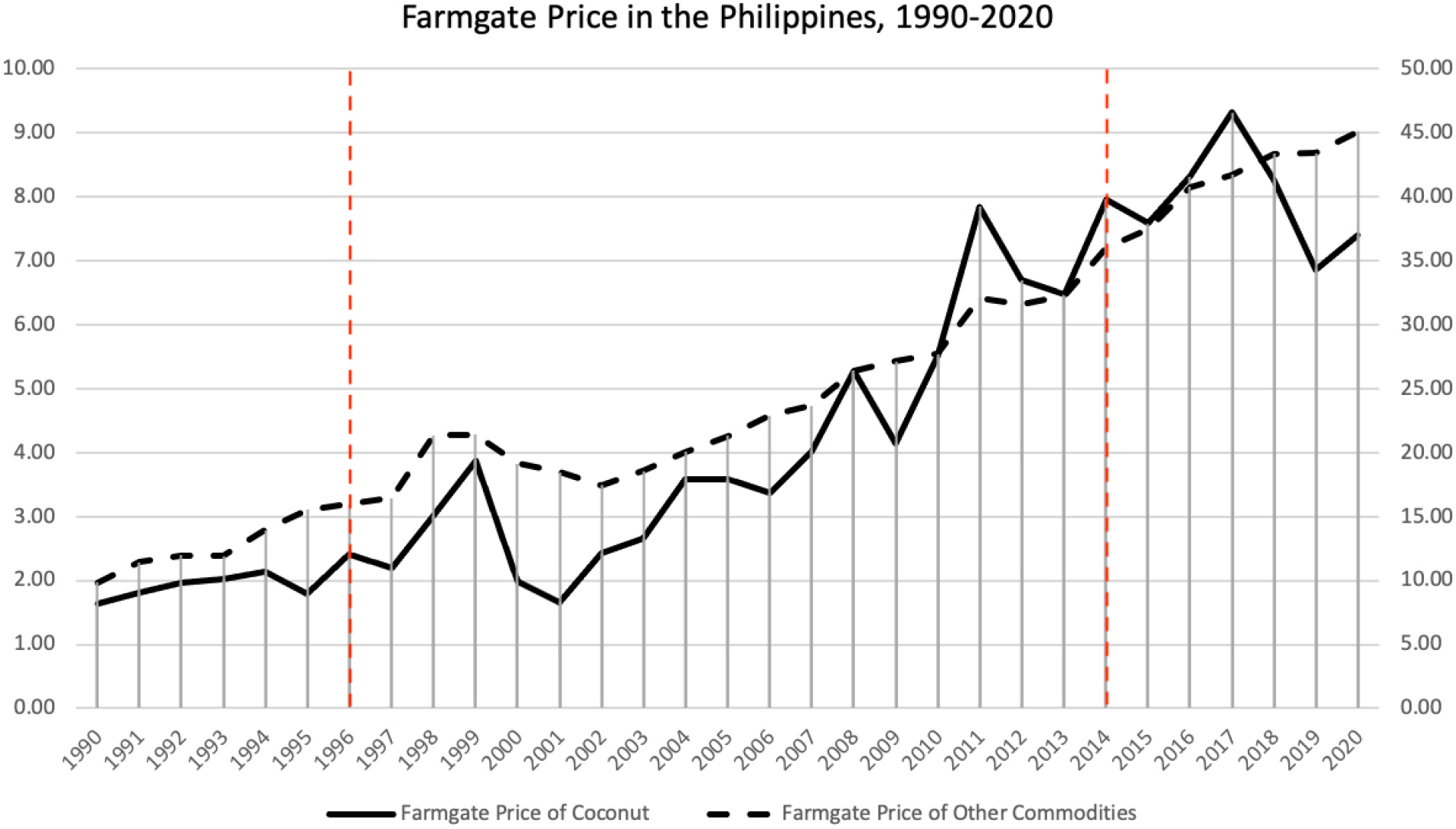
Fig. 1 shows the relationship between the historical plot of farmgate prices for coconut and the price of other agricultural commodities in the Philippines. From the visual observation of the figure, it is noticeable that the farmgate prices for both coconut and other agricultural commodities have increasing trends from 1990 to 2020. We can observe that the farmgate prices of selected agricultural commodities are increasing. This study identified a noticeable disparity in the years 1996 and 2014. These periods were identified as the implementation time for coconut conservation policies in the Philippines. Moreover, on the years 2006, 2009, 2018, and 2019, the price of farmgate prices of other agricultural commodities have increased due to climate and natural disasters struck the country.
Analytical Technique
Synthetic Control Method (SCM), a non-parametric technique (Cerulli, 2019), estimates the causal effects of government intervention through constructing a synthetic control group by assigning weights to different units of the donor pool to estimate what would happen to the treated unit in the absence of treatment (Abadie et al., 2010). The study utilizes SCM to compare the effects of conservation policy on the farmgate price of coconut. Suppose that we observed J + i agricultural commodities in our analysis. The treated unit of the study is i. Since coconut is only the agricultural commodity exposed to the intervention of interest or the treated unit of the study, then our i is equal to 1. J remaining commodities as potential controls or the seventy (70) commercial and highly-valued agricultural commodities. These sets of controls are devised as the “donor pool” for our model. In this study, we have two pre-treatment and post-treatment periods in 1996 and 2014.
The effect of SCM can be estimated from the difference between actual outcome and the counterfactual outcome (Abadie et al., 2010). Let is the observed effect of the coconut conservation policy, and and are the treated units or the potential outcome under the conservation policy and outcome interest in the absence of conservation policy (counterfactual), respectively. The observed effect can be expressed as in equation (1):
Our SCM estimator represents the effect of the policy intervention at time t on the treatment group using a linear combination of optimally chosen units as synthetic control. In this study, we used seventy (70) agricultural commodities and two separate periods. Let is the optimal weights of other agricultural commodities. The post-intervention period of SCM measures the causal effect with the following equation (2):
To obtain the optimal weights of the analysis, the synthetic comparison good is chosen which among other agricultural commodities will be included in the synthetic control. Because of the limited variables, we adopted the study of Grogger (2015) on the soda taxes and prices of sodas and other drinks in Mexico since his study assign each treatment product to a single comparison product. Relatively, our study only accepted the pre-treatment farmgate prices of the comparison goods. The comparison good is chosen to minimize the sum of squared differences over the pre-conservation policy period between the treatment-good price and the price of the synthetic control good. Let is the vector or pre-intervention of coconut, is the vector of the post-intervention of other agricultural commodities, is the symmetric and positive semidefinite matrix. Thus, the optimal weight is obtained with the following equation (3):
To ensure reliable estimation, the study follows the small-sample inference model developed by Abadie et al. (2010) for the Synthetic Control Method (SCM). Standard errors, commonly used in regression-based studies, measure uncertainty in aggregate data. A placebo test is used to assess the significance of the results by applying the synthetic control method to other units to see if similar outcomes occur, which could weaken the case for causality.
The study assumes that if the actual and counterfactual events are equal, the policy does not affect the outcome. By following the placebo treatment effects method from previous research, the study accounts for model uncertainty in estimating the counterfactual post-treatment outcome. The synthetic control is selected to minimize squared differences in pre-treatment farmgate prices between the treated unit and the synthetic control. Extreme weight values that could affect the significance of the analysis are excluded for simplicity.
Results
The study examines whether conservation policies impacted the farmgate price of coconut in the Philippines. A synthetic control was constructed to match the predictors of farmgate prices before the implementation of conservation policies, allowing the estimation of the policy impact as the difference between the treated and synthetic units post-intervention. The analysis focuses on the best-fit model for the available farmgate price data.
Before the 1996 and 2014 conservation policies (RA 8048 and RA 10593), farmgate prices for coconut and other agricultural commodities followed a similar upward trend. However, after the policies were enacted, coconut prices began to diverge, declining while prices for other commodities continued to rise. The study seeks to determine how coconut prices would have evolved without these policies. The analysis is divided into two parts, addressing the effects of each conservation policy separately, which are further discussed in subsequent sections.
SCM Analysis for RA 8048
In the period of 1996, the conservation policy was analyzed, focusing on achieving a strong predictor balance between the treated and synthetic units, as shown in Table 1. The goal of the predictor balance was to construct a synthetic control unit that closely resembles the characteristics of coconuts before the implementation of conservation policies. Ensuring a good predictor balance is critical for the validity of the Synthetic Control Method (SCM), as significant differences between treated and control units can lead to biased policy effect estimates.
Table 1.
Descriptive summary of the predictor balance of farmgate prices in 1996
Following Grogger’s research, only comparison units were used as estimators, with attention restricted to farmgate prices of coconuts and other agricultural commodities prior to the enactment of RA 8048 in 1996. The nearly identical values in Table 1 confirm that the treated and synthetic units had similar trends before the policy’s implementation. For instance, in 1995, the farmgate price was PhP2.19 for the treated unit and PhP2.3366 for the synthetic unit. Similarly, from 1990 to 1994, the values for both units were very close, demonstrating that the synthetic control effectively represents what would have happened to coconuts without the conservation policy.
The study examines the impact of a conservation policy (RA 8048) on the farmgate price of coconut using Synthetic Control Method (SCM). In application of SCM, weights engage in a crucial role in constructing counterpart for the treated unit that did not implement conservation policy. These weights are assigned to the control units (e.g., agricultural commodities without conservation policy) to form a synthetic control that mimics the pre-treatment characteristics of the coconut. The weights are determined by minimizing the difference between the treated unit and the weighted combination of control units based on the farmgate prices of other commodities in the Philippines as predictors. For the pre-intervention period, a synthetic coconut model is created using a weighted combination of other agricultural commodities: Guyabano (49.6%), Chicken Egg (32.1%), Duck Egg (11.8%), and Papaya Green (6.5%), while other commodities are excluded as shown in Table 2.
Table 2.
Weights of agricultural commodities in the synthetic coconut model in 1996
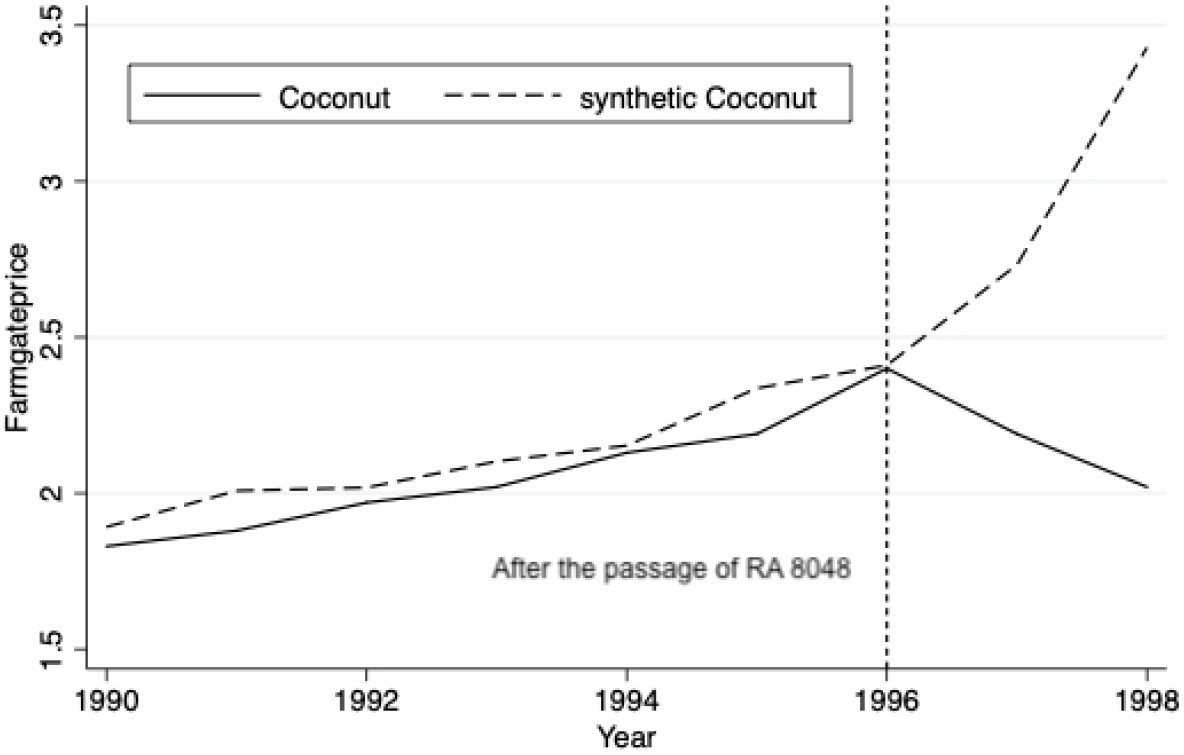
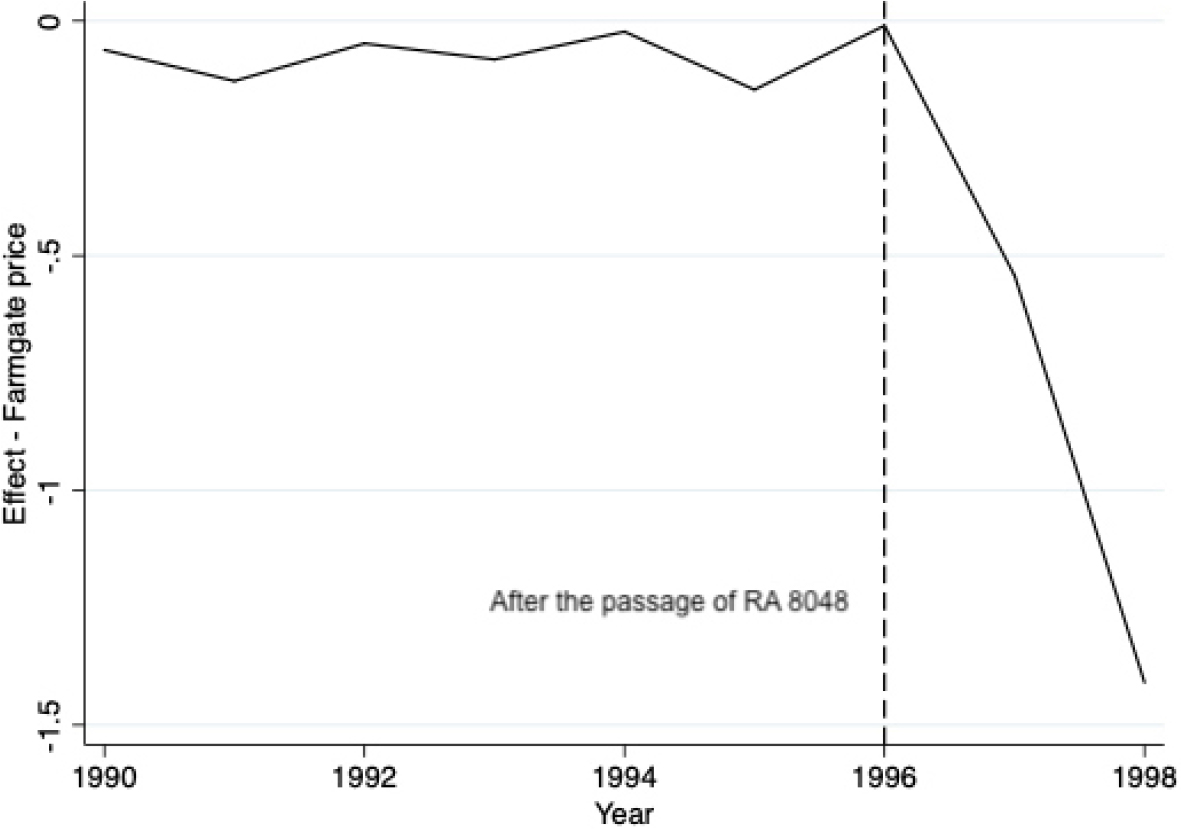
The analysis shows that before the policy, the farmgate prices of actual and synthetic coconuts followed similar upward trends as shown in Fig. 2. However, after the policy’s implementation, the actual coconut price declined, while the synthetic counterpart continued rising. This suggests that the conservation policy had a negative effect on coconut prices by increasing supply and lowering coconut prices. The result shows that government policy affects the supply of coconut in the Philippines, ceteris paribus. The treatment effect of the policy on coconut prices from 1990 to 1998 confirms the policy’s influence in driving down farmgate prices as shown in Fig. 3.
SCM Analysis for RA 10593
The study extends its analysis to the conservation policy implemented in 2014 (RA 10593) using the Synthetic Control Method (SCM) to compare the farmgate prices of coconut and other agricultural commodities before the policy. Table 3 shows the predictor balance, which highlights that the farmgate prices of both treated (actual coconut) and synthetic units (composed of other agricultural commodities) were nearly identical before the policy. For instance, in 2013, the treated price was PhP6.78, while the synthetic was PhP6.5887. Similar closeness in prices is observed for earlier years (2009-2012).
Table 3.
Descriptive summary of the predictor balance of farmgate prices in 2014
| Variables | Treated | Synthetic |
| Farmgate Price (2013) | 6.78 | 6.5887 |
| Farmgate Price (2012) | 6.31 | 6.4304 |
| Farmgate Price (2011) | 5.84 | 5.9807 |
| Farmgate Price (2010) | 5.50 | 5.4407 |
| Farmgate Price (2009) | 4.15 | 4.2955 |
These similarities confirm that the synthetic unit can serve as a valid counterfactual, representing what would have happened to coconut prices in the absence of the 2014 policy. The analysis shows that the treated and synthetic units followed the same trends, validating the assumption that the SCM model accurately reflects the farmgate price behavior before the implementation of the policy.
The study examines the impact of the 2014 conservation policy (RA 10593) on the farmgate price of coconut using the Synthetic Control Method (SCM). In exercising SCM, weights involve an important part in generating a counterfactual for the treated unit that did not implement the conservation policy. These weights are allocated to control units (e.g., agricultural commodities unaffected by the conservation policy) to create a synthetic control that replicates the pre-treatment characteristics of coconut production. The weights are calculated by minimizing the differences between the treated unit and the weighted combination of control units, using the farmgate prices of other commodities in the Philippines as key predictor. For the pre-policy period, a synthetic coconut model is created using a weighted combination of Duck Egg (50.7%), Pineapple Formosa (34.6%), Guyabano (10.8%), and Banana Saba (3.9%), while other agricultural commodities receive zero weight as shown in Table 4.
Table 4.
Weights of agricultural commodities in the synthetic coconut model in 2014
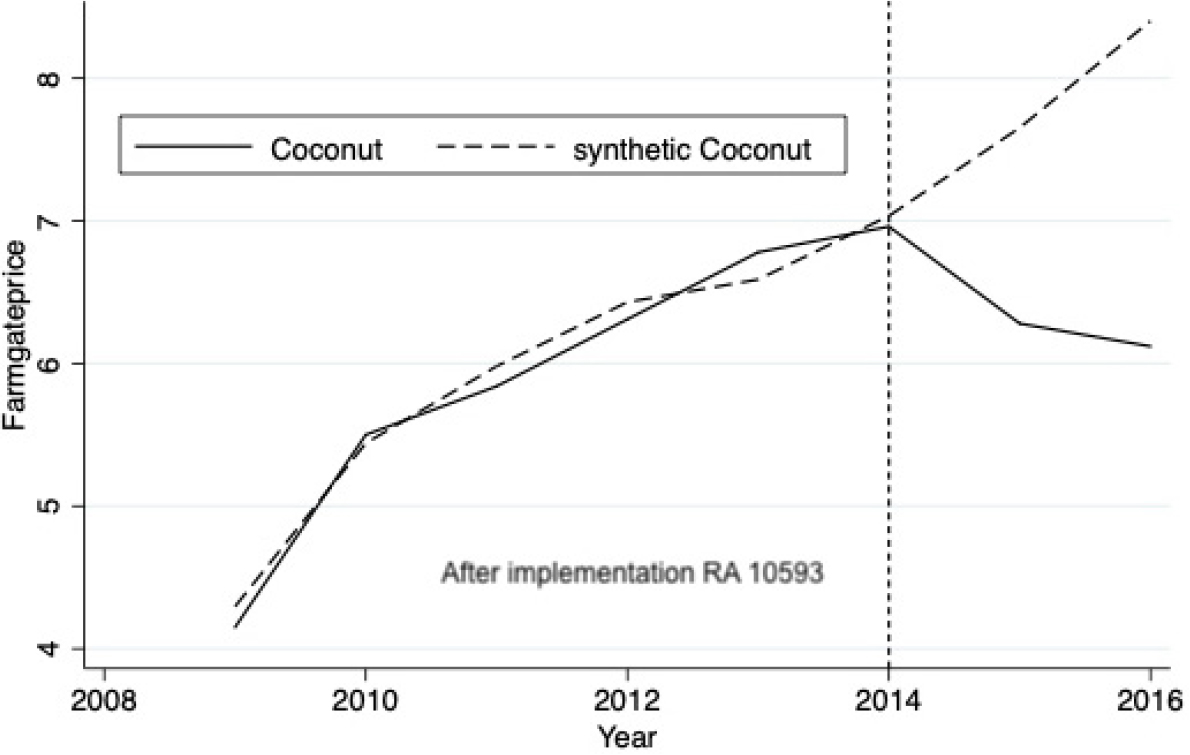
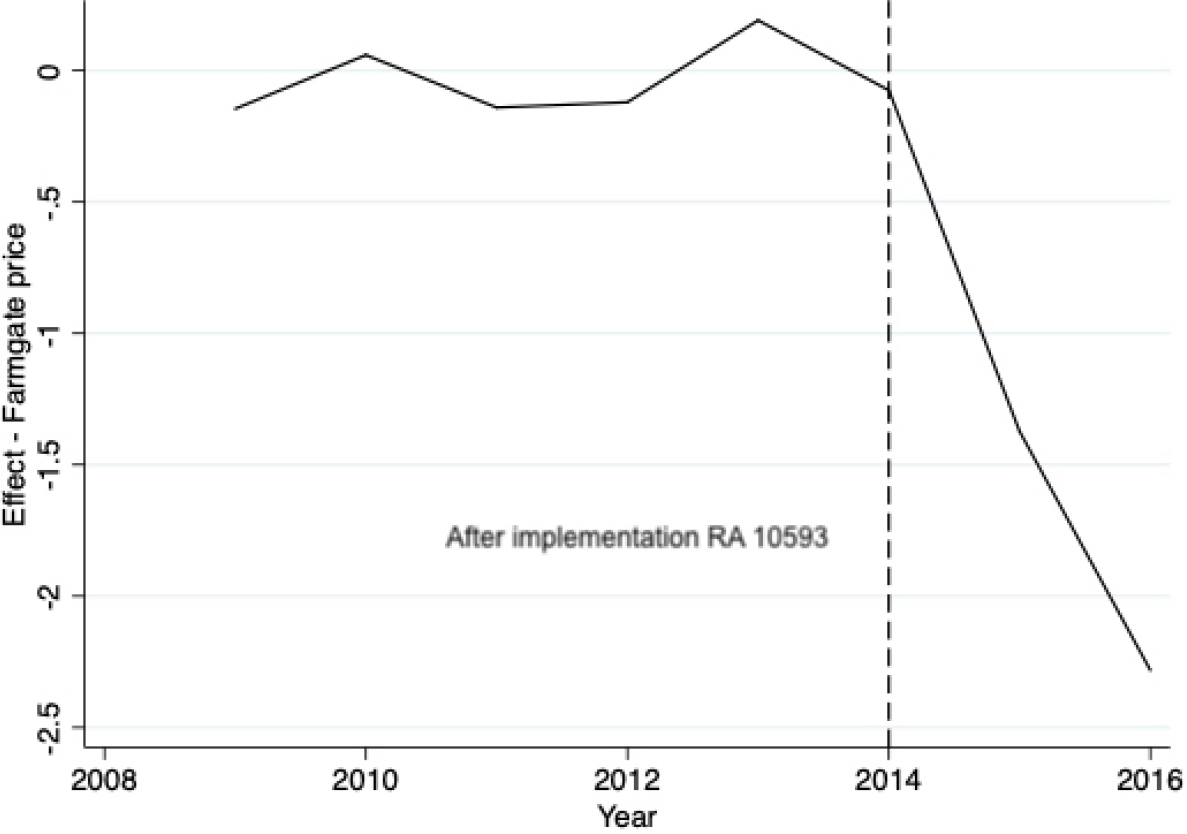
Before policy implementation, the farmgate prices of actual and synthetic coconuts followed similar upward trends as shown in Fig. 4. However, after the intervention, the actual coconut price declined while the synthetic counterpart continued to rise. This divergence suggests that RA 10593 negatively affected coconut prices by increasing the supply, which in turn reduced farmgate prices, confirming that government policy affects the supply of coconut in the Philippines, ceteris paribus. To verify this effect, the study estimates the treatment effect of RA 10593 from 2009 to 2016 as shown in Fig. 5. Similar to earlier findings with RA 8048, the policy’s goal of increasing coconut production led to lower farmgate prices, confirming the influence of government intervention on coconut prices in the Philippines.
Placebo Study for RA 8048
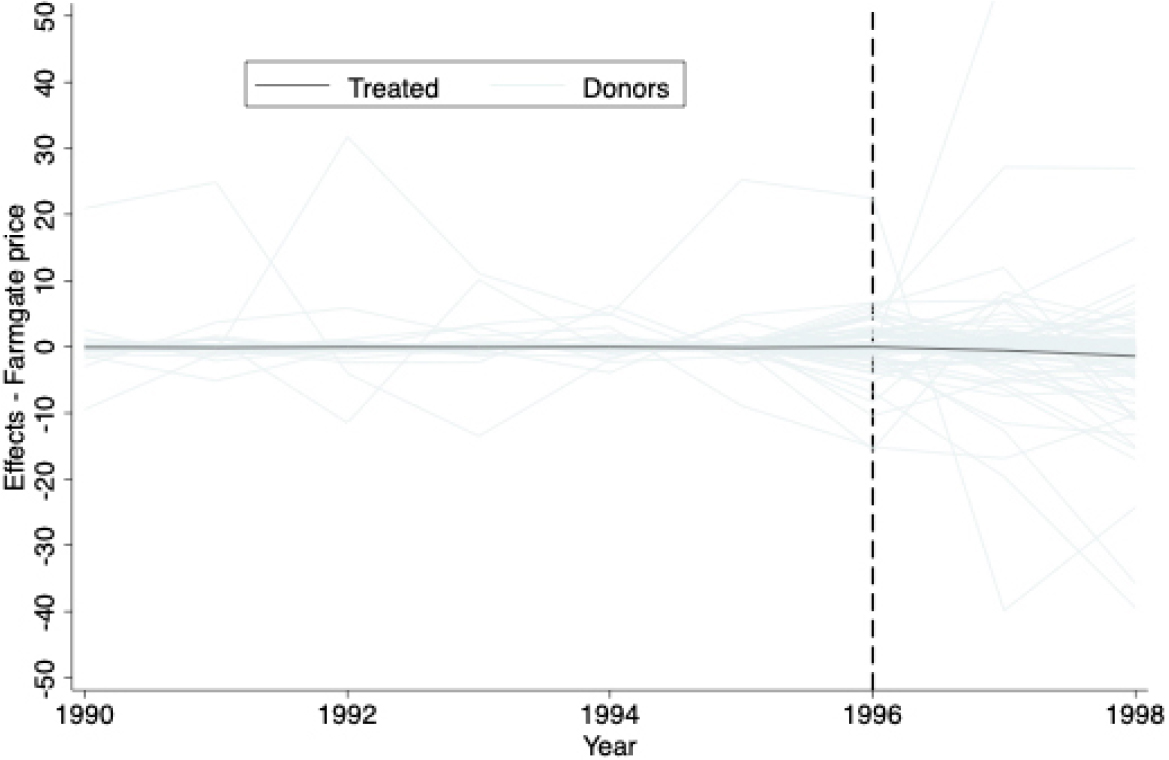
The study performed placebo tests to validate the effect of RA 8048 on the farmgate price of coconut using the Synthetic Control Method (SCM). In these tests, the conservation policy was reassigned to each of the 70 agricultural commodities in the donor pool, while coconut was treated as if it had no intervention. This process simulated a policy effect for each commodity and created a distribution of estimated gaps, comparing the real and synthetic versions of each commodity.
Fig. 6 shows that the gap between real and synthetic coconut prices (represented by the solid black line) was unusually large compared to the gaps for other agricultural commodities (gray lines) during the 1990-1998 period. This suggests a poor fit between the real and synthetic coconut prices before RA 8048, implying that the initial SCM results were unreliable.
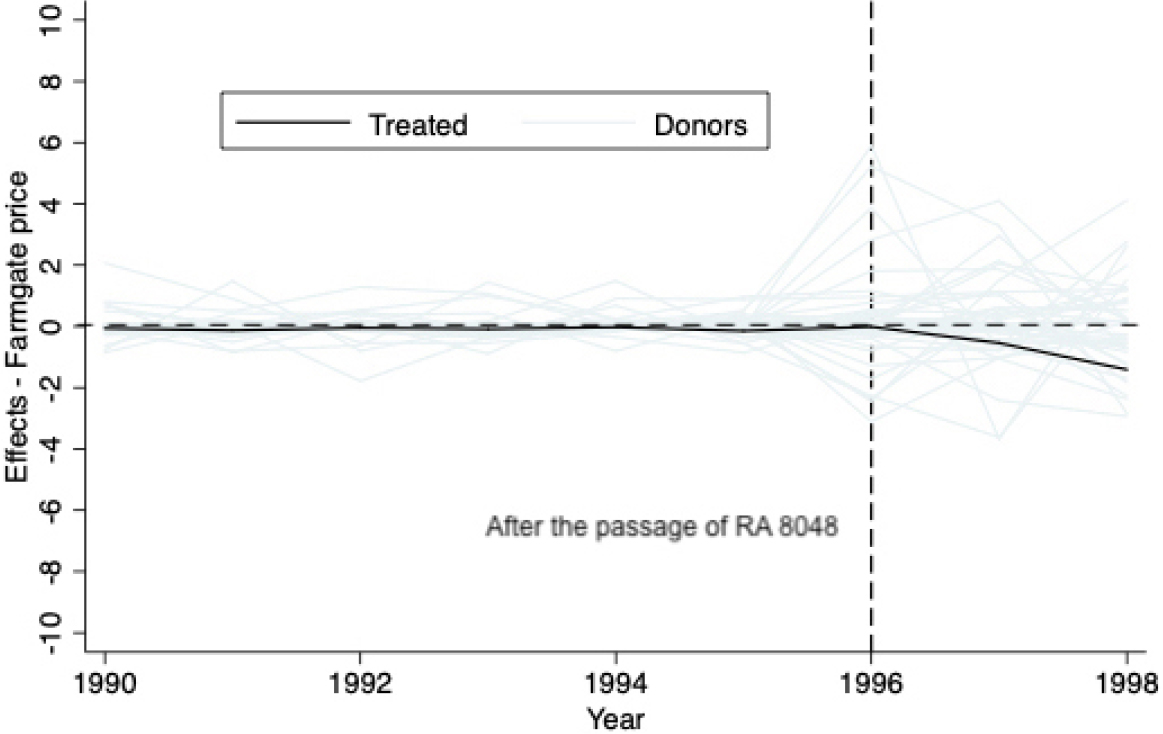
To improve the analysis, commodities with extreme values were excluded from the donor pool, reducing the number of commodities from 70 to 35. Fig. 7 shows that after excluding these outliers, the gap for coconut became clearer and more consistent, confirming that the SCM analysis was statistically significant after this adjustment. This indicates that the results are more reliable after addressing the extreme variations in the placebo test.
Placebo Study for RA 10593
The study conducted placebo tests to assess the validity of the Synthetic Control Method (SCM) in estimating the effect of RA 10593 on the farmgate price of coconut. In these tests, the conservation policy was reassigned to each of the 70 agricultural commodities in the donor pool while treating coconut as if it had no policy intervention. This generated a distribution of estimated gaps for commodities that did not experience any policy intervention.
Fig. 8 shows that the gap between real and synthetic coconut prices (solid black line) during the 2009-2016 period was large compared to other commodities (gray lines), suggesting that the SCM did not provide a reliable fit for coconut prices before RA 10593. This indicated that the initial SCM analysis was statistically insignificant due to inconsistencies in the gaps.
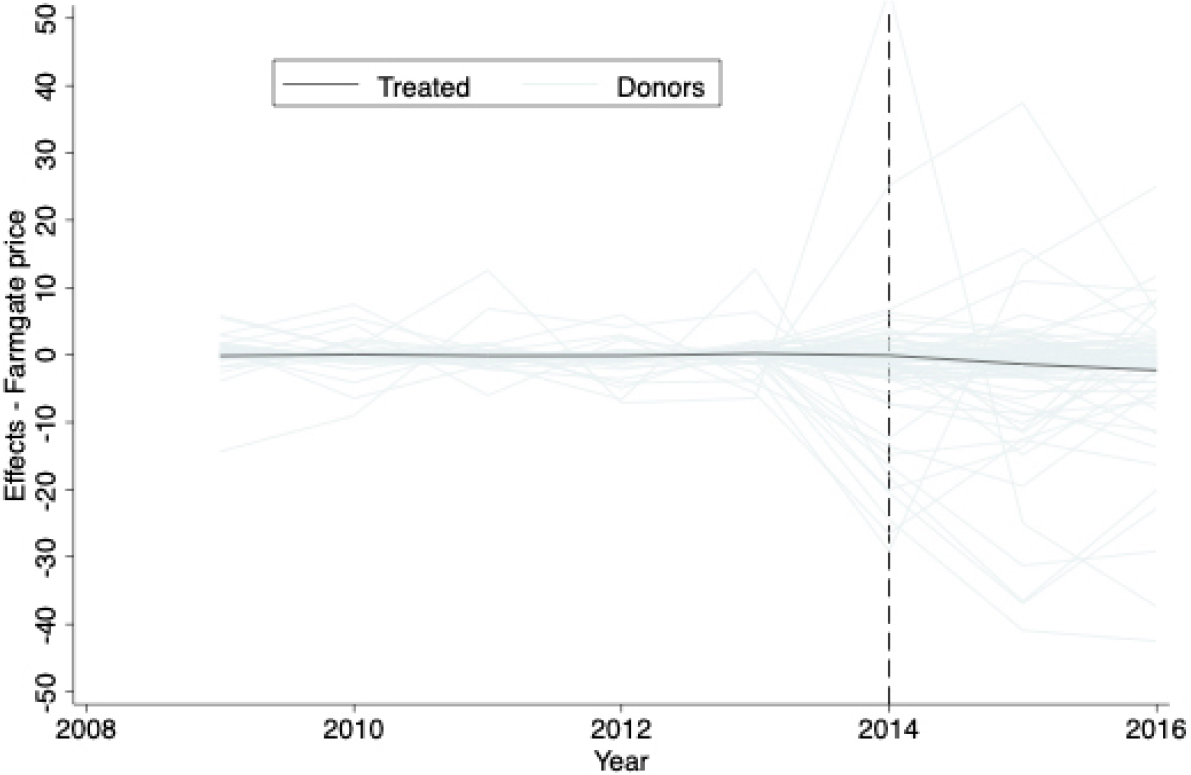
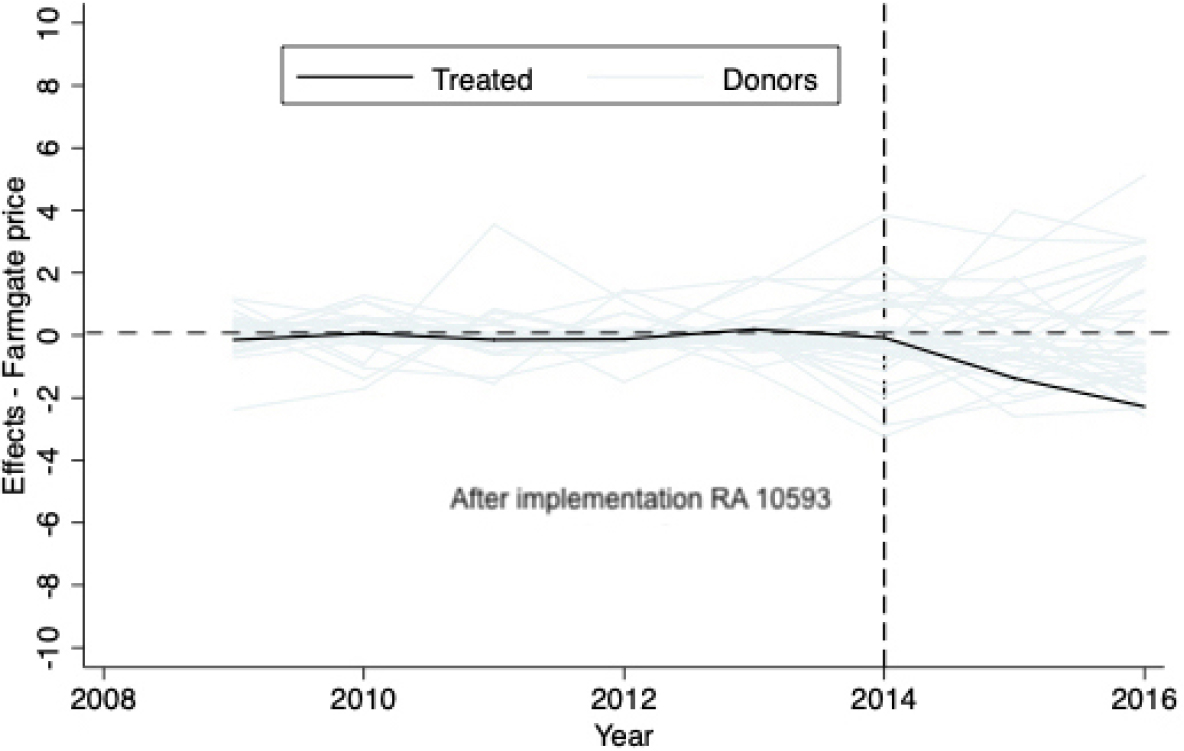
To improve accuracy, the study excluded commodities with extreme values, reducing the number of commodities from 70 to 36. Fig. 9 shows that after excluding these outliers, the gap for coconut became clearer and more consistent, confirming that the SCM analysis is statistically significant after adjustments, supporting the reliability of the findings for the post-treatment period.
Conclusion and Recommendation
Drawing from the results of the analysis, it was found that both conservation policies (RA 8048 and RA 10593) significantly influenced the behavior on the farmgate price of coconut in the Philippines, pushing prices down after implementation of both policies. For the periods 1996 and 2014, the trends of synthetic coconut (derived from other agricultural commodities) diverged from actual coconut prices after the policies took effect, indicating a negative impact on both periods. The analysis confirmed the assumptions of pre-intervention price similarity between actual and synthetic coconut. Moreover, a placebo studies were conducted to test the robustness of the results, which revealed no significant differences between actual and synthetic coconut before the policies. This strengthened the validity of the SCM analysis, confirming that the conservation policies directly affect the behavior of coconut prices. In conclusion, SCM was effective in evaluating policy interventions, showing that the conservation policies reduced coconut farmgate prices, and the analysis was supported by placebo tests that verified the reliability of the findings. The findings revealed that an overall increase in coconut supply, driven by conservation policies, may negatively affect farmers’ incomes by causing a decline in prices. However, this increased supply can also boost local production and expand the coconut market internationally, ultimately enhancing farmers’ incomes.
This study recommends for continued implementation of conservation policies to stabilized coconut prices and securing the level of supply of coconut in the Philippines. First, policymakers should strengthen support systems for farmers, such as providing subsidies for high-yield coconut varieties and access to modern farming technologies, to further enhance productivity and reduce production costs. Second, monitoring and evaluation mechanisms should be established to ensure the consistent implementation of the policy and address more inefficiencies. Third, capacity-building initiatives on sustainable coconut farming practices, should be introduced to empower coconut farmers and improve the quality of their produce. Lastly, collaboration with private sector stakeholders should be encouraged to develop value-added products and expand market opportunities for coconut farmers. The impact conservation policy impact must be amplified to ensure that it continues to contribute to the growth of the Philippine coconut industry.