


Introduction
Materials and Methods
Insects
Bioassay
Results
Previous survey on Chlorantraniliprole resistance
Bioassay
Genetic inheritance of resistance in hybrid strains
Discussion
Introduction
Diamide insecticides are one of the major class of insecticides worldwide, which target insect ryanodine receptors (RyRs). These insecticides were introduced to the market to control a broad range of herbivorous pests, particularly active against lepidopterans (Nauen, 2006; Sattelle et al., 2008). The anthranilic diamides, including chlorantraniliprole and cyantraniliprole, were discovered and developed commercially by Dupont (Cordova et al., 2006; Lahm et al., 2009; Liu et al., 2018). The third systemic anthranilic diamide, cyclaniliprole, was developed by Ishihara Sangyo Kaisha (ISK) Biosciences Corporation in 2004. The phthalic acid diamide flubendiamide was discovered by Nihon Nohyaku and co-developed by Bayer (Tohnishi et al., 2005). These insecticides were commercialized and rapidly gained market share exceeding the US $ 1.4 billion, representing approximately 8% of the insecticide market in 2013 (Sparks and Nauen, 2015). Currently, a total of five types of diamide insecticides have been registered and sold, including tetraniliprole, which most recently registered in 2018.
When diamide insecticide was first supplied to the market in Korea, farmers used it extensively because it was able to control various lepidopteran pests, such as Plutella xylostella, Pieris rapae, Mamestra brassicae, Spodoptera exigua, Agrotis segetum, Agrotis ipsilon, Spodoptera litura, Helicoverpa armigera, Trichoplusia ni, Hellula undalis, Melanchra persicariae, and Sarcopolia illoba in Kimchi cabbage. However, in less than 10 years since the introduction of diamide insecticides in Korea, resistance was reported in some pests. Among them, S. exigua, the beet armyworm (BAW), has exhibited a high level of resistance (Han et al., 2023). Furthermore, various populations of S. exigua in Korea have been difficult to control effectively using insecticides at the recommended concentrations (Cho et al., 2018). Therefore, in this study, we investigated the current status of resistance to chlorantraniliprole in S. exigua populations across various regions of Korea. A total of 22 insecticides were evaluated through bioassays to assess their toxicity. Additionally, bioassays using F1 hybrid and F2 generations were conducted to further examine chlorantraniliprole resistance patterns. These findings will contribute to understanding the regional distribution of resistance and to establishing effective insecticide resistance management strategies for S. exigua in Korea.
Materials and Methods
Insects
Spodoptera exigua was collected in various regions in 2017-2019 from Korea where cabbage and spring onions were grown , then reared for one generation in the lab at Highland Agriculture Research Institute. Larvae of S. exigua were reared on an artificial diet with minor modifications under conditions of 25 ± 1°C, 60 ± 5% relative humidity (RH) and a 14:10 light: dark photoperiod. Field populations were tested with various concentrations of 22 different insecticides. The susceptible strain used in this study had been reared without any prior exposure to insecticides. F1 hybrids were produced by single-pair mating of resistant and susceptible adults (10 pairs of R♂ × S♀, BAW-RS, 10 pairs of S♂ × R♀, BAW-SR) as previously reported (Han et al., 2024). F2 hybrid was generated via F1 families mass mating.
Bioassay
Bioassays were conducted under laboratory conditions using larvae reared on an artificial diet. Third-instar larvae within 12 hours of molting were used for the assays, which were conducted one generation after field collection. For each assay, artificial diet blocks (2 × 2 × 2 cm) were dipped in a diluted insecticide solution for 30 seconds and air-dried for at least 10 minutes. The treated diets were then placed in 24-well plates, and larval mortality was recorded at 24, 48 and 72 hours to calculate mortality rates. The insecticides used in this study were commercially available products.
Results
Previous survey on Chlorantraniliprole resistance
Spodoptera exigua susceptibility and resistant against Chlorantraniliprole (recommended concentration according to the production company) (Fig. 1). Mortality ratio was presented in each locality in each year. The insecticide resistance survey was investigated with the nineteen different localities in Korea. Populations of S. exigua collected in 2014 exhibited 100% mortality at the recommended concentration of chlorantraniliprole, indicating full susceptibility at that time. However, in bioassays conducted a few years later, many regions showed a significant increase in resistance levels, with some populations displaying high levels of resistance. Although a few areas have shown a partial recovery of susceptibility in recent years, the overall resistance in the field remains high enough to pose a serious challenge for effective pest management.
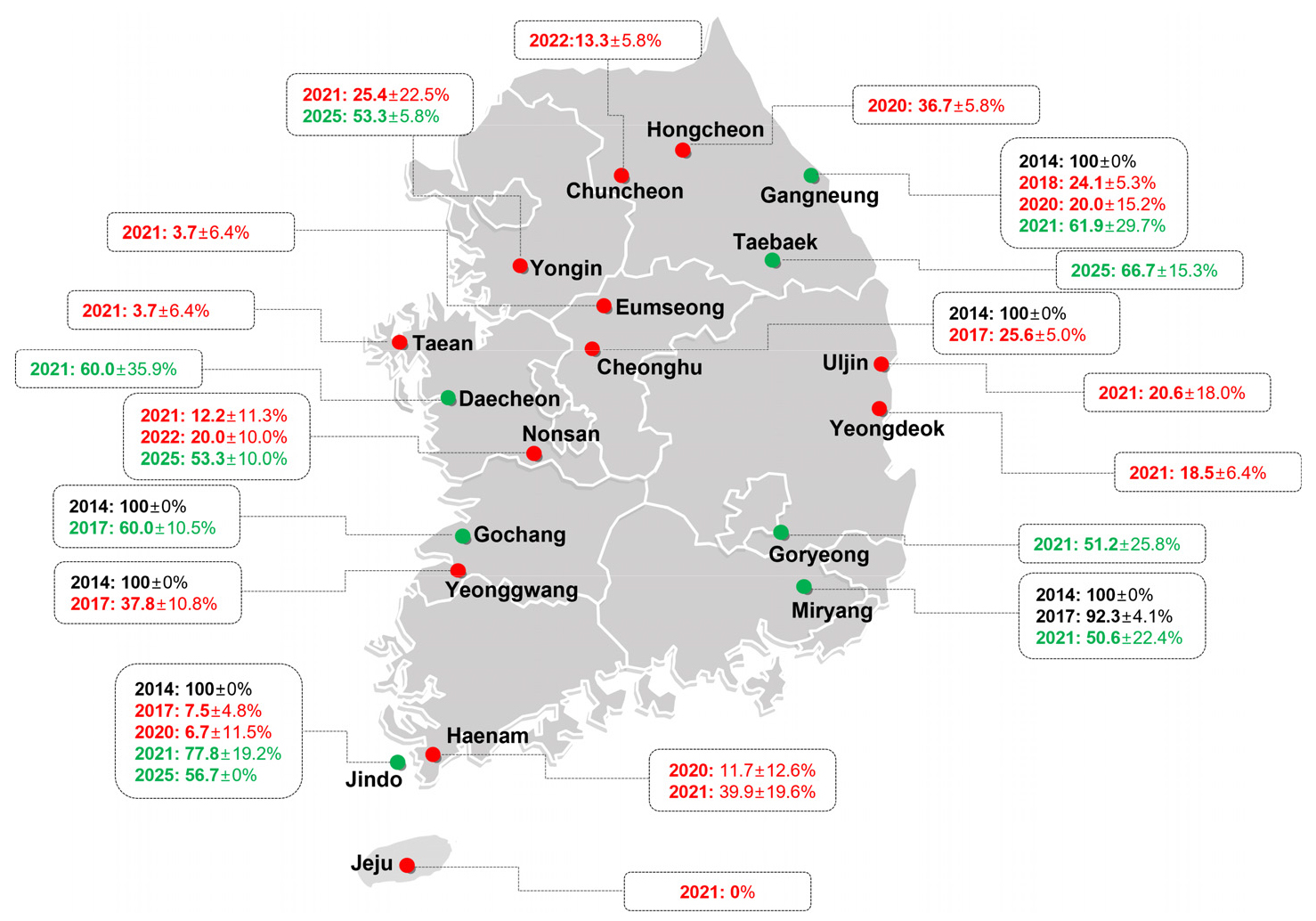
Fig. 1.
Field population collection sites for Chlorantraniliprole bioassay in 2014 to 2025 Korea (updated from Han et al., 2023). Resistance levels were determined based on mortality rates at the recommended concentration of chlorantraniliprole: populations with 100% mortality were considered susceptible (black), those with partial mortality were classified as moderately resistant (green), and those with low or no mortality were classified as highly resistant (red).
Bioassay
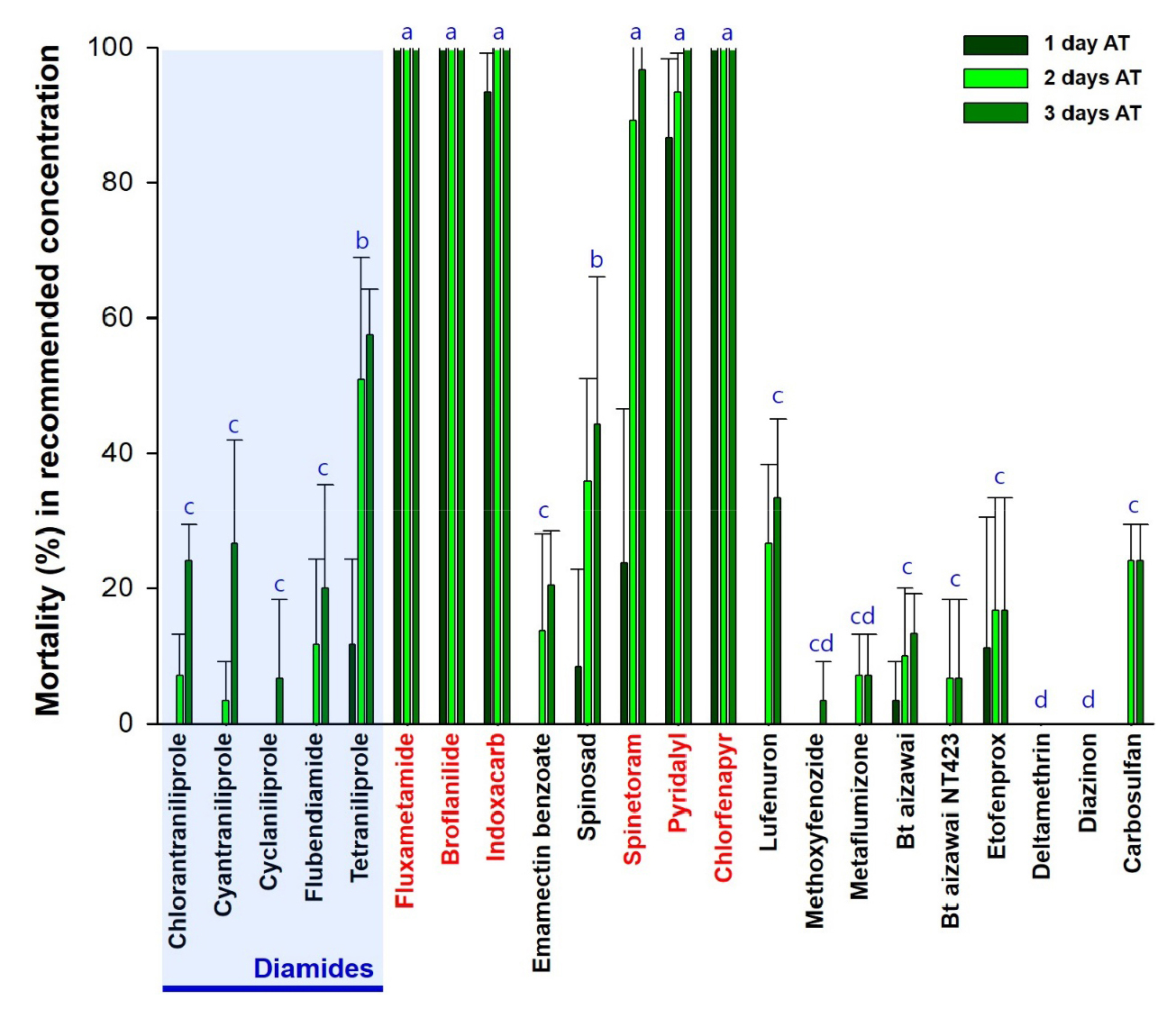
The results of the bioassay for the population collected from Gangneung in 2019 are presented in Fig. 2. All diamide insecticides, except tetraniliprole, showed mortality rates below 30%, indicating a high level of resistance. This suggests the presence of cross-resistance among the diamide compounds. In contrast, all meta-diamide and isoxazolines insecticides resulted in 100% mortality. Among the spinosyn group, resistance was observed to spinosad, while spinetoram showed very high mortality, indicating susceptibility. Additionally, high mortality was observed for both pyridalyl and chlorfenapyr. However, most of the other insecticides tested showed limited efficacy, indicating widespread resistance in the population.
The results confirming cross-resistance between chlorantraniliprole and flubendiamide are presented in Table 1. Six field populations were used for the bioassay: Anseong, Cheongju, Gangneung, Icheon, Jindo, and Yeoju. First, the susceptible strain showed an LC50 value of 0.002 ppm for chlorantraniliprole, and the resistance ratios (RRs) of the field populations were calculated based on this value. The highest resistance ratio (RR) was observed in the Yeoju population, with a value of 12,500, followed by Jindo (6,700) and Anseong (4,000). All other field populations also exhibited high resistance ratios. The LC50 value of the susceptible strain for flubendiamide was determined to be 0.0007 ppm. RRs of the field populations were calculated based on this value, with Gangneung showing the highest RR (300,143), followed by Yeoju (129,186) and Icheon (74,729). All other populations also exhibited extremely high levels of resistance.
Table 1
Susceptibility of six field populations which collected in 2019 and a lab strain of Spodoptera exigua to two diamide insecticides
| Strains | Chlorantraniliprole | Flubendiamide | ||
| LC50 (mgL-1) (95% CL)a | RRb | LC50 (mgL-1) (95% CL)a | RRb | |
| Susceptible | 0.002 | 1 | 0.0007 | 1 |
| Anseong | 8 (5.3-12.5) | 4,000 | 0.3 (0.2-0.5) | 428 |
| Cheongju | 1.2 (0.3-2.7) | 600 | 10.5 (7.0-14.4) | 14,957 |
| Gangneung | 6.6 (5.3-8.2) | 3,300 | 210.1 (71.7-295.1) | 300,143 |
| Icheon | 4.6 (2.3-7.0) | 2,300 | 52.31 (32.1-70.0) | 74,729 |
| Jindo | 13.4 (7.6-25.3) | 6,700 | 27.9 (24.1-32.2) | 39,929 |
| Yeoju | 21.2 (9.9-498.0) | 12,500 | 90.4 (67.8-132.0) | 129,186 |
Genetic inheritance of resistance in hybrid strains
Bioassay results of the hybrid strains are shown in Fig. 3. A wide range of mortality rates was observed in both F1 BAW-RS and SR family. In the RS family, RS5 showed the highest mortality rate at 58%, while RS1 had the lowest at 23%. In the SR family, SR3 exhibited the highest mortality at 57%, whereas SR2 showed the lowest at 39%, but no statistically significant difference was found between the two familes. Bioassays with diamide insecticides on the F2 hybrid strain resulted in an average mortality rate of 35.6%, indicating the presence of cross-resistance.
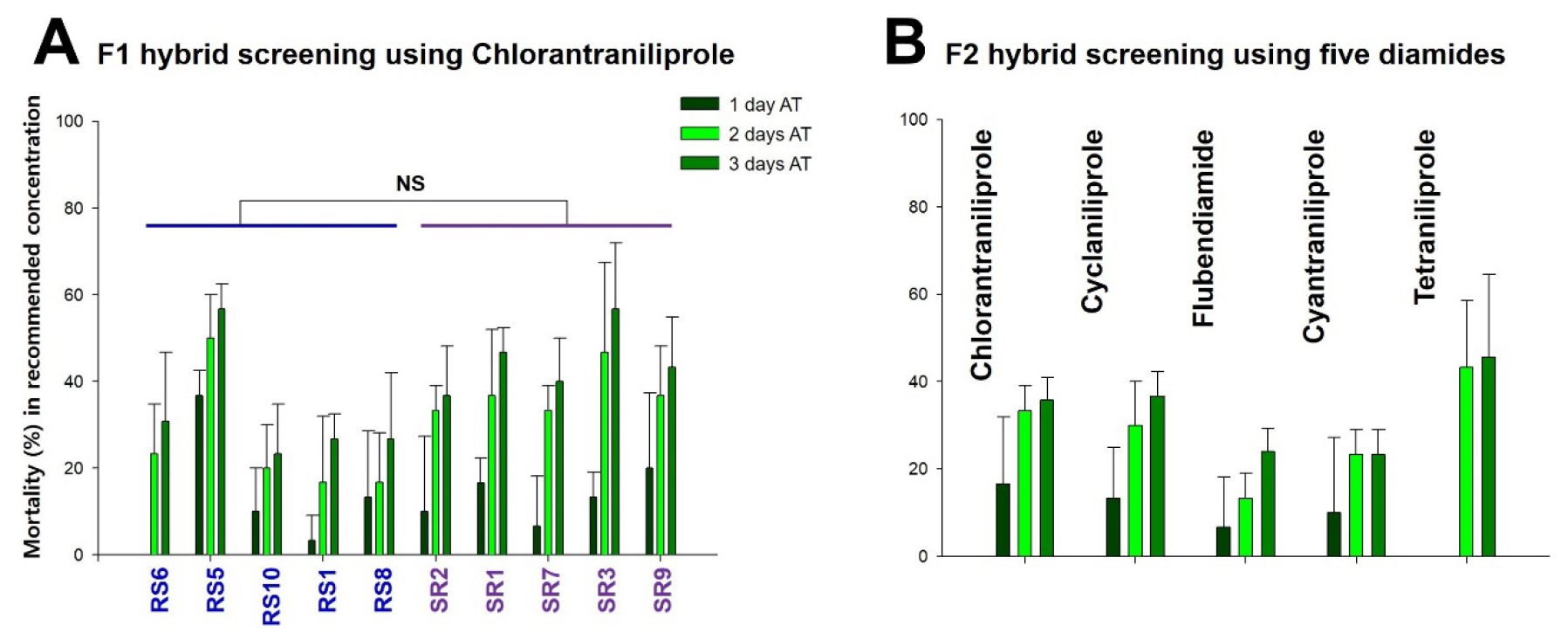
Fig. 3.
Diamide resistant and susceptible strain (A) F1 and (B) F2 hybrid screening results. (A) Chlorantraniliprole was used for F1 hybrid screening in recommended concentration. Five families of RS (R♂ × S♀) and SR (S♂ × R♀) were used, respectively. (B) F2 hybrid was generated via F1 families mass mating. Third instar larvae were used with three replications.
Discussion
The results of this study provide clear evidence of widespread resistance to diamide insecticides in Spodoptera exigua populations across multiple regions in Korea. Field populations, particularly those from Yeoju, Jindo, and Gangneung, exhibited significantly elevated resistance ratios (RRs) to chlorantraniliprole and flubendiamide, indicating reduced field efficacy. Bioassays using F1 and F2 hybrid generations confirmed that the resistance trait is heritable. The F2 hybrids exhibited an average mortality rate of only 35.6% when exposed to diamide insecticides, supporting the stable inheritance of resistance. Moreover, the lack of statistically significant differences in mortality between the reciprocal crosses (BAW-RS and SR families) suggests that the resistance gene is located on an autosome and is likely inherited in a dominant or semi-dominant manner.
At the molecular level, diamide resistance is primarily associated with two mechanisms: target-site mutations in the ryanodine receptor (RyR) and metabolic detoxification (Kim et al., 2025). Diamide insecticides act as modulators of the RyR, which is the primary target site in insects, and are classified as Group 28 by the Insecticide Resistance Action Committee (IRAC).
Among the known target-site mutations, I4790M and G4946E are the most widely reported and are known to reduce the binding affinity of diamides to the RyR, thereby diminishing their insecticidal efficacy. However, recent study (Han et al., 2024) have reported that the overexpression of CYP9A40 plays an even more critical role in resistance than target-site mutations. CYP9A40, a cytochrome P450 monooxygenase, enhances the metabolic detoxification capacity of the insect, reducing the effective concentration of insecticide reaching the target. Although molecular analyses were not conducted in the present study, the observed resistance patterns in bioassays are consistent with previous reports involving both I4790M mutations and P450-mediated metabolic resistance (Han and Kim, 2024).
Given the high levels of resistance and the likely involvement of both target-site and metabolic mechanisms, reliance on diamide insecticides alone is no longer sustainable. A multifaceted insecticide resistance management (IRM) strategy is urgently needed. This should include the rotation of insecticides with different modes of action (MoA), as recommended by IRAC, to reduce selection pressure. In addition, molecular diagnostics, such as LAMP and qRT-PCR, targeting resistance markers like CYP9A40 or RyR mutations, should be incorporated into monitoring programs to allow early detection and informed decision-making. Newly developed insecticides, including meta-diamides (e.g., broflanilide, fluxametamide) and isoxazolines, which target GABA-gated chloride channels, offer promising alternatives and should be considered as part of rotation strategies.
In summary, this study highlights the widespread resistance to diamide insecticides in S. exigua and the need for proactive resistance monitoring. A resistance-informed, integrated pest management approach will be essential to maintain the efficacy of existing insecticides and ensure sustainable pest control in agricultural systems.