


Introduction
Materials and Methods
Sample Preparation and Extraction
Chemicals and reagents
Proximate composition analysis
Measurement of the gallic acid content
Total phenolic and flavonoid content
DPPH radical scavenging assay
Ferric reducing antioxidant power (FRAP) assay
Reducing power
ABTS radical scavenging assay
Statistical analysis
Results and Discussion
Proximate composition of Euphorbia humifusa
Analysis of Gallic Acid Content
Total phenolic and flavonoid contents
DPPH radical scavenging assay
Ferric reducing antioxidant capacity (FRAP)
Reducing power
ABTS radical scavenging assay
Correlation coefficient analysis (R) of antioxidant activity
Conclusion
Introduction
Reactive oxygen species (ROS), such as the superoxide anion, the hydroxyl radical (・OH), and hydrogen peroxide (H2O2), are highly oxidative forms of oxygen produced during various metabolic processes as inhaled oxygen is used in oxidation reactions. Because they attack biological tissues and cause cellular damage, they are associated with a range of diseases (Rhim and Choi, 2011). Therefore, the use of antioxidants that eliminate these ROS and protect against oxidized compounds produced by oxidative stress in the body has recently increased, and the importance of natural antioxidants - widely distributed in the plant kingdom and considered safer than many chemical agents that cause various side effects - has come to the fore. Numerous phenolic compounds and flavonoids present in natural products are known to be effective for antioxidant activity, skin whitening, antiwrinkle effects, and moisturizing (Garg et al., 2017; Panzella and Napolitano, 2019). Recently, driven by growing interest in health, research into natural functional substances has been actively pursued, and studies on functional components and bioactive compounds derived from medicinal plants and herbal medicines have been increasing (Joung et al., 2007).
In the past, synthetic antioxidants, including butylated hydroxytoluene (BHT), butylated hydroxyanisole (BHA) and tertiary butylhydroquinone (TBHQ) were often used in the food industry because they retard undesirable oxidative changes (Branen, 1975; Ito et al., 1983). However, in recent years, the use of natural antioxidants derived from natural substances such as plants has attracted considerable interest due to concerns about the safety of synthetic antioxidants (Ajila et al., 2007; Ali et al., 2008). Wild herbs are defined as any part of an edible plant that grows in mountainous areas. Recently, wild herbs have also been identified as sources of various phytochemicals, including phenolic compounds, which possess a wide range of biological effects (Kim and Lee, 2021). Phenolic and flavonoid compounds are the products of secondary metabolism in plants. They constitute some of the most widespread compounds in the plant kingdom: more than 8,000 are known, and they all have different chemical structures and activities (Bravo, 1998). Significantly, phenolic compounds from plants are known to have potent antioxidant activity.
Several methods have been developed to evaluate the antioxidant capacity of natural substances, including 2,2-diphenyl-1-picrylhydrazyl (DPPH), ferric reducing antioxidant capacity (FRAP), 2,2’-azinobis-3-ethylbenzothiazoline-6-sulphonate (ABTS), oxygen radical absorbance capacity (ORAC) and nitro blue tetrazolium (NBT) assays.
Euphorbia humifusa, a member of the genus Euphorbia L., commonly called ttangbindae or ground spurge, is an annual herb that grows wild in fields and along roadsides nationwide. It contains a white latex; the stems typically branch into two near the top of the root and spread laterally along the ground, often showing a reddish tint. The leaves are narrowly elliptic, measuring 5-10 mm in length and 4-6 mm in width (Choi, 2010). The main constituents of Euphorbia humifusa include flavonoids, gallic acid, and tannins. It exhibits antioxidant pharmacological activity, showing antibacterial effects against pathogenic streptococci and mycobacteria and bactericidal activity against staphylococci, Corynebacterium diphtheriae, Escherichia coli, and Pseudomonas aeruginosa (Heo et al., 2008). In addition, it demonstrates potent anticancer, detoxifying, antibacterial, and sedative activities, and is known to be effective against various cancers, inflammatory conditions, asthma, diabetes, heart disease, kidney disorders, severe headaches, and anxiety disorders (Kim et al., 2016). According to the Chinese pharmacopeia (Chinese Pharmacopoeia Commission, 2020), this species has been attributed to the treatment of multifarious ailments such as dysentery, enteritis, and traumatic bleeding.
Studies on Euphorbia humifusa have reported the antioxidant and anticancer activities of its aqueous extracts (An et al., 2006), antibacterial activity against foodborne pathogens (Choi, 2010), and cytoprotective effects (Kim et al., 2010); however, most studies have used water-extracted samples, and research using extracts obtained by other extraction methods or solvents is scarce, so scientific evidence is needed to establish various extraction conditions and validate their efficacy for practical use. However, physiological activity studies on many traditional medicinal herbs remain relatively limited, so diverse investigations into their bioactivities would provide highly valuable data.
The aim of the present study was to determine the total phenolic content, total flavonoid content, antioxidant effect of Euphorbia humifusa and to investigate the correlation coefficients between bioactive compounds and their biological activities.
Materials and Methods
Sample Preparation and Extraction
Euphorbia humifusa was purchased from Herb Market located in Jegidong, Seoul, Korea. The material was washed with distilled water, dried in a hotair dryer, and ground to pass a 120 mesh sieve for general component analysis. For preparation of extracts used in various bioactive compound assays, the prepared E. humifusa in an Erlenmeyer flask were mixed with nine volumes of distilled 80% methanol (v/v) and refluxextracted for 4 hours. The extract was filtered through gauze, concentrated under reduced pressure (CCA1100, Eyela, Tokyo, Japan), and then rapidly frozen and lyophilized at -70°C (PVTFA 10AT, ILSIN, Suwon, Korea) to yield a powdered extract. The extraction yield obtained from 100 g of dried sample was 20.32%.
Chemicals and reagents
2,2-diphenyl-1-picrylhydrazyl (DPPH), 2,2’-azinobis-3-ethylbenzothiazoline-6-sulfonic acid (ABTS), 3-(2-pyridyl)-5,6-diphenyl-1,2,4-triazine-4’,4”-disulfonic acid, potassium ferricyanide, butylated hydroxyanisole (BHA), ascorbic acid, catechin, tannic acid, trolox, rutin, quercetin and FeCl3 were purchased from Sigma Chemical Co. (St. Louis, MO, USA), and Folin-Ciocalteu’s (Darmstadt, Germany). All the chemicals used to include the solvents were of analytical grade.
Proximate composition analysis
Analysis for proximate was conducted using the Association of Official Analytical Chemist (Association of Official Analytical Chemists, 1980) method. The moisture content of the E. humifusa was determined by the drying method in an oven at 105°C, under normal atmospheric pressure. Crude ash content was determined by the dry-ashing method at 550°C. Crude fat content was determined by the Soxhlet method and crude protein content by the Kjeldahl method. Total carbohydrate content was determined by difference of 100 minus the sum of moisture, crude ash, crude fat, and crude protein.
Measurement of the gallic acid content
The gallic acid content was measured using a modified high-performance liquid chromatography (HPLC) method based on Cho et al. (2016). A total of 50 mg of extract was added to a 10 mL volumetric flask, dissolved in MeOH, and filtered through a 0.45 µm membrane filter. A 10 µL aliquot of the filtered extract was injected into the HPLC system. All reagents were of HPLC grade. The gallic acid used as a marker compound was purchased from Sigma-Aldrich (St. Louis, MO, USA). The analytical conditions for gallic acid detection are detailed in Table 1.
Table 1.
HPLC conditions for the analysis of gallic acid
Total phenolic and flavonoid content
The Phenolic contents of E. humifusa were evaluated by Folin-Ciocalteu method, slightly modified from a previous report by fan and coworkers (Fan et al., 2020). In brief, the sample was incubated with Folin-Ciocalteu reagent (10%, v/v) and sodium carbonate (7.5%, w/v) before 60 min incubation in the dark. The absorbance of the mixture was then read on a microplate reader (Molecular Devices, Sunnyvale, CA, USA) at a wavelength of 760 nm. Gallic acid was used as the calibration standard, and the results were presented as its equivalent per gram of dried sample (mg GAE/g).
Total flavonoid content was measured with slight modification of the method of Kim et al. (2011). To 0.5 mL of the E. humifusa sample solution were added 1.5 mL of 95% ethanol, 0.1 mL of 10% aluminum nitrate, 0.1 mL of 1 M potassium acetate, and 2.8 mL of distilled water, and the mixture was allowed to react at room temperature for 30 minutes. Absorbance was measured at 415 nm using a microplate reader, and total flavonoid content was determined from a rutin calibration curve.
DPPH radical scavenging assay
The radical-scavenging activity of DPPH was determined using a method previously described (Adjimani and Asare, 2015), with some modifications. Briefly, 0.2 mL of sample solution was mixed with 0.8 mL of 0.4 mM DPPH solution (adjusting an absorbance of 1.1 ± 0.1 at 517 nm). The mixture was incubated for 10 min in dark at 25°C, subsequently, absorbance was measured at 517 nm, using a microplate reader. The radical-scavenging activity of DPPH was calculated and expressed using the following formula.
Ferric reducing antioxidant power (FRAP) assay
FRAP activity was determined using a previously described method (Wijekoon, et al., 2011), with some modifications. Briefly, FRAP reagent was prepared by mixing 300 mM of sodium acetate buffer (pH 3.6):10 mM of TPTZ:20 mM of FeCl・6H2O at a ratio of 10:1:1. Subsequently, 0.05 mL of sample solution was mixed with 1.5 mL of FRAP reagent and 0.15 mL of distilled water and incubated for 4 min at 37°C. Finally, absorbance was measured at 593 nm, using a microplate reader. The FRAP activity of the sample was expressed as OD value (593 nm).
Reducing power
The reducing power activity was determined using a method described previously (Park et al., 2019), with some modifications. Briefly, 0.5 mL of sample solution was mixed with 2.5 mL of 0.2 M sodium phosphate buffer and 2.5 mL of 1% potassium ferricyanide and, incubated for 20 min at 50°C. Subsequently, the reaction was stopped by adding 2.5 mL of 10% trichloroacetic acid. Thereafter, 2.5 mL of supernatant was collected by centrifugation (1,790 G, 10 min) and mixed with 0.5 mL of 0.1% iron (III) chloride and 2.5 mL of distilled water. Absorbance was measured at 700 nm using a microplate reader. The reducing power activity of the sample was expressed as OD value (700 nm).
ABTS radical scavenging assay
To determine ABTS radical scavenging assay, the method of Re et al. (1999) was adopted. The stock solutions included 7 mM ABTS solution and 2.4 mM potassium persulfate solution. The working solution was then prepared by mixing the two stock solutions in equal quantities and allowing them to react for 12 h at room temperature in the dark. The solution was then diluted by mixing 1 mL ABTS solution with 60 mL methanol to obtain an absorbance of 0.706 ± 0.001 units at 750 nm. Fresh ABTS solution was prepared for each assay. E. humifusa extract (1 mL) were allowed to react with 1 mL of the ABTS solution and the absorbance was taken at 734 nm after 7 min. ABTS radical scavenging activities were calculated and expressed as a percentage using the following formula:
Statistical analysis
All results were expressed as mean ± standard deviation of triplicated experiments. All values were statistically analyzed through one-way analysis of variance (ANOVA) followed by Duncan’s multiple range test using SAS 9.4 software (SAS Institute Inc. Cary, NC, USA). All statistical significance was tested at the p < 0.05.
Results and Discussion
Proximate composition of Euphorbia humifusa
The results from the proximate composition analysis of E. humifusa are shown in Table 2. In 100 g of E. humifusa, moisture, crude fat, crude ash, crude protein, and carbohydrates were 7.21%, 2.77%, 3.25%, 7.63%, and 79.14%, respectively. The main constituent of E. humifusa was carbohydrates, which are structural components of the plant, while crude fat was the lowest component. As compositional analyses of E. humifusa are scarce, comparison with the nutritional composition of E. hyssopifolia (Igwenyi et al., 2014) showed similar results. But these results may vary depending on the growth environment. The main constituent of E. humifusa is carbohydrates, which are common components of most plant tissues, and dietary fiber accounted for approximately 28.30% of those carbohydrates; dietary fiber is mainly composed of insoluble fibers - structural polysaccharides and structural non carbohydrate components present in the cell wall - and soluble fibers located in the middle lamella between the cell wall and the cell membrane. Further studies on the composition of insoluble and soluble dietary fiber are needed to assess the functional potential of this material as a food ingredient.
Table 2.
Proximate compositions of the Euphorbia humifusa
| Nutrients | Euphorbia humifusa | |
|
General Nutrients (%) | Moisture | 7.21 ± 0.721) |
| Carbohydrate2) | 79.14 ± 0.25 | |
| Crude protein | 7.63 ± 1.23 | |
| Crude fat | 2.77 ± 0.74 | |
| Crude ash | 3.25 ± 1.40 | |
| Dietary fiber | 28.30 ± 0.02 | |
Analysis of Gallic Acid Content
The gallic acid content of the E. humifusa extract is presented in Table 3, it was high at 11.29 mg/g. Gallic acid is a watersoluble compound found in many plants either in the free form or bound as gallotannins, and it dissolves readily in water. Compared with reported gallic acid contents in chestnut cultivars, which ranged from 0.15% to 1.3% (Jeon et al., 2020), the methanol extract of E. humifusa showed a higher gallic acid content. Gallic acid content was highest in E. ammak and very low in E. hirta, indicating a pronounced interspecific difference (Hazzazi et al., 2025). This variation may be due to species-specific chemical profiles, differences in growth environment, or genetic factors (Fig. 1).
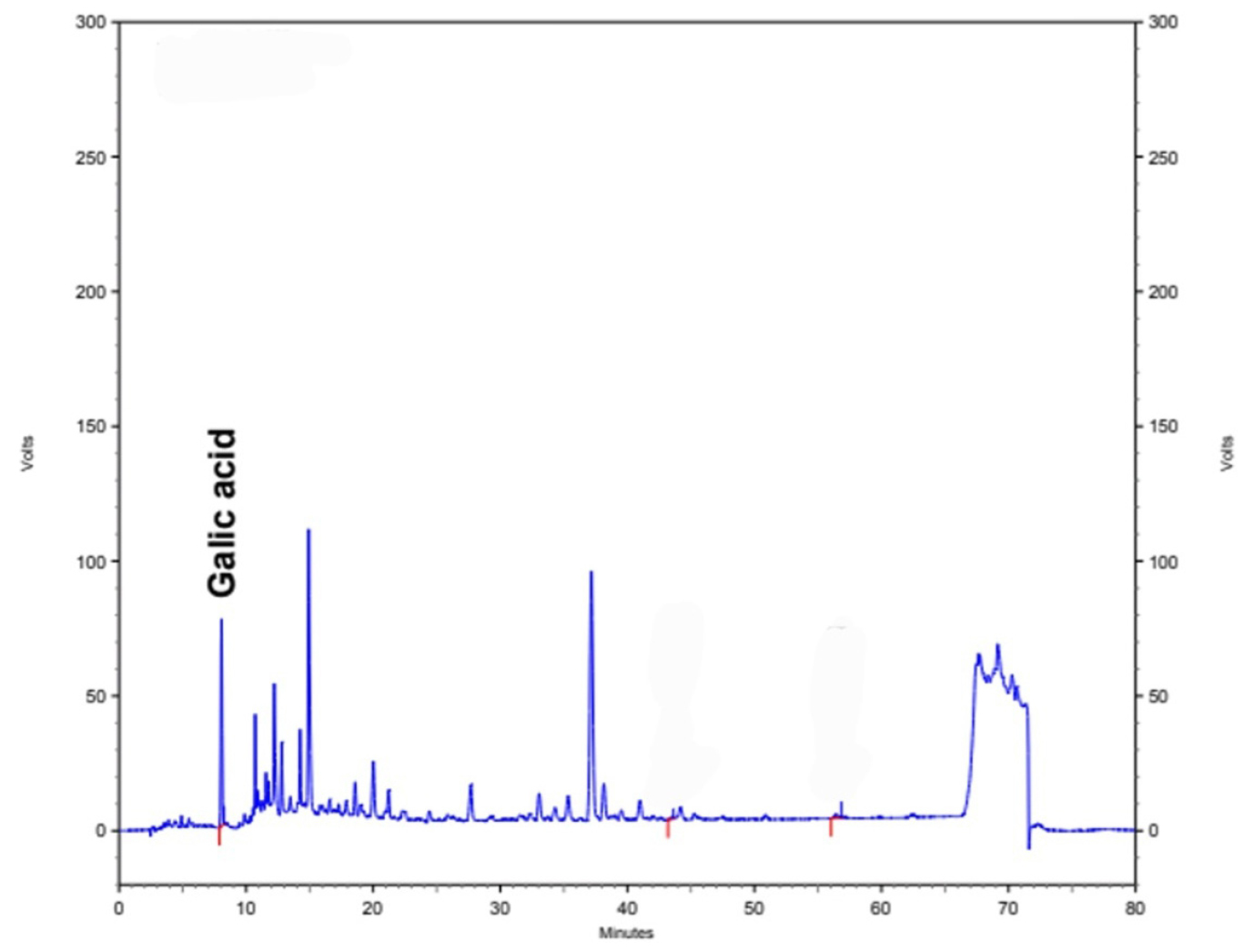
Table 3.
Contents of gallic acid in Euphorbia humifusa extracts
Sample | Contents(mg/g) |
| Euphorbia humifusa | 11.29 ± 0.19 |
Total phenolic and flavonoid contents
The phenolic compounds present in plant-based foods have diverse functions; phenolic molecules found in such foods are known to exert antioxidant, anti-obesity, and anti-inflammatory effects in the body (Cho et al., 2007). As polyphenolic substances, flavonoids are classified by chemical structure into groups such as flavonols, flavones, catechins, and isoflavones; they differ in solubility in water and ethanol, and their biochemical activities (such as inhibition of lipid peroxidation) are thought to arise from these structural differences (Middleton and Kandaswami, 1994). Therefore, we determined the total phenolic and flavonoid contents of extracts obtained from E. humifusa. As shown in Table 4, the E. humifusa extract showed the total phenolic content (164.21 ± 0.45 mg GAE/g), and the total flavonoid content (53.62 ± 0.18 mg RE/g). Total content of phenolic and flavonoid influence antioxidant ability (Cho et al., 2011; Lachman, 2009). Many medicinal plants contain large amounts of antioxidants such as polyphenols (Adedapo et al., 2009), and the antioxidant activity of the extracts from various plants might be correlated with their total phenolic compounds (Cho et al., 2011). The results strongly suggest that phenolics are important components of this plant, and some of its pharmacological effects could be attributed to the presence of these valuable constituents.
Table 4.
Total polyphenol and flavonoid content of Euphorbia humifusa extracts
Sample | Euphorbia humifusa |
| Total Phenol contents (GAE1) mg/g) | 164.21 ± 0.45 |
| Total Flavonoid contents (RE2) mg/g) | 53.62 ± 0.18 |
DPPH radical scavenging assay
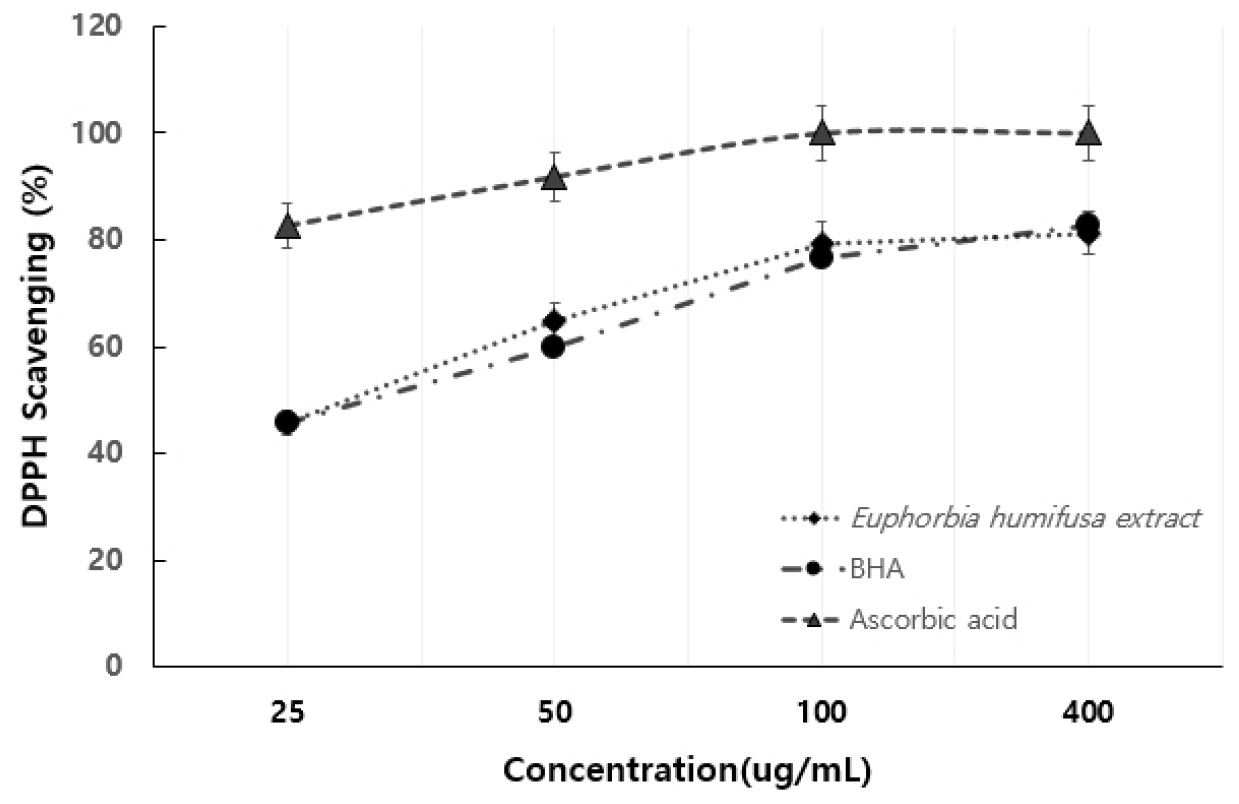
DPPH radical-scavenging activity is a representative method of measuring antioxidant activity using the principle of decolorization of purple compounds (DPPH free radical) through hydrogen donation in antioxidants with a hydroxyl group (-OH) (Mahapatra and Banerjee, 2013). Fig. 2 shows the dose-response curve of DPPH radical scavenging activity of the methanol extracts of the E. humifusa compared with BHA and ascorbic acid. At a concentration of 400 µg/mL, the scavenging activity of methanol extract of the E. humifusa extract reached 81.25%. The effect of antioxidants on DPPH is thought to be due to their hydrogen donating ability (Baumann et al., 1980). Though the DPPH radical scavenging abilities of the extracts were less than those of ascorbic acid (100%) and BHA (82.81%) at 400 µg/mL, the study showed that the extracts have the proton-donating ability and could serve as free radical inhibitors or scavengers, acting possibly as primary antioxidants.
Ferric reducing antioxidant capacity (FRAP)
The reducing ability of the extracts was 584.32 ± 1.62 µmol Fe (II)/g (Table 5). The antioxidant potentials of the methanol extracts of the E. humifusa were estimated from their ability to reduce TPTZ-Fe (III) complex to TPTZ-Fe (II). The FRAP values for the methanol extracts of the E. humifusa were significantly lower than that of ascorbic acid and quercetin, but higher than that of BHA. The ferric reducing/antioxidant power (FRAP assay) is widely used in the evaluation of the antioxidant component in dietary polyphenols (Luximon-Ramma et al., 2005). Antioxidant activity increased proportionally to the polyphenol content. According to recent reports, a highly positive relationship between total phenols and antioxidant activity appears to be the trend in many plant species (Oktay et al., 2003).
Table 5.
FRAP activity of the Euphorbia humifusa extracts
| FRAP1) | |
| Euphorbia humifusa extracts | 584.32 ± 1.62 |
| BHA | 63.25 ± 1.57 |
| Ascorbic acid | 1,726.14 ± 9.54 |
| Quercetin | 3,623.47 ± 3.25 |
Reducing power
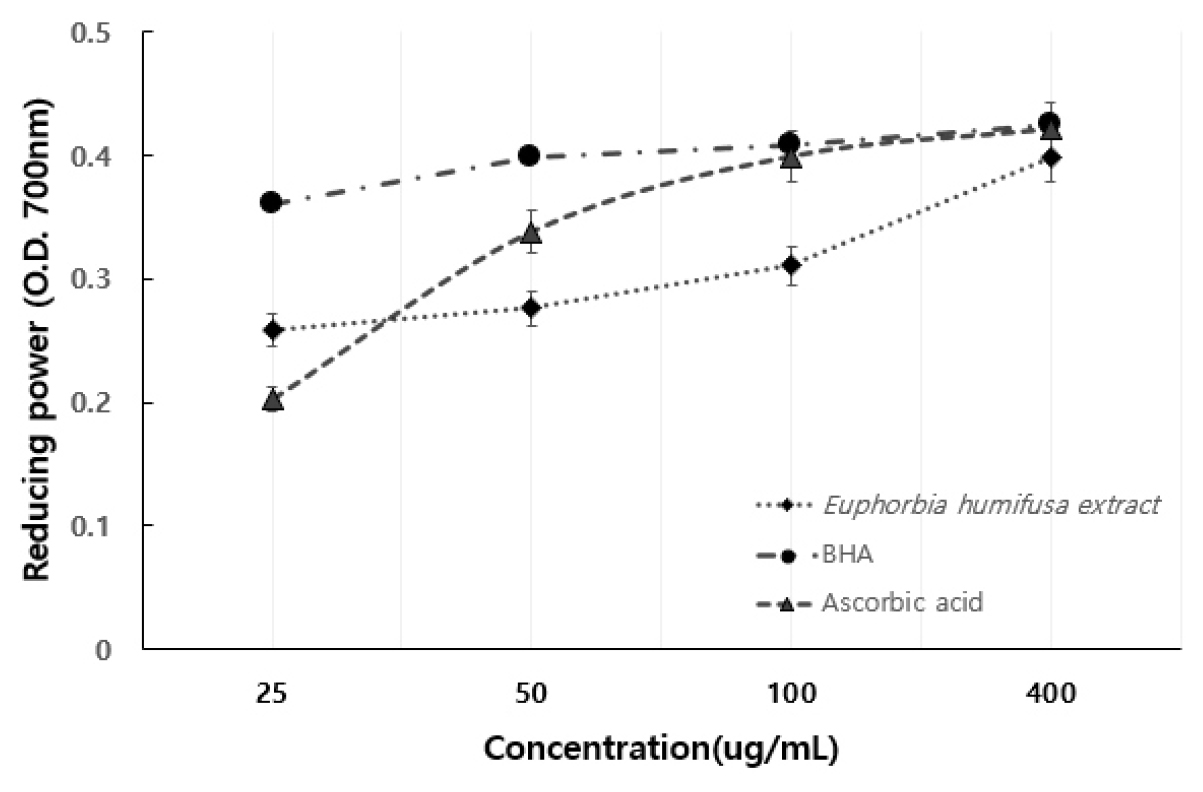
Reducing power activity is a reduction test for antioxidants. Unstable potassium ferricyanide, which receives electrons from antioxidants, provides electrons to ferrichloride to produce ferrochloride. Higher absorbance means higher antioxidant activity, using colorimetric method (Berker et al., 2012). The reducing power activity of methanol extracts of E. humifusa varied from 0.258 ± 0.00 to 0.398 ± 0.00 (value of OD 700 nm) at concentrations of 25, 50, 100, and 400 µg/mL (Fig. 3). Reducing power activity increased in a concentration-dependent manner in methanol extracts E. humifusa.
ABTS radical scavenging assay
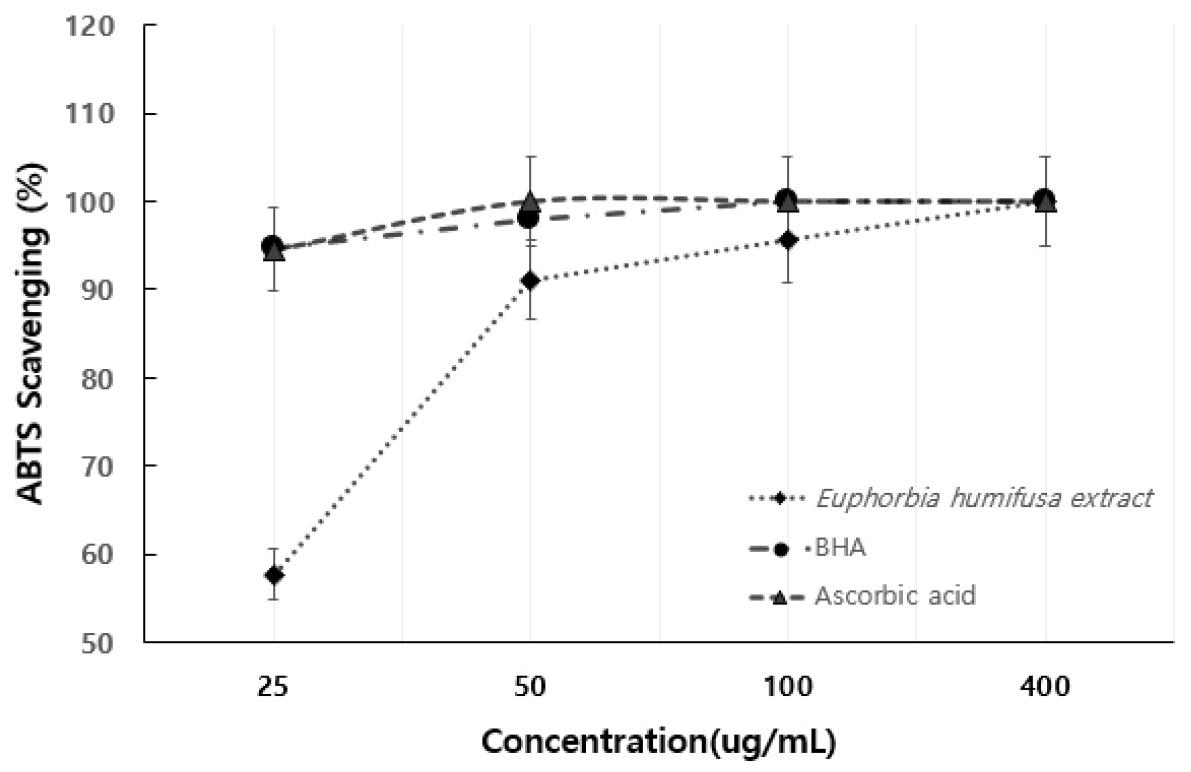
The methanol extracts of the E. humifusa extract were fast and effective scavengers of the ABTS radical (Fig. 4) and this activity was comparable to that of BHA and ascorbic acid. At 100 µg/mL, the extracts exhibited lower activity than BHA, but at 400 µg/mL the activity of the extracts were like that of BHA. The percentage inhibition was all values were found to be greater than 99.99 for the E. humifusa extract, BHA, and ascorbic acid, respectively at 400 µg/mL concentration. Proton radical scavenging is an important attribute of antioxidants. ABTS, a protonated radical, has characteristic absorbance maxima at 734 nm which decreases with the scavenging of the proton radicals (Mathew and Abraham, 2006). The scavenging of the ABTS+ radical by the extracts was found to be much higher than that of DPPH radical. Factors like stereoselectivity of the radicals or the solubility of the extract in different testing systems have been reported to affect the capacity of extracts to react and quench different radicals (Yu et al., 2002). Wang et al. (1998) found that some compounds which have ABTS+ scavenging activity did not show DPPH scavenging activity. This is not the case in this study. This further showed the capability of the extracts to scavenge different free radicals in different systems, indicating that they may be useful natural antioxidant materials.
Correlation coefficient analysis (R) of antioxidant activity
Antioxidant activity is commonly assessed using five in vitro methods based on metal ion chelation, hydrogen donation, antioxidant enzyme activity, oxygen scavenging, and singlet oxygen quenching (Lee et al., 2012; Yang et al., 2011). Pearson’s correlation coefficients of antioxidant activity and antioxidant compounds are shown at Table 6. Strong positive correlations were observed between DPPH radical-scavenging activity, ABTS, reducing power activity, FRAP, total phenolic content, and total flavonoid content (ranged from 0.792 to 0.998). Table 6 shows the correlation coefficients among total phenols, total flavonoids and antioxidant capacity. Strong correlations were observed between the total phenolic contents (TPC) and antioxidant capacity including DPPH (R = 0.998, p < 0.01), ABTS (R = 0.997, p < 0.01) and reducing power (R = 0.998, p < 0.01) assays, which may be caused by the different antioxidant mechanism for determination (Terpinc et al., 2012). On the other hand, TPC was only moderately correlated with FRAP (R = 0.892, p < 0.05) assays, which may be caused by the different reaction mechanisms of the antioxidant activity determination methods (Alañóna et al., 2011). Total flavonoid contents (TFC) correlated with DPPH (R = 0.993, p < 0.01), ABTS (R = 0.985, p < 0.01) and reducing power (R = 0.961, p < 0.01) assays. These correlations were lower than the correlation between TPC and antioxidant capacity (Table 6). Chun et al. (2003) and Kim et al. (2003) reported that antioxidant capacity as measured by DPPH and ABTS were more strongly correlated with TPC versus TFC. Dudonne et al. (2009) reported that the total phenolic contents from 30 types of plants significantly correlated with ABTS assay. In general, the antioxidant activity of plant extracts was correlated with their major compounds, such as phenolic compounds, flavonoids, carotenoids, and pigments (Skerget et al., 2005). DPPH radical scavenging activity is closely correlated with total phenolic compound content (Wang et al., 2003). Our results likewise showed that DPPH radical scavenging activity increased with the total polyphenol content of E. humifusa, supporting the existence of this correlation. As a result, all antioxidant activity experiments showed R values close to 1 with respect to antioxidant components, indicating that antioxidant activity significantly increased as phenol and flavonoid contents increased. Based on these findings, it is considered that the E. humifusa methanol extract of antioxidant activity through radical scavenging and redox reactions, and is expected to have high potential for application as a natural antioxidant material.
Table 6.
Correlation analysis (R) among the antioxidant activity and antioxidant compounds of Euphorbia humifusa extracts
| Parameter | DPPH | ABTS | Reducing power | FRAP | TPC1) | TFC2) |
| DPPH | 1.000 | 0.927**3) | 0.885 | 0.792 | 0.998** | 0.993** |
| ABTS | 0.927** | 1.000 | 0.851** | 0.894* | 0.997** | 0.985** |
| Reducing power | 0.885 | 0.851** | 1.000 | 0.952** | 0.998** | 0.961** |
| FRAP | 0.792 | 0.894* | 0.952** | 1.000 | 0.892* | 0.902* |
| TPC1) | 0.998** | 0.997** | 0.998** | 0.892* | 1.000 | 0.978 |
| TFC2) | 0.993** | 0.985** | 0.96** | 0.902* | 0.978** | 1.000 |
Conclusion
The methanolic extract of Euphorbia humifusa exhibited substantial antioxidant potential, underpinned by a high gallic acid content (11.29 mg/g) and elevated total phenolic and flavonoid levels (164.21 mg GAE/g and 53.62 mg RE/g, respectively). In vitro assays (DPPH, ABTS, FRAP, and reducing power) demonstrated concentrationdependent radicalscavenging and reducing activities, with the extract achieving 81.25% DPPH scavenging at 400 µg/mL. Strong positive correlations between total phenolics and antioxidant indices (e.g., DPPH R = 0.998) indicate that phenolic compounds—particularly gallic acid—are major contributors to the observed activity. These findings suggest that E. humifusa methanol extract is a promising natural antioxidant candidate for applications in food, cosmetics, and nutraceuticals. To advance practical use and ensure reproducibility. This study provides strong in vitro evidence that E. humifusa is a valuable source of phenolic antioxidants and warrants further development as a standardized functional material.
In future research, we will isolate and structurally characterize the principal active constituents, evaluate bioavailability, efficacy, and safety in cellular and animal models, and investigate the effects of extraction parameters, harvest timing, and growth environment on active compound yield and consistency.