


Introduction
Agriculture has long been a fundamental part of Nigeria’s economy, even in the face of the nation’s oil boom. According to Oyaniran (2020), agriculture directly employs more than 36% of the labor force, contributes about 25% to the country’s GDP and is globally reckoned in the production of numerous commodities, one of which is cassava. Nigeria is the largest producer of cassava globally, accounting for 26.40% of the world’s production and 46.7% of Africa’s total output (FAOSTAT, 2021). In Nigeria, the tuberous, starchy root, rich in carbohydrates, is a crucial staple crop processed into products like garri, fufu, flour and starch, and used for industrial purposes (especially ethanol and animal feed). As such, cassava production in Nigeria, serve as a major source of livelihood and calories for the populace (Simonyan, 2015). However, a greater proportion of the farmers that produce these life-saving crops are smallholder farmers who are characterized by sale of raw agricultural produce, limited product variety due with limited engagement in value addition. According to Coltrain et al. (2000), value addition involves enhancing a product’s market value by altering its place, time, and form characteristics. In Nigeria, cassava value addition involves various processes such as sorting, washing, peeling, grating and chipping, fermenting, drying and frying (NAERLS, 2010). Depending on the level of access, farmers carry out these processes using either traditional techniques, mechanized processes or a mix of both (Musa et al., 2022). This transformation reduces post-harvest losses, thereby sustaining productivity. It is therefore not surprising that the low income and poverty levels among farmers can often be traced to their inability to maximize value addition opportunities.
Despite a significant number of farmers engaged in cassava production, the return on investment (ROI) remains relatively low within the cassava value chain. Many of these farmers sell their freshly harvested cassava roots at farm gate prices, making it challenging to realize the additional profits achievable through value addition (Adio et al., 2016). Consequently, these small-scale farmers struggle to raise sufficient capital for the next farming season. Another issue faced by cassava farmers in the study area is post-harvest loss. Due to its high moisture content, cassava tuber deteriorates very fast after harvesting (Wenham, 1995). According to Iyer et al. (2010), the common strategy to mitigate post-harvest losses it to either sell process immediately after harvest. Unfortunately, this does not always happen, with farmers experiencing varying degrees of quality degradation. Thus, compelling farmers to sell their cassava tubers at discounted prices. Thereby reducing their ROI, as they are forced to forfeit profits and sometimes even part of the production costs due to post-harvest losses. This study analyzes the impact of cassava value addition on smallholder farmers and the factors that influence farmers’ decisions to practice value addition. The findings from this study will be relevant for policy formulation, development planning and drive initiatives to enhance the economic capacity of smallholder farmers.
Data
The study was conducted in Kogi State, located in Nigeria’s middle belt zone, between latitudes 6°30'N and 8°48'N and longitudes 5°23'E and 7°48'E. Spanning approximately 29,833 square kilometers, the state had an estimated population of 3,314,043 in 2006, projected to reach about 4,466,800 by 2022, with an annual growth rate of 1.9% (NBS, 2020; NPC, 2006). Politically and agriculturally, Kogi is divided into three zones: Kogi West, Kogi East, and Kogi Central. It is uniquely bordered by ten other states: Ekiti and Kwara to the west, the Federal Capital Territory to the north, Nasarawa State to the northeast, Niger State to the northwest, Edo and Ondo states to the southwest, Anambra and Enugu states to the southeast, and Benue State to the east (Kogi State Government, 2022). Significant geographical features include the Niger River flowing from the northwest and the Benue River from the northeast, converging in the center of Kogi and flowing southward (Oluwole, 2022). The state experiences annual rainfall ranging from 1,100 mm to 1,300 mm (Ogunyinka, 2021). Economically, Kogi State relies heavily on agriculture, producing cashew, groundnut, cocoa, oil palm, cassava, and yam. Other key industries include crude oil extraction and livestock herding of cattle, goats, and sheep. The state is divided into twenty-one Local Government Areas, primarily inhabited by the Okun, Ebira, and Igala people.
Table 1 shows the sample size and methodology. Primary data were used in this study. Instruments used to collect information include a carefully designed questionnaire supplemented by interviews conducted with the support of resident extension agents and trained enumerators. The questionnaire captured details on the socio-economic profiles of smallholder farmers, the various value-added cassava products they produced, the factors influencing their value addition practices, and the income derived from cassava production and value addition activities. The sampling procedure for this study was implemented in multiple stages, utilizing a multistage sampling method to select the respondents. The sampling framework was based on the Agricultural Development Programme (ADP) zones in the state, which are divided into West, Eastd, and Central zones. A sample frame of 540 from the 134,635 cassava farm holdings in state (Kogi State Agricultural Development Project (Kogi ADP, 2017). In the first stage, two Local Government Areas (LGAs) were randomly selected from each zone: Ijumu and Mopa-Muro from Kogi West, Idah and Dekina from Kogi East, and Bassa and Adavi from Kogi Central, resulting in a total of six LGAs. The second stage involved the purposive selection of two cassava farming communities from each selected LGA, based on their involvement in cassava farming. This included Ayere, Iyara, Oguma, Gboloko, Anyigba, Donga, Okehi, Ogaminana, Odole, Ileteju, Aduku, and Agejojo, totaling twelve cassava farming communities. Selected communities cut across urban, semi-urban and rural areas of the state which allows for participation of farmers with different exposure, level of access of key inputs or services and production capacity. In the third stage, a stratified sampling approach was employed to categorize farmers into two groups: those who engage in value addition (value adders) and those who do not (non-value adders). Data collection exercise was carried out in December-January which falls within the peak harvest period (November-March) for cassava tubers in the state (IITA, 2004).
Table 1
Summary of sampling outlay for the study
Table 2 shows the socioeconomic characteristics of both groups of farmers (value adders and non-value adders) which were described using the means and standard deviations of the key socioeconomic variables. The findings show that age, access to credit, education, farm size, cooperatives, access to processing equipment, and faming experience play a significant role in influencing the farmers’ decision to adopt value addition. The research identifies the key differences between value-adding and non-value-adding cassava. Relative to non-value adders, value adders cultivate bigger farm areas (1 hectare vs. 0.7 hectares), have higher levels of education (5 years vs. 3 years), and are older (45 years vs 37 years). Value addition is more prevalent among women, which is consistent with their involvement in post-harvest activities. The importance of access to credit and market linkage in fostering value addition is highlighted by the much strong market linkage (83.5% vs. 42.4%) and loan availability (73.5% vs. 40.6%) for value adders. While access to extension services is comparable for both groups (~70%), cooperative participation is somewhat greater among value adders (79.4% vs. 73.5%).
Table 2
Socio-economic characteristics of respondents
Empirical Methods
Participation in value addition is endogenously determined. Thus, without appropriate identification strategies, the impact of cassava value addition on smallholder farmers’ income could be either over- or under- estimated due to confounding factors. We address this endogeneity issue by matching farms who participate in value addition to similar farms who do not using the propensity score matching (PSM).
Propensity score matching is a statistical method used to estimate the effect of treatment in observational studies, where participants are not randomly assigned to treated and control groups. PSM aims to reduce self-selection bias resulting from non-random participation. To analyze the treatment’s impact effectively, it is essential to establish a counterfactual, i.e., what the income of smallholder cassava farmers would be without participating in value-added activities (Baker, 2000). To identify a suitable control group with similar observable characteristics as the treated group, a comparison group is used (Friedlander and Robins, 1995), and their propensity scores are determined through probit or logit regression (Rosenbaum and Rubin, 1983).
To evaluate the treatment effect, propensity scores from the treated group (value adders) were matched to those of the comparison group (non-value adders). The propensity score reflects the conditional probability of receiving treatment based on pre-treatment characteristics. In this study, propensity scores for both groups were initially estimated using a logit regression model based on their similar pre-treatment characteristics as follows Eq. (1):
Where X is a vector of observable or pre-treatment characteristics and D denotes treatment.
We match treated farms to control farms based on similarities in their propensity score. According to Rosenbaum and Rubin (1983), the outcome is independent of the treatment conditional on the propensity score if a potential outcome is independent of a treatment conditional on a vector of covariates (Eq. (2)).
where is farmer’s income with cassava value addition is farmer’s income without cassava value addition.
Once matching was completed, the average treatment effect on the treated (ATET) was estimated by comparing the outcomes of both groups Eq. (3):
Results
Table 3 shows the results of the logit estimation of Eq. (1). The coefficient of age was positive and found to be statistically significant at 1% indicating that as farmer’s age increases, the likelihood of participation in value addition increases. This corroborates with the findings of Ayinde et al. (2020), who observed that older farmers were more likely to welcome innovations on agricultural practices considering their long years of experience and access to resources. This disparity in age suggests that the higher the age reflects more experience and ability to make profitable decisions, which may drive value addition practices.
Table 3
Propensity score estimation (logit estimation)
Education had a positive impact on the decision to practice value addition and is statistically significant at 1%. The more educated a farmer is, the higher the likelihood of engaging in value addition. This shows that higher education among the value adders probably influences the decision to engage in value addition as education is crucial in information reception and better decision making.
Farm size was positive and statistically significant at 5%, which implies that farm size influences the decision to practice value addition. Barrett et al. (2012) opined that larger farm size is expected to contribute to higher output, which increases the capacity to engage in value addition. This serves as an added advantage to facilitate engagement in agricultural value addition.
The result showed that more women engaged in value addition as compared to men. As reported by FAO (2011), women involvement in post-harvesting and value addition is higher compared to the male counterpart due to their distinctive gender roles.
Access to credit and market linkage were found to have a positive relationship with the decision to practice value addition and statistically significant at 1%. Which suggests that having access to credit and market linkage is an important determinant of the farmer’s participation in value addition. Access to credit promotes the acquisition of the inputs necessary for value addition while strong market linkage may serve as an incentive for value addition among farmers. Similarly, Oluwatayo and Ojo (2016) asserted that having access to finances plays a significant role influencing value chain participation in agriculture.
Access to extension services, cooperative membership and access to processing equipment were not statistically significant. This shows that while access to an extension service is available, their relevance might be related to other aspects of agricultural services. Low levels of cooperative membership could likely be the reason for its insignificant coefficient. Access to processing equipment has no impact on the decision to practice value addition, suggesting that access does not necessarily guarantee utilization.
Surprisingly, the coefficient of farming experience was found to be negative, suggesting that as years of farming experience increases, the likelihood of a farmer engaging in value addition decreases. This could mean that experience only does not translate to interest in value addition. Experienced farmers could be risk averse which means they may rather stick to their known traditional methods than welcome innovative practices.
Table 4 reports the balance tests for each covariate between the covariates from the treated and control group before and after matching. It assesses if the matching reduced the differences between the treated and control group thereby making both groups comparable. The result clearly depicts a satisfactory balance between the value adders and non-value adders after matching.
Table 4
Matching quality test of covariate means before and after
The result shows that the differences between all the covariate means of both groups (value adders and non-value adders) before matching were evident and significant, but after matching, they became insignificant, except the covariate age. This indicates the covariates are more balanced after matching, which address the endogeneity concern of participation in value addition.
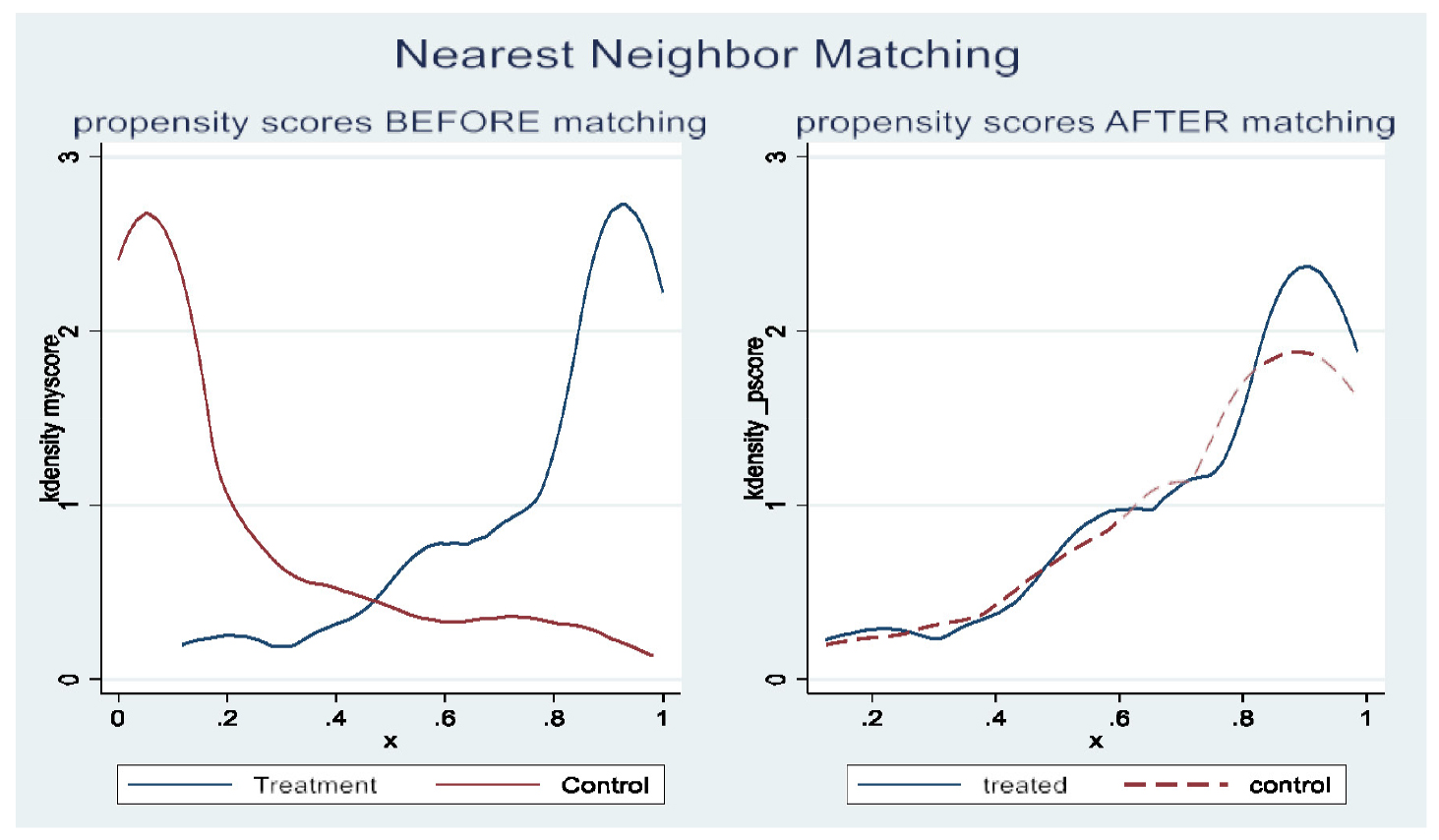
Fig. 1 shows the graphical distribution of the propensity scores of the treatment and control groups before and after matching using the nearest neighbor’s matching estimator. The essence of this graph is to assess the balance of the matching procedure between the covariates of the treatment and control group. Before matching, there is a significant difference between the propensity scores of both groups indicating substantial imbalance in their covariates suggesting insufficient overlap between both groups. This lack of overlap shows that many treated units do not have directly comparable control units, and this could lead to bias in estimating treatment effects. After matching, the propensity scores of both groups are seen to align closely especially in the region of overlap indicating that matching balanced the covariate difference between the treated and control groups. This shows that the control group is a suitable counterfactual for the treated group.
Table 5 provides the estimation results of the average treatment effect on the treated. To ensure the robustness of the results, we exploit two different matching algorithms: nearest neighbor matching (NNM) and radius matching. The results show value addition has a positive and statistically significant impact on smallholders’ farm income. The consistent and statistically significant treatment effects across two different matching algorithms revealed the causal impact of value-added activities on Cassava farmer’s income generation.
Table 5
Average treatment effect on the treated (ATT) estimates
| Outcome variable | Matching estimators | ATT for outcome variables | Standard error | t-test |
| Income (Naira/ha) | Nearest neighbor matching | 113945.8 | 20197.5 | 5.64*** |
| Radius matching | 106141.1 | 19158.9 | 5.54*** |
Farmers engaged in value addition realized a significant income premium ranging from ₦106,141 to ₦113,945 compared to their counterparts solely reliant on primary production. By transforming raw agricultural commodities into higher-value products, farmers can enhance their livelihoods, reduce income volatility, and contribute to rural economic growth. These results highlight the importance of promoting and supporting value-added activities within the Cassava sector. This result aligns with the findings of Wanyama et al. (2013) emphasizing the income diversification benefits of agricultural value addition. However, it is crucial to recognize that the observed income differential is likely influenced by a combination of factors beyond value addition alone.
Conclusion and Recommendations
Cassava is a versatile staple crop in Nigeria, serving as a major source of livelihood, especially for rural households. Unfortunately, poverty remains pervasive among these farmers, hence the need to explore the potential for value-addition. The study’s findings unequivocally established a robust causal relationship between cassava value addition and increased income among smallholder farmers in Kogi State, Nigeria. Employing propensity score matching to mitigate selection bias, the analysis revealed income premium ranging from ₦106,141 to ₦113,945 for cassava farmers who engaged in value-added as against those who do not engage in value addition. These findings revealed the potential of value addition as a strategic pathway to enhance rural livelihoods and agricultural transformation. Key factors influencing the adoption of value addition include gender, education, access to credit, age, market linkage, access to and farming experience. Women, individuals with higher educational attainment, and those with access to financial resources were more likely to engage in value-added activities. Access to credit gives farmers a higher advantage to engage in value addition practices. By providing farmers with the necessary financial resources, credit facilitates investments in processing equipment, raw materials, and working capital. Consequently, it empowers them to diversify income sources, reduce income volatility, and enhance overall agricultural productivity.
This study recommends that policymakers and development practitioners should prioritize investments in gender-responsive initiatives, education and skill development, and access to finance. The revitalization of agricultural cooperatives and other farmer organizations is also imperative to enhance their capacity to support value-added activities. In subsequent studies, researchers could explore additional identification strategies, such as using instrumental variables (IV), difference-in-differences (DID) with panel data, or other approaches that can help address latent heterogeneity.